
Eyelid surgery produces some of the most dramatic results in facial plastic surgery relative to the size of the incision. A procedure that takes ninety minutes in the operating room can take ten years off someone's face. But the recovery period confuses patients more than almost any other operation, partly because the eyes are so visible, and partly because the swelling and bruising that follow blepharoplasty look alarming before they look good.
Dr. Hardik Doshi performs upper blepharoplasty, lower blepharoplasty, and combined four-lid procedures at Doshi Plastic Surgery, with offices serving Long Island, Huntington, and Manhattan. This guide reflects how he prepares patients for recovery, what the realistic timeline looks like week by week, and the questions that come up most often in the days after surgery.
What Blepharoplasty Actually Does to the Tissue
Before getting into recovery, it helps to understand what the surgery involves, because the recovery experience follows directly from the anatomy.
Upper blepharoplasty removes excess skin, and sometimes a small amount of fat or muscle, from the upper eyelid. The incision sits in the natural crease of the lid and is essentially invisible once healed. The goal is to restore the eyelid platform, eliminate the hood that covers the lash line, and in some cases improve peripheral vision that heavy upper lids have compromised.
Lower blepharoplasty is more anatomically complex. The lower lid can be addressed from the outside (transcutaneous approach, with an incision just below the lash line) or from the inside (transconjunctival approach, with no external incision). The choice depends on how much skin needs to be removed versus how much is a volume and fat redistribution problem. Many patients who think they need skin removed actually need fat repositioned, and the transconjunctival approach handles this without any visible scarring.
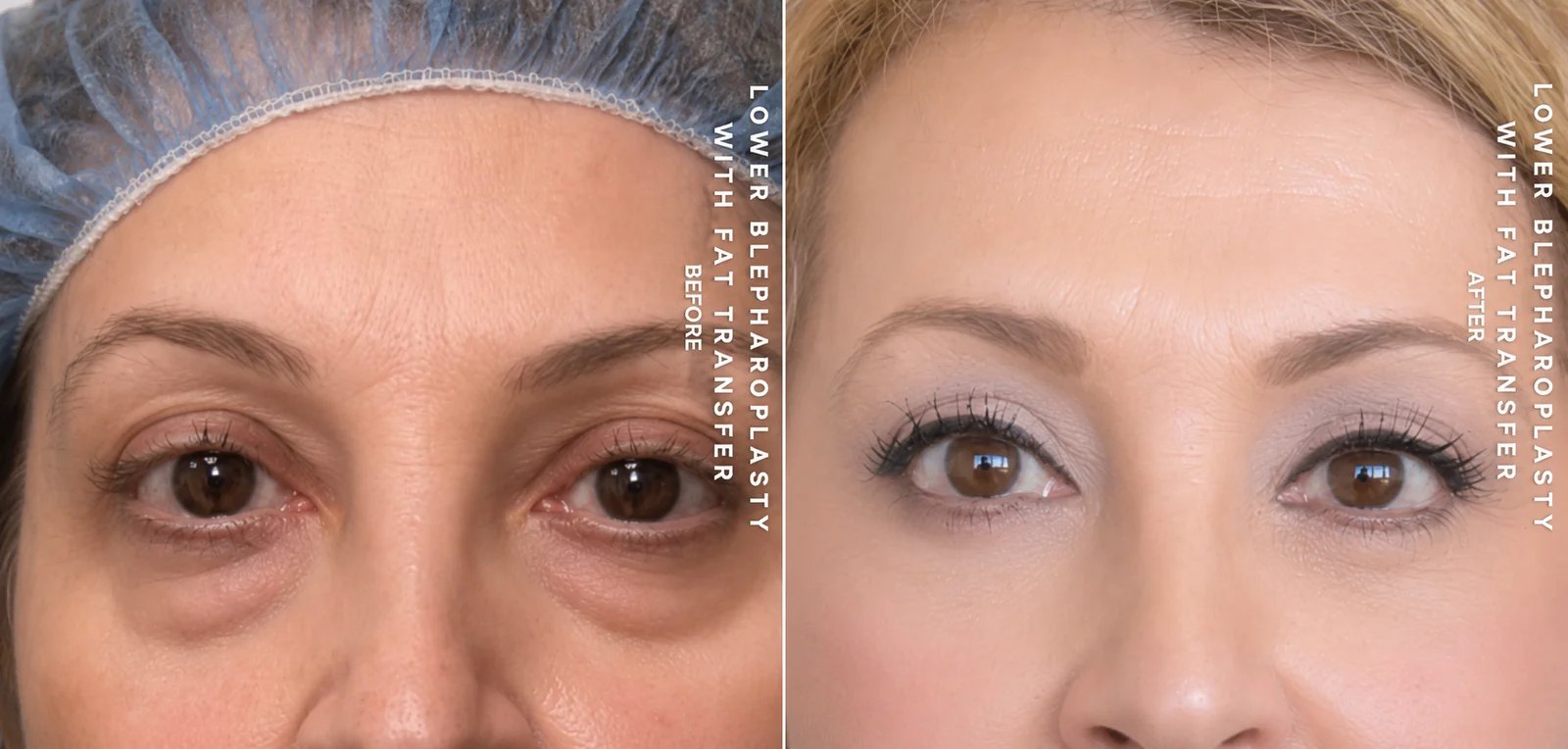
Combined procedures address all four lids. They are common because upper and lower lid aging tend to occur together, and because combining them in a single anesthesia session produces a more balanced result.
Each approach creates a different recovery pattern. Transconjunctival lower blepharoplasty, for instance, tends to have less dramatic surface bruising than the transcutaneous approach. Upper blepharoplasty bruising is usually contained to the upper lid and brow. Four-lid procedures produce more cumulative swelling simply because more tissue is involved.
The First 24 Hours
The first day after blepharoplasty is not comfortable, but it is rarely as painful as patients expect. Eyelid tissue responds to surgery with swelling more than with pain. Most patients describe the sensation as tightness, pressure, and heaviness rather than sharp pain.
What to expect in the first 24 hours:
Vision will be blurry. Lubricating ointment applied during and after surgery creates a film over the eyes. This is intentional and temporary. Artificial tears help, but patients should not try to clear their vision by rubbing.
Cold compresses are important. Applying cold in cycles, roughly 20 minutes on and 20 minutes off, reduces swelling and bruising during this initial phase. Gel packs designed for the eyes work better than ice directly on skin. Do not apply pressure.
Sleep position matters immediately. Keeping the head elevated reduces fluid pooling around the eyes. Most surgeons recommend sleeping with the head elevated 30 to 45 degrees for the first week, either on extra pillows or in a recliner. Lying flat accelerates swelling.
Driving is not permitted. This is non-negotiable. Vision is compromised, pain medications may still be in the system, and reaction time is reduced. Patients need someone to drive them home from surgery and should not drive for at least 48 to 72 hours at minimum.
Screen use should be minimal. Looking at screens requires sustained eye muscle use, which contributes to discomfort and fatigue. Audiobooks, podcasts, and television at a distance are more comfortable than phones or computers.
Most patients sleep a great deal on the first day. This is the body's response to anesthesia and to the surgery itself, and it helps.

Days 2 Through 4: Peak Swelling
Swelling after blepharoplasty peaks between 48 and 72 hours after surgery. This surprises patients who feel relatively fine the morning after the procedure and then wake up on day two looking significantly more swollen.
The bruising during this period is typically purple or dark red and concentrated around the eyelids. It can extend into the cheeks and below the orbital rim. This is normal. Bruising that spreads is not necessarily a sign of a problem — it is gravity and tissue fluid redistribution doing what they do.
Some specific things to know about this phase:
Asymmetry is expected. The left and right sides of the face heal at different rates. One eye may be more swollen, more bruised, or more open than the other during the first week. This is not a sign that something went wrong. The asymmetry resolves as swelling comes down.
Chemosis can occur. Chemosis is swelling of the conjunctiva, the clear tissue covering the white of the eye. It looks like a bubble of clear fluid at the inner corner of the eye. It is more common after lower blepharoplasty. It is uncomfortable but not dangerous, and it resolves with lubricating drops and time. Patients who sleep with their eyes slightly open are more prone to it.
Do not take aspirin or ibuprofen. These medications thin the blood and can worsen bruising. Acetaminophen is acceptable if pain management is needed beyond what was prescribed.
Numbness is normal. The eyelid skin may feel numb or have altered sensation for several weeks. Nerve endings in the thin eyelid tissue recover more slowly than the tissue heals.
Cold compresses remain useful through this phase. Most patients find they feel significantly better with compresses than without.
The First Week: What Changes and What Stays the Same
By the end of the first week, most patients have had their sutures removed (typically around day five to seven for upper lid procedures). The bruising has usually shifted from purple to yellow-green, which means the body is breaking down the blood. The swelling has begun to decrease, though it is not gone.
Many patients feel well enough to appear in public by day seven or eight if they are comfortable with some visible healing. Makeup over the incisions is typically permitted after sutures are out and the skin has closed, though this varies by patient and should be confirmed with the surgeon.
What remains restricted through the first week:
Strenuous physical activity is off limits. Anything that elevates heart rate significantly, including running, cycling, swimming, and weight training, raises blood pressure and increases the risk of bleeding and prolonged swelling. Most surgeons clear light walking but ask patients to avoid exertion for two to three weeks.
Bending over or straining should be avoided. This includes picking up heavy objects, gardening, or anything that puts the head below the level of the heart for sustained periods.
Contact lenses remain out. The eyes need time to settle, and contact lens insertion requires manipulating the lids in ways that are uncomfortable and potentially disruptive to healing.
Sun exposure to the healing incisions should be avoided or covered with SPF. UV exposure to fresh scars causes hyperpigmentation and delays fading. Wide-brimmed hats are practical for the first weeks outdoors.
Weeks Two Through Four: The Functional Recovery Window
By the second week, most patients have returned to desk work, light daily activities, and social situations where they feel comfortable. The bruising has largely faded. The remaining issue is swelling, which can be subtle but is still present.
This phase is when patients tend to grow impatient. They feel well, they look reasonably good, and the temptation to return to full activity is strong. It is also the phase when returning to activity too quickly produces setbacks.
Gradually reintroducing exercise after week two or three, starting with walking and progressing to light cardio, is the standard approach. Contact lenses can typically return around weeks two to three. Reading, screens, and focused close work are fine.
The incision lines are healing during this period. Upper lid incisions, tucked into the crease, become less red and more faded. Lower lid transconjunctival incisions are not visible at all. Transcutaneous lower lid incisions fade more slowly but are positioned close to the lash line where they are difficult to see even before they are fully healed.
Months One Through Three: Seeing the Final Shape
The result of blepharoplasty is not fully visible at one month. Residual swelling, particularly in the lower lids, can persist for eight to twelve weeks. Patients who have had lower blepharoplasty sometimes worry that the lower lid looks slightly fuller than they expected during this period. This is swelling, not a permanent outcome.
By three months, the vast majority of patients are seeing something close to their final result. The incision lines have softened and faded. The upper eyelid crease looks natural and settled. The lower lid contour has stabilized.
Some patients, particularly those who heal more slowly or who had more extensive work done, may continue to see subtle improvements through six months. This is especially true for lower lid work involving fat repositioning, which takes longer to settle than simple fat removal.
Long Island Patients: Practical Recovery Logistics
For patients commuting from Nassau County, Suffolk County, or traveling from Manhattan for surgery at Doshi Plastic Surgery, recovery logistics are worth thinking through in advance.
Arrange transportation for the day of surgery and the day after. Even patients who feel clear-headed after the anesthesia has worn off should not be driving themselves.
Plan for two to three days when you genuinely do not need to be anywhere. The peak swelling phase is uncomfortable and the appearance is at its most dramatic. Having nothing scheduled during days two through four makes the recovery significantly easier.
If you have young children, arrange help. Bending to pick up a toddler is exactly the kind of activity that needs to be avoided during the first week, and this is something many parents do not think through before surgery.
Consider sunglasses and hats as practical recovery tools rather than vanity items. Getting through the first two weeks of healing with appropriate sun protection makes a measurable difference in how quickly the incision lines fade.
When to Call the Office
Most of what happens during blepharoplasty recovery is expected and does not require a call. But some situations do warrant reaching out to the practice:
Contact the office if there is significant pain in one eye that is disproportionate to the other, particularly if it is accompanied by changes in vision. While rare, increased intraocular pressure can occur after eyelid surgery and needs to be evaluated.
Contact the office if redness and warmth are increasing rather than decreasing after the first several days. The normal trend is improvement, not worsening.
Contact the office if the lower lid appears to be pulling away from the eye rather than resting against it. Lower lid laxity post-surgery is a complication that is addressed more easily when caught early.
Contact the office for significant asymmetry that is not improving, for suture-related concerns, or simply for reassurance if something looks different from what was described.
Dr. Doshi's team is reachable and the expectation is that patients use that access during recovery. The goal of post-operative care is to catch anything that needs attention early, before it requires more significant intervention.
Dr. Hardik Doshi is a double board-certified facial plastic surgeon serving Long Island and Manhattan. He performs upper blepharoplasty, lower blepharoplasty, and combined eyelid procedures at Doshi Plastic Surgery. To schedule a consultation, contact the practice at doshiplasticsurgery.com.