
Test One: The Raised Eyebrow
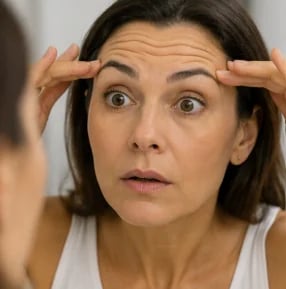
Stand in front of a mirror in good, even light and simply raise your eyebrows as high as you comfortably can, the way you might in genuine surprise. Watch what happens to your forehead skin above your brows as you do this. If your forehead skin bunches into deep, well-defined horizontal lines and your brows lift a noticeable, satisfying amount, your forehead muscles, specifically the frontalis muscle running across your forehead, are doing real, functional work to elevate your brow position, and that muscle activity is precisely what a Botox brow lift can influence.
If, on the other hand, your brows barely move even with your best effort, and what little movement occurs seems to come more from your eyelid skin shifting than your brow itself lifting, this is useful information pointing in a different direction, which the tests below will help clarify further.
Test Two: The Relaxed Baseline
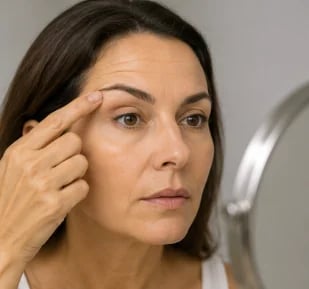
Now let your face go completely neutral, no expression at all, and look at where your brows naturally sit relative to your eyes without any effort on your part. Note specifically whether your brow sits at, above, or below your natural eye socket rim, the bony ridge you can feel just above your eye if you press gently there. A brow that sits at or slightly above this bony rim in a relaxed state is generally considered anatomically well-positioned. A brow that sits at or below this rim, even when your face is fully relaxed and you're not actively straining to keep your eyes open, suggests a baseline positional problem rather than a purely dynamic, muscle-related one.
This distinction between Test One and Test Two matters enormously for what comes next: Test One reveals how your muscles function during movement, while Test Two reveals where your brow actually sits at rest, and these can tell two very different stories about the same face.
Test Three: The Skin Pinch
With your face relaxed again, gently place a finger just beneath your eyebrow and press upward, mimicking the lift a surgical brow procedure would provide, then release and watch what happens as the skin settles back down. If a small amount of gentle upward pressure produces a meaningfully more open, alert eye appearance that disappears the moment you release, and if the skin above your brow, when pinched gently, feels like there's a genuine excess of loose, stretched tissue rather than a thin, taut covering, this is a sign that actual excess skin, not just muscle position, has become part of your brow concern.
This matters because Botox works exclusively on muscle activity. It cannot remove excess skin, tighten loose tissue, or reposition tissue that has genuinely descended and stretched beyond what muscle relaxation alone can lift back into place. A brow with significant excess skin revealed by this pinch test is signaling a structural concern that sits outside what any injectable, however skillfully administered, is designed to address.
Test Four: The Frown
Bring your eyebrows down and together in a deliberate frown, the expression associated with concentration or displeasure, and notice the vertical lines that form between your brows, often called the elevens given their characteristic double-line appearance. Also notice, as you do this, whether your brows seem to be pulled down forcefully by this frowning motion in a way that seems to be actively fighting against whatever natural or Botox-assisted lift you might otherwise have. This is covered in more detail on our surgical brow lift page.
This test matters because the muscles responsible for frowning, the corrugator and procerus muscles, work in direct opposition to the frontalis muscle tested in Test One. A Botox brow lift specifically targets this opposition: by relaxing the depressor muscles that pull the brow down and together, while carefully preserving enough frontalis function to maintain some lifting capacity, a skilled injector can shift the balance of this muscular tug-of-war in favor of a more lifted, less furrowed brow position, without eliminating natural forehead movement entirely.
Test Five: The Long, Honest Look
This last test isn't a physical maneuver so much as an honest inventory. Look at your whole upper face, brows, forehead, and upper eyelids together, and ask yourself specifically whether your primary complaint is that your brow looks positioned lower than it used to, your forehead looks less smooth than it used to, or your upper eyelids look heavier and more hooded than they used to. These are related concerns that often occur together, but they are not identical, and different combinations of these specific complaints point toward different appropriate interventions, sometimes Botox alone, sometimes a surgical brow lift, and sometimes a combination approach involving the eyelids specifically through blepharoplasty rather than the brow itself.
Reading Your Results: What the Five Tests Actually Tell You
If Test One showed strong, functional forehead muscle movement, Test Two showed a brow sitting reasonably close to its ideal position even at rest, and Test Three showed minimal excess skin, your presentation is a strong candidate for Botox brow lift alone. This combination suggests your primary concern is muscular imbalance and dynamic positioning rather than structural excess or significant baseline descent, exactly the category Botox is designed to influence.
If Test Two revealed a brow sitting notably below the bony rim even at complete rest, and Test Three revealed genuine excess skin under the pinch test, Botox alone is unlikely to fully satisfy your goals, regardless of how well Test One's muscle activity responded to the maneuver. This combination points toward a structural, positional problem that muscle relaxation alone cannot correct, since Botox cannot lift tissue that has genuinely descended and stretched beyond what remaining muscle tone can support, even with the depressor muscles fully relaxed.
If your results fell somewhere in between, some genuine excess skin alongside meaningful muscle activity and a brow position that's borderline rather than clearly one category or the other, this is an extremely common presentation, and it's precisely the category where an in-person, hands-on evaluation matters most, since the balance between what Botox can achieve and what requires surgical correction is genuinely a matter of degree in these intermediate cases, not a clean yes-or-no answer your own mirror test alone can fully resolve. This is covered in more detail on our blepharoplasty page.
What Botox Actually Does, Mechanically, Once You Understand Your Own Anatomy
For patients whose self-assessment points toward Botox as the appropriate first step, it's worth understanding precisely what the injections accomplish. Botox relaxes the depressor muscles, primarily the corrugator, procerus, and the lateral portion of the orbicularis oculi around the outer eye, all of which pull the brow downward and inward. By selectively weakening these depressor muscles while carefully preserving appropriate frontalis function in the central and lateral forehead, an experienced injector can shift the resting position of the brow upward by a modest but often meaningfully noticeable amount, along with softening the frown lines tested in Test Four.
This is a genuinely different mechanism from surgical brow lift, which physically repositions and secures the brow and forehead tissue itself, often removing excess skin in the process, addressing the anatomical reality Test Three was designed to reveal. Botox cannot replicate this physical repositioning; it can only influence how existing tissue behaves based on the muscles pulling on it.
What Surgical Brow Lift Adds That No Amount of Botox Can
For patients whose tests revealed genuine structural excess and baseline descent, a surgical brow lift directly addresses what Botox structurally cannot: it repositions the brow and forehead tissue to a higher, more youthful position and can remove excess skin that has stretched beyond what muscle tone alone will ever support again, regardless of how completely the depressor muscles are relaxed. Modern surgical brow lift techniques, including endoscopic approaches using small incisions hidden within the hairline, have made meaningful advances in reducing scarring and recovery time compared to older, more invasive coronal techniques, while still achieving the structural repositioning injectables cannot replicate.
For patients whose presentation includes both genuine excess skin and functional muscle imbalance, which describes a meaningful proportion of patients in their late forties and beyond, a combined approach, addressing the structural component surgically while using Botox to fine-tune the remaining muscular balance afterward, often produces a more complete and lasting result than either approach used in isolation. Our Botox and Dysport page walks through this in more depth.
Why Your Own Mirror Test Still Needs a Professional Confirmation
It's worth being honest about the limits of self-assessment even after walking through these five tests carefully. Determining exactly how much excess skin is present, precisely where your brow sits relative to standardized aesthetic proportions rather than just a general bony landmark, and how your specific muscle anatomy will respond to a given Botox dosing pattern all benefit considerably from a trained, hands-on evaluation that goes beyond what you can reliably assess in your own bathroom mirror. These tests are designed to help you walk into a consultation with a much clearer, more specific sense of your own presentation and the right questions to ask, not to replace the exam itself.
What Recovery Actually Looks Like on Each Path
For patients following the Botox path, there is, practically speaking, no recovery period to plan around. Most patients return directly to normal activity immediately after treatment, with only minor, temporary redness at injection sites and a general recommendation to avoid lying flat or vigorously exercising for a few hours afterward, allowing the product to settle in the intended location before increased blood flow or gravity has a chance to shift it. Visible results generally begin appearing within three to five days as the muscle relaxation takes effect, with full results apparent by roughly two weeks.
For patients following the surgical brow lift path, recovery involves a more significant commitment, typically one to two weeks of visible swelling and bruising, with modern endoscopic techniques generally involving less dramatic swelling than older, more invasive approaches given the smaller incisions and more limited tissue disruption involved. Numbness or altered sensation across the scalp and forehead is common in the initial weeks following surgery and generally resolves gradually over the following months as sensory nerves recover. Most patients feel comfortable returning to work and normal social activity within one to two weeks, though more strenuous exercise is typically restricted for three to four weeks to protect the healing incisions and allow swelling to fully resolve.
What to Actually Bring Up in Your Consultation, Based on Your Own Test Results
Given the specific, individualized nature of the tests above, it's worth walking into your consultation with your own specific observations in hand rather than a general concern about "looking tired." Mention specifically what you noticed in Test One about your forehead's movement and line formation, what you found in Test Two about your brow's resting position relative to your bony rim, and what the pinch test in Test Three revealed about skin quantity. A provider working from this level of specific, patient-reported detail, combined with their own hands-on exam, is positioned to build a recommendation around your actual anatomy far more precisely than a provider working from a vague opening description alone.
Why Age Alone Doesn't Determine Which Category You Fall Into
It's worth directly addressing an assumption many patients bring into this specific consultation: that Botox is simply what younger patients get and surgical brow lift is what older patients eventually graduate to, as though the two exist on a single, age-based continuum. The five tests throughout this piece are deliberately built around anatomy and function rather than age, precisely because this assumption doesn't hold up well against what actually happens in individual faces. Some patients in their fifties and sixties still have excellent frontalis muscle function and minimal excess skin, remaining strong Botox candidates well past the age many people assume surgery becomes necessary. Some patients in their thirties, particularly those with a strong genetic predisposition toward brow descent or naturally thin, less elastic skin, show the structural signs described in Tests Two and Three considerably earlier than population averages would predict, and Botox alone would underdeliver relative to what they're hoping to see.
This is precisely why the diagnostic tests in this piece are structured around what your own forehead and brow are actually doing, not around a birthday. Bringing this same specific, function-first framing into your consultation, rather than opening with an assumption about what treatment your age "should" call for, tends to produce a more accurate recommendation from the start.
What a Brow Consultation With Dr. Doshi Actually Involves
A thorough brow evaluation includes an assessment mirroring the tests above but performed with a trained eye and precise measurement: brow position relative to standardized facial proportions, an evaluation of forehead and depressor muscle strength and balance, and a direct assessment of skin quality and excess. From there, a specific recommendation, Botox alone, surgical brow lift alone, or a combined and sequenced approach, is built around your particular anatomy rather than a generalized assumption based on your age or a single visual impression.
Curious which category your brow concern falls into? Learn more about surgical brow lift with Dr. Hardik Doshi on Long Island, or explore Botox and Dysport for non-surgical options. For a broader look at upper face rejuvenation, visit our blepharoplasty page.