
Of all the procedures in facial plastic surgery, the brow lift is perhaps the most chronically underestimated. Patients who would readily consider a facelift or rhinoplasty often dismiss brow lifting as something they do not need, when in fact the changes at the forehead and brow level are driving a significant portion of what they find most bothersome about their upper face.
The tired expression. The stern resting look that does not match how the patient feels. The deep horizontal forehead lines that have developed over years of habitually raising the brows to compensate for their descent. The upper eyelid heaviness that the patient attributes to their eyelids, when the source of the problem sits a centimetre higher. These are the clinical presentation of brow ptosis, the anatomical term for the inferior displacement of the brow from its naturally appropriate position. And in a meaningful proportion of patients, a brow lift addresses them more completely than any other intervention.
Dr. Hardik Doshi is a double board-certified facial plastic surgeon at Doshi Plastic Surgery in Garden City, Long Island and Manhattan. He performs endoscopic brow lift, temporal brow lift, and combined upper facial rejuvenation procedures for patients whose brow position is contributing to upper facial concerns. Details of the brow lift procedure at Doshi Plastic Surgery are available on the procedure page. This blog covers the clinical depth: what brow descent actually is, how it is assessed, which technique is appropriate for which anatomy, where the brow lift ends and other procedures begin, and why the decision to wait often costs more than it saves.
The Anatomy of Brow Position and Why It Changes
The brow sits at the junction between the forehead and the upper eyelid, and its position in youth is determined by a balance of structural forces. The frontalis muscle of the forehead elevates the brow. The glabellar depressors, which include the corrugator supercilii, the procerus, and the depressor supercilii, pull the medial brow downward. The orbicularis oculi pulls the lateral brow downward. The periosteal attachments along the orbital rim, together with the retaining ligaments of the upper face, anchor the brow soft tissue in its anatomically correct position.
As the face ages, several of these structural elements weaken simultaneously. The periosteal attachments along the superior orbital rim elongate. The retaining ligaments of the lateral orbital area lose tensile strength. The soft tissue of the brow, including the orbital fat and the subcutaneous tissue of the forehead, loses volume. The combined effect is that the brow descends from its youthful position, typically earliest and most significantly at the lateral aspect, where the structural support is least robust.
The descent is not uniform. The medial brow may descend to a different degree and at a different rate than the lateral brow. The arch of the brow, which in women typically peaks above the lateral limbus of the iris, may flatten as the lateral aspect descends disproportionately. The overall shape change, not just the degree of descent, matters both aesthetically and surgically.
As the brow descends, the frontalis muscle compensates by chronically contracting to hold the brow at an acceptable position. This compensatory activity produces the deep horizontal forehead lines that patients often present with as a separate concern. The lines are not primarily a skin problem. They are the visible consequence of a muscular compensation for structural descent. Lifting the brow eliminates the need for the compensation and allows the forehead lines to soften, though they may not resolve completely in patients whose skin has been repeatedly creased for many years.
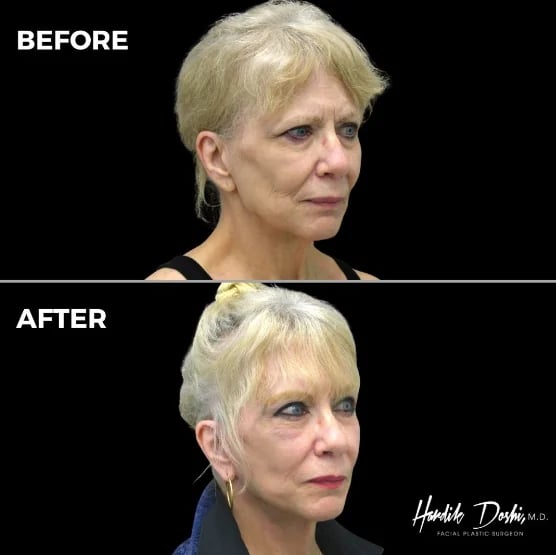
How to Tell Whether Your Problem Is the Brow, the Eyelid, or Both
This is the clinical question that matters most in the assessment of upper facial ageing, and it is one that many patients arrive at consultation having already answered incorrectly.
The most common diagnostic error is attributing upper eyelid heaviness entirely to the eyelids when the brow is driving a significant portion or all of the concern. A patient who presents asking about upper blepharoplasty, who has in fact significant brow ptosis with minimal true eyelid skin redundancy, will achieve a poor result from eyelid surgery because the source of the problem has not been addressed. If anything, removing eyelid skin in this patient without lifting the brow may accelerate apparent descent by reducing the tissue buffer between the descended brow and the eyelid margin.
The Manual Brow Lift Test
A simple bedside assessment can provide directional guidance before any formal clinical examination. Standing in front of a mirror, place the pads of the index fingers along the upper orbital rim, just at the brow. Gently lift the brow to the position it occupied in your 30s, taking care to lift the brow rather than stretch the forehead skin upward.
If this manoeuvre significantly reduces the appearance of upper eyelid heaviness, the brow is a meaningful contributor. If the heaviness remains largely unchanged after lifting the brow, the eyelid tissue itself is the primary source.
In patients where both effects are present, which is common in patients in their 50s and beyond, both brow lift and upper blepharoplasty may be appropriate. The sequencing matters: the brow lift is performed first within the operative session so the surgeon can accurately assess how much residual eyelid skin requires excision after the brow has been repositioned.
For a detailed comparison of brow lift and upper blepharoplasty for Long Island patients, the eyelid surgery page provides information on the full range of eyelid procedures available at Doshi Plastic Surgery.
Brow Lift Techniques: Which Approach Is Right for Which Patient
There is no single brow lift technique that is appropriate for all patients. The choice between endoscopic, temporal, and open approaches depends on the patient's hairline position, the degree and pattern of descent, the amount of forehead skin excess present, and the aesthetic goals of the specific case.
Endoscopic Brow Lift
The endoscopic brow lift is the technique Dr. Doshi uses most frequently for appropriate candidates. It involves three to five small incisions within the hairline, each approximately one to two centimetres in length. Through these incisions, an endoscope, a thin camera that transmits a magnified image to a monitor, and specialised instruments are introduced beneath the scalp.
The surgeon uses these instruments to release the periosteal attachments along the superior and lateral orbital rim, which are the primary structural anchors holding the brow in its descended position. Once these attachments are released, the brow soft tissue can be mobilised and elevated to its corrected position. The elevated brow is then secured in place using absorbable fixation devices anchored to the skull through the small hairline incisions.
The endoscopic approach produces the same degree of brow elevation as the traditional open coronal approach through incisions that are significantly smaller and better concealed within the hairline. There is no long coronal scar crossing the top of the scalp. The hairline is not advanced or elevated. For patients with an already-high hairline who are concerned about further elevation, the endoscopic technique can be designed to avoid hairline advancement.
The endoscopic approach is appropriate for patients with mild to moderate brow descent, adequate scalp laxity that allows tissue movement during the procedure, and a hairline position that accommodates the incision placement.
Temporal Brow Lift
The temporal brow lift targets the lateral brow specifically. It uses small incisions within the temporal hairline to address the lateral descent that is often the most visually significant component of brow ptosis. The temporal approach is appropriate when the concern is primarily lateral brow heaviness and the medial brow position is relatively well-maintained.
It is also useful as an adjunct to facelift surgery. Facelift incisions extend into the temporal hairline, creating access that can be used simultaneously to address the lateral brow without additional incisions. Patients having a facelift who also have lateral brow descent benefit from temporal brow lifting incorporated into the same operative session.
Open or Coronal Brow Lift
The traditional open brow lift, which involves a long incision across the top of the scalp from ear to ear or within the hairline, is less commonly performed today than it was before endoscopic techniques became established. However, it remains appropriate for patients with very significant brow descent, significant forehead skin excess, or anatomy that does not accommodate the endoscopic approach effectively.
The open approach provides the surgeon with direct visual access to all of the structures involved in brow position, allows more complete release of the restraining attachments, and can address larger amounts of forehead tissue than the endoscopic technique. The trade-off is a longer incision and a more involved recovery.
Direct and Transpalpebral Brow Lift
Direct brow lift, which involves an incision immediately above the brow, and transpalpebral brow lift, which accesses the brow from within an upper blepharoplasty incision, are used in specific clinical contexts. These techniques are particularly applicable in male patients with deep forehead lines and significant lateral brow descent, where the direct incision can be concealed within a deep forehead crease. They are also used in patients with facial nerve weakness or asymmetric brow descent where targeted, precisely controlled elevation is needed.
The Brow Lift and the Upper Face: What It Can and Cannot Do
Setting accurate expectations is as important as the surgical technique itself. The brow lift addresses brow position. Understanding precisely what this means in terms of visible change, and what it does not mean, prevents the disappointment that comes from misaligned expectations.
What a Brow Lift Can Change
- The position of the brow relative to the orbital rim, restoring it to a more youthful height and shape.
- The appearance of upper eyelid heaviness that is being driven by brow descent rather than by excess eyelid skin.
- The resting expression of the upper face, softening a stern or fatigued appearance caused by medial brow depression.
- The depth of horizontal forehead lines that result from chronic frontalis compensation for brow descent.
- The shape of the brow arch, which may flatten with lateral descent and can be restored to a more defined curvature with targeted lateral elevation.
What a Brow Lift Cannot Change
- True upper eyelid skin redundancy (dermatochalasis) that exists within the eyelid itself rather than being driven by brow descent. This requires upper blepharoplasty.
- The shape of the eye opening or the configuration of the eyelid margins. Brow position and eyelid anatomy are distinct structures.
- Surface skin quality, fine lines from sun damage, or volume loss in the forehead. These require separate interventions.
- Lower eyelid concerns. The brow lift is an upper facial procedure with no direct effect on the lower eyelid, tear trough, or midface.
- Deep glabellar lines that are permanently etched into the skin. These may soften but are unlikely to resolve completely from brow lifting alone.
For patients whose primary concern is forehead lines and glabellar frowning, wrinkle relaxers address the muscular activity component of these lines effectively as a non-surgical option.
Botox for Brow Lifting: Where It Works and Where It Does Not
The Botox page at Doshi Plastic Surgery describes the full range of neuromodulator treatments available. In the context of brow position, Botox can produce a modest chemical brow lift by selectively relaxing the depressor muscles that pull the brow inferiorly, allowing the frontalis to elevate the brow slightly without opposition.
The chemical brow lift is a real effect that is appropriate for patients in their 30s and early 40s with mild brow descent and good skin quality. In these patients, relaxing the lateral orbicularis and the corrugator and procerus at the medial brow can produce a visible improvement in brow position that is meaningful and aesthetically appropriate.
The limitations of Botox for brow lifting are primarily those of degree and durability. The effect lasts three to four months before retreatment is required. The degree of elevation achievable is limited by the fact that Botox works by relaxing opposing muscles rather than by repositioning the structural tissue itself. In patients with significant brow ptosis, structural descent of the brow soft tissue, or significant skin laxity at the forehead, Botox will not produce adequate improvement regardless of how precisely it is placed.
The practical clinical use of Botox in the context of brow lifting is as an early intervention for mild changes, a maintenance tool for patients who have had surgical lifting and want to preserve the result, and a bridge treatment for patients who know they will eventually need surgery but want to manage their appearance in the interim.
Why the 40s Are Often the Right Time to Act
The most common conversation Dr. Doshi has with patients presenting for brow lift consultation in their 50s is a variation on the same theme: they first noticed the brow change in their early to mid-40s, assumed it was too soon for surgery, and spent a decade managing the progression with Botox and fillers. Now the brow has descended further, the forehead lines are more deeply etched, and the skin is less elastic than it was when the change was first apparent.
This pattern is clinically significant because the anatomy available for brow lifting in the 40s is genuinely more favourable than the anatomy available in the 50s. The skin has more elasticity and redrapes more readily over repositioned tissue. The soft tissue of the brow and forehead has not undergone as many years of continued descent, meaning the correction required is smaller and the repositioning more precisely achievable. The horizontal forehead lines, though present, have not been etched as deeply into the skin.
A brow lift performed in the mid-to-late 40s on appropriate anatomy produces a result that holds well for eight to twelve years. A patient who has this procedure at 46 and is reassessed at 56 will look significantly better than a patient of the same age who deferred surgery, even accounting for the continued ageing that occurs after the procedure. The decade of advantage that earlier intervention establishes compounds over time.
This is not an argument for premature surgery. A patient who does not have meaningful brow ptosis at 42 is not a candidate for brow lifting, and performing the procedure in the absence of genuine anatomical indication produces an operated result on a face that did not require the operation. The argument is specifically for patients who do have meaningful brow descent in their 40s and who are deferring based on the assumption that they are too young, when the clinical evidence suggests the opposite is true.
Combining Brow Lift With Other Procedures
Brow lift is most commonly performed as part of a broader upper facial rejuvenation plan rather than as an isolated procedure. The most frequent combination is brow lift with upper blepharoplasty, which addresses both the brow position and the eyelid tissue simultaneously in a single operative session with a single recovery period. When both are appropriate, this combination produces a more complete and natural-looking result than either procedure alone.
Patients who are having a facelift often benefit from simultaneously addressing the upper facial ageing changes that facelift surgery does not reach. A facelift comprehensively addresses the midface, jowl, and neck but has no direct effect on brow position. Patients who have both lower facial descent and significant brow ptosis achieve the most balanced overall result when both are addressed in the same operative session.
For patients with upper facial volume loss alongside brow descent, facial fat transfer to the temples and periorbital area can be incorporated into the same operative session, addressing both the structural position of the brow and the volumetric depletion of the surrounding tissue simultaneously.
Recovery After a Brow Lift on Long Island
Recovery after endoscopic brow lift is more involved than non-surgical treatments but less extensive than facelift surgery. Patients should plan for the following timeline:
- Days one to seven: Swelling and bruising in the forehead and upper eyelid area. The degree of swelling is typically less than after facelift surgery but can be significant, particularly in the first three to four days. Cold compresses applied to the forehead, not to the eyes directly, help manage acute swelling.
- Days seven to fourteen: Most bruising resolves. Swelling begins to subside visibly. Temporary numbness or tingling in the forehead and scalp is common and expected. Small hairline incisions are well-healed at this point and typically not visible with normal hairstyling.
- Two to three weeks: Most patients are comfortable in social situations. The elevated brow position is visible and the result is beginning to be assessable, though the full settled appearance requires more time.
- Four to six weeks: Strenuous exercise and activities with impact or elevated heart rate can be resumed. Most residual swelling has resolved.
- Three months: The final, settled result is fully apparent. The brow is in its corrected position, forehead swelling has completely resolved, and the full aesthetic benefit of the procedure can be assessed.
Temporary alteration of forehead sensation and scalp numbness is common after endoscopic brow lift and typically resolves over weeks to months as the cutaneous nerves recover from the manipulation involved in the procedure. Permanent sensory change is uncommon.

The Consultation: What Dr. Doshi Assesses and How the Plan Is Developed
Brow lift consultations at Doshi Plastic Surgery are structured assessments of the full upper facial anatomy rather than a discussion of a single procedure. Dr. Doshi evaluates brow position, brow shape, and the degree and pattern of descent. He assesses the upper eyelid for true skin redundancy, levator function, and the relationship between brow position and eyelid appearance. He examines the forehead for skin laxity, hairline position, and the feasibility of the endoscopic approach. And he discusses the patient's goals in terms of what they want to change and what they are prepared to undergo to achieve it.
For patients who are not yet ready for an in-person consultation, virtual consultations are available and can provide an initial assessment and discussion of options before the patient commits to an in-office visit.
The recommendation that comes out of the consultation is specific to the anatomy present, not to a generalised protocol. Some patients are appropriate for brow lift alone. Some need upper blepharoplasty alone. Many need both. Some would benefit from a broader combined procedure including facelift and fat transfer. The plan is built around what the specific patient's anatomy requires and what their goals realistically necessitate.
Scheduling a Brow Lift Consultation at Doshi Plastic Surgery
Dr. Hardik Doshi sees patients for brow lift consultations at Doshi Plastic Surgery in Garden City, Long Island and in Manhattan. To learn more about Dr. Doshi's training and credentials, visit the about Dr. Doshi page and the board certification page. To schedule a consultation, visit doshiplasticsurgery.com or contact the practice directly.
What is brow ptosis and how do I know if I have it?
Brow ptosis is the medical term for the inferior descent of the brow from its anatomically appropriate position. Signs that you may have brow ptosis include a heavy, tired, or stern resting appearance that does not reflect how you feel; deep horizontal forehead lines from habitually raising your eyebrows to compensate for brow descent; upper eyelid heaviness that improves when you manually lift your brow upward with your fingers; and a brow that sits at or below the orbital rim. A consultation with an experienced surgeon who examines both brow position and upper eyelid anatomy is required for a definitive diagnosis and treatment recommendation.
What is the difference between a brow lift and upper blepharoplasty?
A brow lift elevates the position of the brow itself by repositioning the soft tissue of the forehead and brow region upward. Upper blepharoplasty removes excess skin and sometimes fat from the upper eyelid. The two procedures address different anatomical structures and different causes of upper eyelid heaviness. When upper eyelid heaviness is caused primarily by a descended brow pressing skin onto the eyelid, a brow lift addresses the source of the problem. When the heaviness is caused by excess eyelid skin itself, upper blepharoplasty is required. Many patients have both conditions simultaneously and benefit from both procedures.
What is an endoscopic brow lift and who is it appropriate for?
An endoscopic brow lift uses three to five small incisions in the hairline through which a camera and instruments are introduced to release the brow's periosteal attachments, mobilise the brow soft tissue, and elevate and secure the brow in its corrected position. It is appropriate for patients with mild to moderate brow descent who have adequate scalp laxity and a hairline position that accommodates the technique. Patients with very high hairlines, significant forehead skin excess, or extensive descent may be better served by an open approach.
Will a brow lift make me look surprised or unnatural?
A brow lift performed by an experienced surgeon with appropriate patient selection and a conservative elevation target should not produce a surprised or unnatural appearance. The surprised look associated with older brow lift results was a consequence of over-elevation and techniques that did not adequately account for natural brow shape. Modern endoscopic techniques allow for precise, graduated elevation that restores natural position without overcorrection. The goal is to return the brow to where it was, not to elevate it beyond its natural range.
Can Botox replace a brow lift on Long Island?
Botox can produce a modest chemical brow lift by relaxing the depressor muscles that pull the brow downward, allowing the frontalis to elevate the brow slightly without opposition. In patients with early, mild brow descent and good skin quality, this can provide meaningful but temporary improvement lasting three to four months. Botox cannot address significant brow descent, cannot reposition descended soft tissue, and cannot address the redundant upper eyelid skin that accumulates as a consequence of brow descent over time. It is a useful early intervention but not a substitute for surgery in patients with meaningful brow ptosis.
How long does a brow lift result last?
A well-performed endoscopic or temporal brow lift produces results that typically last five to ten years or more before any secondary procedure might be considered. The result depends on the degree of elevation achieved, the fixation technique used, and the individual patient's rate of continued ageing. The brow does not return to its pre-operative position immediately but continues to age from the improved baseline that surgery established. Patients who have a brow lift in their 40s and are reassessed in their 50s will typically look significantly better than they would have without the procedure, even accounting for the continued ageing that occurs after surgery.
What is the recovery like after a brow lift on Long Island?
Recovery after an endoscopic brow lift typically involves one to two weeks of visible swelling and bruising around the forehead and upper eyelid area. Temporary numbness or altered sensation in the forehead and scalp is common and usually resolves over several weeks to months. Most patients are comfortable returning to desk-based work at ten to fourteen days. Strenuous activity should be avoided for four to six weeks. The final, settled result is apparent at approximately three months when swelling has fully resolved.
Should I have a brow lift before or after having upper blepharoplasty?
When both procedures are indicated, performing the brow lift first or simultaneously within the same operative session is the correct sequence. The brow lift is completed first so the surgeon can assess how much upper eyelid skin redundancy remains after the brow has been elevated to its corrected position. Performing the blepharoplasty before the brow lift risks excising more eyelid skin than is appropriate, since some of the apparent eyelid redundancy will be addressed by brow repositioning. The two procedures are frequently performed together, with the brow lift completed first and the blepharoplasty addressing only the residual eyelid tissue that remains after brow elevation.
About Dr. Hardik Doshi
Dr. Hardik Doshi is a double board-certified facial plastic surgeon and founder of Doshi Plastic Surgery, with offices in Garden City, Long Island and Manhattan, New York. He is certified by the American Board of Facial Plastic and Reconstructive Surgery and the American Board of Otolaryngology-Head and Neck Surgery, and has performed over 5,000 facial plastic surgery procedures. Dr. Doshi performs endoscopic brow lift, temporal brow lift, upper blepharoplasty, facelift, and the full range of facial aesthetic procedures. To schedule a consultation, visit doshiplasticsurgery.com.