The brow lift is one of the most misunderstood procedures in facial plastic surgery. Patients who need one often do not know they need one, pursuing upper blepharoplasty consultations when what they actually have is brow ptosis - a descended brow that creates the appearance of heavy upper lids. And patients who have researched it sometimes arrive with outdated ideas about what the surgery involves, largely because the procedure has changed dramatically in the last two decades.
Dr. Hardik Doshi performs endoscopic brow lift and related forehead rejuvenation procedures at Doshi Plastic Surgery, serving patients across Long Island, Huntington, and Manhattan. This guide covers who is a good candidate for brow lift surgery, what recovery actually looks like, and why the procedure is often a better solution than eyelid surgery alone for patients with upper facial heaviness.
The Anatomy Behind Brow Ptosis
The brow occupies the space between the orbital rim and the hairline. Its position, shape, and height change with age in ways that are distinct from eyelid changes, though the two are closely related visually.
With age, the soft tissue structures that hold the brow in its youthful position gradually descend. The frontalis muscle, which runs vertically across the forehead, is what patients are unconsciously contracting when they raise their eyebrows to compensate for the heaviness. Many patients with significant brow ptosis develop habitual frontalis contraction as a functional adaptation to keep their brows elevated enough to see comfortably. This contraction, sustained over years, contributes to the horizontal forehead lines that are themselves a complaint.
The female brow at its most aesthetic sits at or slightly above the orbital rim, with the highest point of the arch over the lateral third of the brow. The male brow typically sits at or just below the orbital rim with a flatter contour. These are general principles, not rigid rules, and individual facial structure should always guide what a specific patient's ideal position looks like.
When the brow descends, it pushes the upper lid skin down with it. This creates the appearance of upper eyelid excess. Surgeons who evaluate this carefully will distinguish between true upper lid skin excess (corrected by blepharoplasty), pseudo-excess created by brow ptosis (corrected by brow lift), and a combination of both. Operating on the lids without addressing a descended brow in a patient who has both conditions produces a result that looks incomplete.
Endoscopic Versus Coronal Brow Lift
The traditional open or coronal brow lift involved an incision running ear to ear across the top of the scalp, inside the hairline. It provided excellent elevation and longevity. It also produced significant scalp numbness that could be permanent in some areas, added scar risk, and altered the hairline position. For patients with a high hairline, the coronal approach was particularly problematic.
The endoscopic brow lift, which became the standard approach over the past two decades, uses three to five small incisions inside the hairline, through which an endoscope and dissecting instruments allow the surgeon to release the brow from its attachments and reposition it. The fixation method varies by surgeon preference; some use absorbable fixation devices anchored to the bone, others use suture techniques.
Benefits of the endoscopic approach include no visible scar, no alteration of the hairline position, and significantly reduced risk of permanent scalp numbness. The trade-off is that it requires specific surgical training and produces somewhat less dramatic elevation in patients who need significant correction.
For some patients, a temporal brow lift, which uses lateral incisions inside the hairline to elevate the outer third of the brow, is sufficient. This is appropriate when the primary complaint is lateral hooding created by a descended outer brow, rather than global brow descent.
The right procedure depends on the degree and pattern of brow ptosis, the patient's hairline position, and the surgeon's assessment of what will produce the most natural result. Dr. Doshi evaluates each patient's brow position carefully before recommending a specific approach.
Recovery: The First 72 Hours
The first three days after a brow lift are the most uncomfortable, though the discomfort is different in character from, say, rhinoplasty recovery. The primary sensation is tension and pressure across the forehead rather than sharp pain. Most patients describe it as feeling like a very tight headband around the head.
Swelling is inevitable and significant during this phase. It distributes differently than in eyelid surgery - the forehead and brow swell substantially, and that swelling often descends into the upper eyelid and brow area over the first 48 hours, temporarily making the area look heavily swollen and the eyes look smaller. This alarming-looking phase passes.
Bruising with the endoscopic approach is typically less extensive than with open approaches, but it still occurs. It is usually concentrated around the temples and upper eyelids and may track into the cheeks with gravity.
Specific instructions for the first 72 hours:
Head elevation is essential. Sleeping with the head significantly elevated, either on multiple pillows or in a recliner, reduces swelling by preventing fluid from pooling in the forehead tissues. Most surgeons recommend 30 to 45 degrees of elevation for the first week.
Cold compresses can be applied to the forehead and brow area carefully. They should not be placed directly on incisions or applied with significant pressure.
Physical activity should be entirely restricted. Bending, straining, and elevated heart rate all increase pressure in the forehead tissue and risk both bleeding and prolonged swelling.
Patients will have a bandage or wrap around the forehead following surgery. This is typically removed at the first post-operative visit, often 24 to 48 hours after surgery.
Itching is common and should not be scratched. The healing nerve endings in the scalp and forehead produce significant itching during the first week. Antihistamines can help. Scratching, particularly near the small incisions, risks opening them.
Days 4 Through 14: The Functional Recovery Window
By day four, most patients are feeling substantially better than they did on day two or three. The peak swelling is passing. The headband sensation is easing. Bruising has usually shifted from its most dramatic phase and is beginning to yellow.
Patients are often surprised that they feel functional well before they look like themselves. This is characteristic of brow lift recovery. The sensation improves faster than the appearance does.
Sutures or staples at the small incisions are typically removed between days seven and ten. By this point, most patients are comfortable going about daily life, though the hairline area may still be tender to the touch and the forehead may feel stiff when attempting to make expressions.
The stiffness and limited facial movement in the forehead is worth addressing specifically because it worries patients. After brow lift surgery, the ability to raise the eyebrows, furrow, and make full forehead expressions is temporarily reduced. This is because the tissue has been elevated and fixed in a new position and needs time to settle. Full expressive range returns gradually over weeks to months.
What to expect during this functional recovery window:
Driving can usually resume when the patient is no longer taking prescription pain medication and feels alert enough to react normally, typically around days five to seven for most patients.
Return to desk work and sedentary activities is reasonable by week one to two for most patients.
Exercise restriction continues through the first two to three weeks for cardiovascular activity. Light walking is typically cleared before running or anything more strenuous.
Months One Through Three: Settling and Refinement
At one month, many brow lift patients feel they look good but not yet like the final version of themselves. There is residual firmness and subtle swelling in the forehead that takes months to fully resolve. Some patients notice that the brow feels slightly higher than they expected during this phase and that the skin has a different texture or quality of movement than before. This is normal and temporary.
The fixation devices or sutures used to hold the brow in its new position are doing their job during this period while the tissue heals into place. By three to four months, the brow has settled into a position that is permanent. The tissue has adhered and the result is stable.
The forehead lines, which are one of the common secondary benefits of brow elevation, often look better during this settling phase than they did before surgery. Elevating the brow reduces the compressive effect on the forehead skin, and the lines soften as a result. Botox in the forehead can complement this effect beautifully once healing is complete.
Scalp sensation, which may have been altered or diminished following surgery, typically recovers over two to six months. Patients may experience numbness, tingling, or hypersensitivity in different zones of the scalp during recovery. Full sensation usually returns, though it may take closer to a year in some patients.
Brow Lift and Botox: How They Work Together
Botox and brow lift surgery are not competing interventions. They address different components of the aging forehead and complement each other effectively.
Botox relaxes the depressor muscles of the brow, including the corrugator supercilii and the orbicularis oculi, to allow the frontalis to elevate the brow without opposition. In patients who are earlier in the aging process, this can produce a meaningful brow lift effect without surgery. The effect lasts four to six months and requires ongoing maintenance.
Brow lift surgery repositions the entire brow structure at a tissue level. It is not temporary and does not require maintenance. The longevity of the result depends partly on aging, which continues, and partly on how the surgery was performed and how much the brow was elevated.
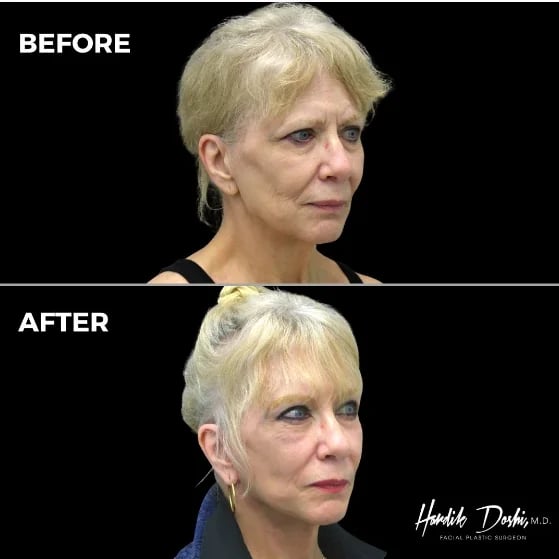
After brow lift surgery, Botox remains useful for managing dynamic forehead lines and for fine-tuning the brow position if there is any asymmetry or if one side is slightly more elevated than the other. It is a complementary tool, not a replacement for the surgery.
Patients who have relied heavily on Botox for brow elevation for many years and then pursue surgery should understand that the two will ultimately work together as a maintenance strategy, with Botox serving a different role than it did before surgery.
Brow Lift and Facelift: When Surgeons Recommend Combining
Brow lift is frequently performed in combination with facelift when the aging pattern affects both the upper and lower face. This is a common scenario for patients in their fifties and sixties who have significant brow ptosis, upper facial heaviness, and mid-face and lower-face descent.
Combining procedures in a single operating session means one anesthesia event, one recovery period, and the ability to address the face as a unified structure rather than in isolated pieces. Dr. Doshi's approach to facial rejuvenation accounts for the relationship between upper, mid, and lower face. Elevating the brow without addressing the mid-face, for instance, can create a disconnected result. Addressing the facelift without correcting a descended brow leaves an imbalance between the upper and lower face.
When procedures are combined, recovery is naturally longer and more involved. There is simply more tissue healing, more swelling, and more bruising distributed across a larger area. The fundamental timeline is similar to brow lift recovery but extended, and the total return to baseline appearance takes longer. For many patients, the trade-off of a single, more complete recovery is preferred to sequential operations spaced months apart.
Long Island Patients: Questions About Surgery at Doshi Plastic Surgery
Patients traveling from Nassau County, Suffolk County, or from Manhattan to Doshi Plastic Surgery for brow lift consultation should expect a detailed evaluation of the brow position in relation to the orbital rim, the eyelid, and the overall facial structure.
The consultation will address whether the primary issue is brow ptosis, eyelid excess, or both. Some patients who have researched upper blepharoplasty will be redirected toward brow lift evaluation when the examination reveals that the brow is the driving factor. This is not a recommendation to perform a more expensive procedure - it is a recommendation to address the correct anatomical problem.
Dr. Doshi will discuss the approach appropriate for the patient's anatomy and the degree of correction needed. The conversation about realistic expectations is part of every consultation. Brow lift produces meaningful, lasting rejuvenation of the upper face, but it does not arrest further aging, and patients should understand that the result may need to be complemented with other treatments over the years.
*Dr. Hardik Doshi is a double board-certified facial plastic surgeon serving Long Island and Manhattan. He performs endoscopic brow lift and forehead rejuvenation procedures at Doshi Plastic Surgery. To schedule a consultation, contact the practice at doshiplasticsurgery.com.*