
Buccal fat removal is one of the most requested procedures at facial plastic surgery consultations across Long Island and Manhattan right now. It is also, in candid terms, one of the procedures most frequently recommended to patients for whom it is not appropriate - and one of the most common sources of patients who appear in revision consultations five to ten years later, unhappy with what time and surgery together have produced.
This is not a guide designed to discourage buccal fat removal. It is designed to help patients understand exactly what buccal fat does for the face across a lifetime - not just at the age they are sitting in the consultation chair - and what the honest clinical conversation about this procedure should cover before any decision is made.
The patients who benefit most from this guide are the ones in their mid-twenties to late thirties who are considering the procedure because of what they see on social media, what their friends have done, or because a provider has offered it without the full conversation. That full conversation is what follows.
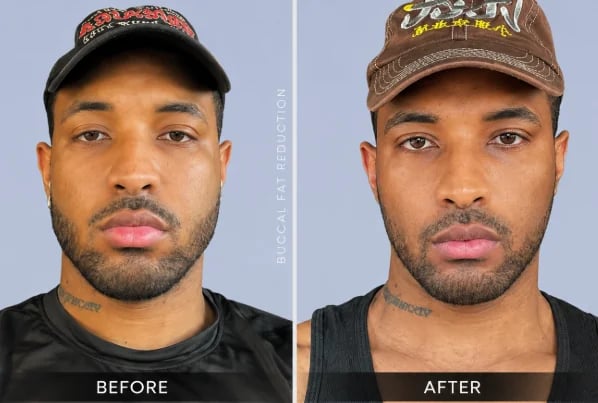
What Buccal Fat Is and What It Does for the Face
The buccal fat pad is a discrete, encapsulated collection of fat that sits deep in the cheek - between the masseter muscle on the outside and the buccinator muscle on the inside. It has three lobes that extend from the cheek into the temporal region. What patients and providers most commonly discuss is the buccal extension - the portion visible as mid-face fullness between the cheekbone and the mouth.
The Anatomical Role of Buccal Fat
In youth, the buccal fat pad contributes to the characteristic fullness of the mid-face that is associated with a young, healthy appearance. It gives the cheeks their three-dimensional quality, provides structural support for the overlying skin, and contributes to the smooth contour between the cheekbone and the mouth that is one of the defining visual signatures of a young face.
This is the point that most buccal fat removal conversations fail to address adequately: the same volume that makes a face look round or full at twenty-five is part of the volume that keeps a face looking supported and youthful at forty-five. The face loses fat compartment volume throughout adult life - a process that begins in the late twenties and accelerates through the forties and fifties. Buccal fat removal adds a permanent, surgical fat reduction on top of a natural ageing process that is already moving in the same direction.
What Buccal Fat Removal Actually Produces
At the age of twenty-five or thirty, buccal fat removal produces a chiselled, defined mid-face. The cheeks are hollowed. The cheekbones appear more prominent. The face looks angular and sculpted. In the right lighting, in photographs, on social media, the result is exactly what the patient requested.
At the age of forty-five or fifty, on that same patient, the picture changes. The natural fat compartment loss that occurs in every face has compounded with the surgical absence of buccal volume. The face that was attractively chiselled at thirty may look prematurely gaunt, hollow, or skeletonised at fifty. The nasolabial folds may have deepened. The mid-face support that the buccal fat was providing to the overlying skin is absent. The aesthetic problem is now not fullness - it is hollowness. And the correction for hollowness is fat transfer: a more expensive, more invasive procedure than simply leaving the buccal fat in place.
The Social Media Problem - Why Long Island Patients Are Seeing This Everywhere
The surge in buccal fat removal requests over the past four to five years reflects a specific social media aesthetic - high cheekbones, hollowed mid-face, sharply angular lower face - that has been amplified by celebrity visibility and the prevalence of heavily filtered, specifically lit content that makes this aesthetic look dramatically attractive.
The Lighting and Filter Problem
The snatched, chiselled mid-face look that drives buccal fat removal requests appears at its most compelling in certain lighting conditions: strong directional light from above that creates shadows in the hollows of the face, emphasising the angularity. The same face in flat, natural daylight - the lighting in which most people move through the world and are seen by others - looks different. The hollowing that photographs beautifully under studio lighting can look gaunt in natural light.
Patients who are making treatment decisions based on social media content are making them based on a visual context that is not representative of how they will look in their daily lives. This is not a theoretical concern - it is a clinical pattern that facial plastic surgeons on Long Island and in Manhattan are seeing regularly: patients who love their result in photographs and are troubled by it in person, or whose result looks appropriate at twenty-eight and creates new aesthetic concerns at forty.
The Age Problem
The patients most frequently requesting buccal fat removal are in their mid-twenties to early thirties - precisely the age at which the procedure looks most immediately gratifying and at which the long-term consequences are furthest in the future. A twenty-six-year-old patient who removes buccal fat today will not see the full consequence of that decision until their late thirties or forties - when the natural fat compartment loss of ageing has progressed significantly and the absence of buccal volume becomes apparent not as definition but as depletion.
Who Actually Qualifies - The Honest Clinical Assessment
With the full context of what buccal fat does and what its removal means across a lifetime, the patient who genuinely benefits from buccal fat removal is a narrower group than current demand would suggest.
Patients with True Buccal Hypertrophy
Some patients have buccal fat pads that are genuinely disproportionate - significantly larger than average and creating a facial fullness that persists regardless of overall body weight, age, or lifestyle. In these patients, the buccal fat is contributing to a facial proportion that the patient has a reasonable clinical basis for wanting to address. The distinction - whether the fullness reflects true buccal hypertrophy or simply a full face at a young age - requires clinical assessment, not a self-diagnosis from social media content.
Patients in Their Late Thirties or Older
Patients who are old enough that natural fat compartment loss has already begun reducing overall facial volume are better candidates than younger patients. In the late thirties and early forties, the face has typically begun the natural deflation process that reduces mid-face volume. The risk of compounding surgical with natural loss is lower for these patients because the natural process has already reduced the margin available.
Patients with Good Overall Facial Bone Structure
A patient with naturally prominent cheekbones, good overall facial bone structure, and sufficient mid-face volume from other compartments can tolerate buccal fat removal more safely than a patient whose facial volume is primarily buccal in origin. The assessment requires looking at the face comprehensively - the cheekbone projection, the overall mid-face depth, the relationship between the buccal fat and other volume sources - not just the buccal region in isolation.
Who Should Not Proceed
Patients under thirty without true buccal hypertrophy. Patients who are thin overall, with low BMI, where hollowing would be more dramatic and more immediate. Patients whose primary motivation is a social media aesthetic rather than a genuine anatomical concern assessed in natural, unfiltered conditions. Patients with naturally prominent nasolabial folds, as buccal fat provides structural support that its removal may further compromise.
The Honest Consultation - What Dr. Doshi's Assessment Covers
At Doshi Plastic Surgery, every patient who presents requesting buccal fat removal undergoes a thorough anatomical assessment before any recommendation is made. This assessment covers the buccal fat pad size relative to overall facial volume, the patient's age and natural ageing trajectory, overall facial bone structure and the mid-face volume contributions of other compartments, and an explicit conversation about what the face will look like in fifteen to twenty years with and without buccal volume.
The Long-Term Projection Conversation
The most important element of the buccal fat consultation is the long-term projection conversation. A patient in their mid-twenties making a permanent decision about their facial volume needs to understand what natural ageing will do to the face over the next twenty years - and how the absence of buccal fat will interact with that process. This conversation involves describing specifically what the mid-face will look like as natural fat compartment loss progresses, and whether the surgical absence of buccal volume will compound that loss in a way the patient will find acceptable in their forties and fifties.
What It Means When a Surgeon Recommends Against It
Buccal fat removal is a relatively simple, profitable, in-demand procedure. A surgeon who declines to perform it - or who has a detailed conversation about why they recommend against it for a specific patient - is not withholding a service. They are demonstrating the clinical judgment and patient-first philosophy that should characterise every surgical recommendation. The best surgeons in facial plastic surgery routinely talk patients out of procedures they request. This is a feature, not a limitation.

If You Have Already Had Buccal Fat Removal - Correction Options
For patients who have already undergone buccal fat removal and are experiencing the consequences - either immediately post-procedure or years later as natural ageing has progressed - correction options exist, though they are more complex and less predictable than prevention.
Autologous Fat Transfer
Autologous fat transfer - harvesting fat from the abdomen or flanks and injecting it into the depleted mid-face - is the primary correction option. The procedure can restore volume to the mid-face, reduce the gaunt appearance, and improve facial proportions disrupted by buccal removal. The limitations are real: injected fat does not exactly replicate the anatomical position and structural properties of native buccal fat, fat absorption means overcorrection is required at the time of injection, and multiple sessions may be needed for optimal results.
Hyaluronic Acid Filler as a Bridge
For patients who are not ready for a surgical correction or who are in the earlier post-operative period, hyaluronic acid filler can provide temporary mid-face volume restoration. It is reversible, adjustable, and immediate. The limitation is duration - filler in this region requires replacement every six to twelve months - making it most appropriate as a bridge to a longer-term plan rather than a permanent solution.