By Dr. Hardik Doshi | Doshi Plastic Surgery, Long Island and Manhattan
Buccal fat removal is one of the most discussed facial procedures of recent years, and the discussion has not always been accurate. For patients on Long Island who are considering this procedure, two things matter most before deciding to proceed: an honest assessment of whether they are the right candidate, and a realistic understanding of what recovery involves.
At Doshi Plastic Surgery the candidacy conversation comes first. Buccal fat removal produces a permanent result because the removed fat does not regenerate. For the right patient this is a significant advantage. For the wrong patient it creates a result that looks appropriate at 30 and problematic at 50. Dr. Doshi turns away patients who are not suitable candidates and explains clearly why.
For patients who are appropriate candidates and have made the decision to proceed, this guide covers the recovery process week by week, with specific timelines, dietary requirements, and practical instructions drawn from the post-operative protocol at Doshi Plastic Surgery.
What Buccal Fat Removal Involves
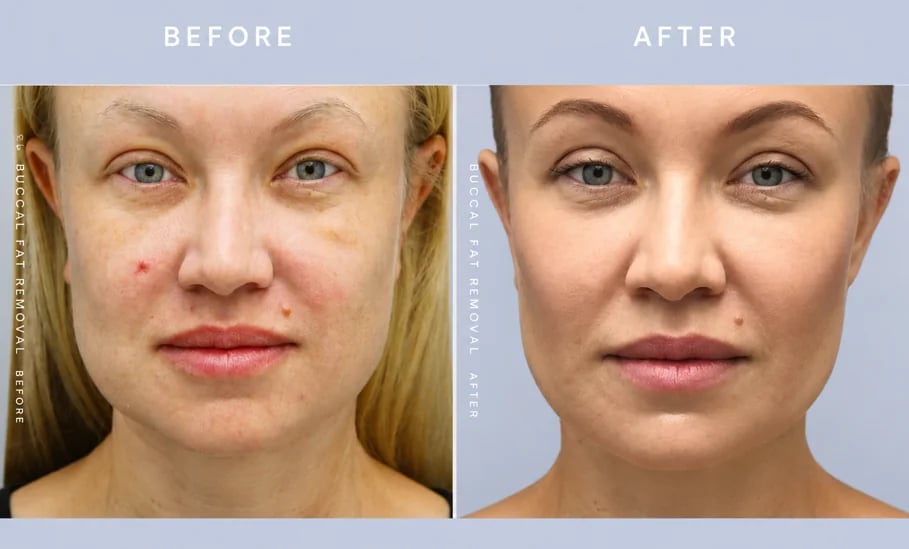
The buccal fat pad is a discrete collection of fatty tissue that sits deep in the midface, between the layers of the cheek muscles. It is responsible for the rounded fullness in the lower and mid cheek that patients describe as chubby, full, or baby-faced. Unlike the surface fat that responds to weight change, the buccal fat pad is structural. It does not reduce meaningfully with diet or exercise.
To remove it, Dr. Doshi makes a small incision inside the mouth against the inner cheek wall, gently teases the buccal fat pad from its anatomical pocket, and removes a precisely planned amount. The incision is closed with absorbable sutures that dissolve within 7 to 10 days. There are no external incisions.
The procedure takes 30 to 45 minutes when performed alone. It is occasionally combined with other facial procedures including chin augmentation, rhinoplasty, or neck liposuction at Doshi Plastic Surgery, in which case the recovery windows overlap and the total downtime is not significantly longer.
Candidacy: The Honest Assessment
Not everyone who wants this procedure should have it. Dr. Doshi's candidacy assessment at consultation considers three things: the amount of buccal fat present, the patient's overall facial volume relative to their structure, and the likely trajectory of the result as the face ages.
The best candidates are patients in their 20s to early 40s who have genuine lower cheek fullness that is disproportionate to their facial structure and that has not changed meaningfully with weight loss. These patients have enough facial volume that the removal of the buccal fat produces definition without hollowing.
Patients who are already lean, who have naturally narrow or angular faces, or who are in their mid-40s or older with early signs of natural volume loss are not good candidates. The defining feature of the buccal fat pad is that it persists even when the rest of the face has lost volume. Removing it in patients who are already thinning accelerates a process that will continue on its own. The result worsens with age in a way that is not correctable without fat grafting.
This is the conversation Dr. Doshi has at consultation. Patients who are told they are not candidates should hear that as the surgeon protecting the long-term appearance of their face.
Day of Surgery
Buccal fat removal is performed under local anesthesia with sedation or light general anesthesia. Patients are discharged the same day. Because the surgery is entirely internal with no external incisions, the face looks largely normal immediately after the procedure. Swelling is present but has not yet peaked.
Day of Surgery Instructions
- Cool or room-temperature soft foods only for the first 24 hours, nothing hot
- Begin prescribed antiseptic mouthwash rinses from the evening of surgery
- Keep the head elevated at 30 to 45 degrees including during sleep
- Apply a cool compress to the outside of the cheeks, not directly on the incision
- Begin pain medication as directed before the local anesthesia wears off
- Do not spit forcefully, use a straw, or smoke
- Arrange for someone to drive home from the surgical facility
Days 1 to 3: The Counterintuitive Phase
The first 72 hours produce the most confusing visual experience of buccal fat removal recovery. The cheeks will look fuller than they did before surgery. The fat has been removed but the tissue surrounding the now-empty pocket is swollen with the body's inflammatory response. This is temporary and is a predictable part of the healing process.
Patients who are not prepared for this find it alarming. Patients who understand it simply track the swelling as it reduces over the following days and weeks. The contour change that motivated the procedure is present but hidden temporarily underneath the swelling.
Pain and Discomfort
Most patients describe the discomfort as mild to moderate cheek soreness, jaw stiffness, and tenderness when the face moves. Prescription pain medication is provided and most patients use it for 2 to 3 days before transitioning to acetaminophen. Avoid aspirin, ibuprofen, and naproxen for the first week.
Oral Hygiene
Because the incisions are inside the mouth, oral hygiene is essential from the beginning of recovery. The prescribed antiseptic mouthwash should be used after every meal. Brush teeth gently and avoid the incision sites directly until the sutures have dissolved. The absorbable sutures dissolve within 7 to 10 days without requiring removal.
Diet
A liquid and soft food diet is required for the first 7 to 10 days. The purpose is to protect the internal incisions from the mechanical stress of chewing. Appropriate foods include smoothies, protein shakes, yogurt, soup, mashed vegetables, scrambled eggs, and soft fish. Avoid hot foods, spicy foods, alcohol, and anything requiring significant jaw movement. Do not use a straw during the first 48 hours as the suction motion places tension on the incision sites.
Days 4 to 7: Early Improvement
By day 4 most patients notice meaningful improvement in comfort. Talking is easier. Jaw stiffness begins to reduce. The cheeks are still swollen but the peak has passed and daily improvement is visible.
The day 5 to 7 follow-up appointment at Doshi Plastic Surgery is where Dr. Doshi assesses the internal incisions, confirms healing is progressing normally, and checks that there are no signs of infection or hematoma. Patients bring any questions about their recovery to this appointment.
Returning to Work
Remote workers and those in desk-based roles typically return between days 3 and 5. Because there is no external evidence of surgery, return to work is generally easier than after procedures that involve external incisions or bandaging. In-person patient-facing roles are appropriate from day 5 to 7 in most cases.
Week 2: The Swelling Lifts
Week 2 is when buccal fat removal recovery becomes noticeably easier. The internal swelling reduces day by day and patients begin to see the contour change they came for. The midface looks more defined. The lower cheek fullness is visibly reduced. The face starts to reflect the pre-operative plan.
By the end of week 2 most patients feel entirely comfortable in all normal settings. The residual swelling is subtle and not detectable to others.
Diet at Week 2
Most patients reintroduce a largely normal diet at week 2. Continue to avoid very hard, crunchy, or chewy foods for another week. A fully normal, unrestricted diet is appropriate from week 3 in most cases.
Exercise
- Light walking: appropriate from day 3
- Moderate cardio such as cycling or swimming: cleared at week 2 to 3
- Resistance training: cleared at week 3 to 4
- High-intensity activity causing significant facial flushing or sweating: cleared at week 3 to 4
Months 1 to 6: The Result Develops
The result from buccal fat removal is not fully visible until 3 to 6 months after surgery. This is longer than most facial plastic surgery procedures and reflects the mechanism of the change. The fat has been removed but the tissue surrounding the empty pocket takes weeks to contract and remodel. The contour improvement is gradual and progressive rather than immediate.
Patients who evaluate their result at 4 to 6 weeks and feel uncertain should understand that the process is still underway. The 3-month follow-up at Doshi Plastic Surgery is the first accurate assessment point. Patients with slower swelling resolution may need to wait until month 6 to see the full outcome.
Result Timeline
- Week 1 to 2: Cheeks appear swollen and temporarily fuller than before surgery
- Week 3 to 4: Swelling significantly reduced, early contour change becoming visible
- Month 2 to 3: Midface definition apparent, lower cheek fullness noticeably reduced
- Month 3 to 6: Full result visible as the tissue contracts completely around the empty buccal pocket
Long-Term Result
Buccal fat removal is permanent. The fat that is removed does not grow back. For the right candidate the result is proportionate to the face that existed at the time of surgery and ages well because the reduction was appropriate to the starting anatomy.
For patients who were not ideal candidates, the long-term picture is different. Natural volume loss continues throughout the 40s, 50s, and beyond. A face that had its buccal fat removed when it was already borderline lean will continue to lose volume in the years following surgery, producing a result that looks increasingly hollow rather than defined. This is why the candidacy conversation at Doshi Plastic Surgery is not optional. It is the most important part of the consultation.