
The chin is one of the most influential features of the lower face, and it is one of the most commonly overlooked when patients plan facial plastic surgery. Patients who consult at Doshi Plastic Surgery for rhinoplasty, facelift or neck lift often arrive having not considered their chin at all - and leave the consultation understanding that the chin's projection, or lack of it, is affecting how every other feature of their face reads.
A chin that does not project adequately in relation to the nose and lips creates an imbalance in the lower facial third that no amount of work on other features can fully resolve. Conversely, a well-projected chin that is in balance with the nose and lips brings the face into proportion in a way that can make an existing concern about the nose or profile appear significantly less prominent without any surgical change to those features.
Dr. Hardik Doshi is a double board-certified facial plastic surgeon with practices in Long Beach, Huntington, and Manhattan who evaluates chin projection as part of every facial assessment - particularly in the context of rhinoplasty consultations. What follows is a complete guide to chin augmentation on Long Island: what the procedure involves, who is a candidate, how it relates to other facial procedures, and what recovery and results look like.

The Lower Facial Third and Why Chin Projection Matters
Facial balance is evaluated in terms of three horizontal thirds: the upper third from the hairline to the brow, the middle third from the brow to the base of the nose, and the lower third from the base of the nose to the chin. These three thirds should be roughly equal in a proportionate face. When the lower third is short or the chin recedes significantly, the face reads as bottom-heavy in the wrong direction - the nose and midface appear to dominate a face that has an inadequate anchor at its lower point.
The chin defines the terminus of the facial profile. When viewed from the side, the projection of the chin relative to the nose - measured along the vertical line dropped from the most projecting point of the upper lip - tells the observer whether the face is in proportion. A chin that falls significantly behind this reference line creates the impression of a weak, receding jaw that makes the nose appear larger than it is. The nose has not changed in size. The proportion has.
This relationship between the nose and the chin is why rhinoplasty and chin augmentation are so frequently discussed together in the same consultation. Improving the chin's projection changes the nasal-chin-lip relationship in profile without touching the nose. In some patients, the rhinoplasty result they sought can be closely approximated by chin augmentation alone. In others, both procedures together produce an overall profile result that neither could achieve individually.
Dr. Doshi uses profile analysis as a routine part of every rhinoplasty consultation. Patients who arrive focused entirely on their nose are assessed for chin projection as a matter of course. Where augmentation would meaningfully improve the overall result, this is discussed honestly and without pressure.
What Chin Augmentation Surgery Involves
Chin augmentation is performed by placing a solid silicone implant against the chin bone, beneath the periosteum or in a pocket directly over it, to increase the projection and definition of the chin. The procedure is performed under general anesthesia or intravenous sedation as an outpatient surgery and takes approximately forty-five to sixty minutes.
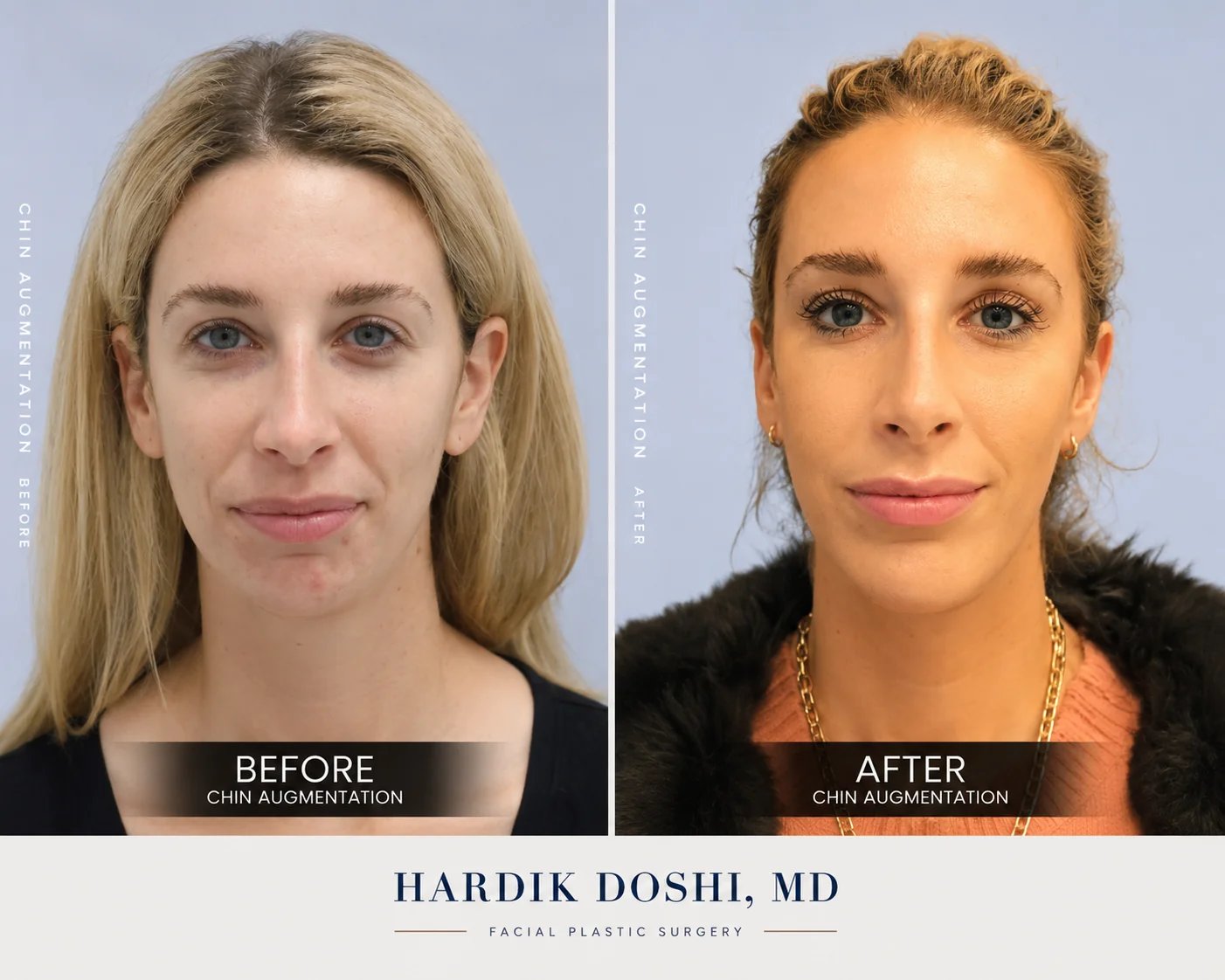
There are two primary incision approaches. The submental approach places the incision in the natural crease beneath the chin - approximately two to three centimeters in length - through which the implant pocket is created and the implant placed. The submental approach provides excellent access, allows precise pocket creation, and results in a scar that is hidden in the chin crease and is not visible when the head is in a level position. This is the more common approach for standalone chin augmentation.
The intraoral approach places the incision inside the mouth, along the inner lower gum line. This produces no external scar, which is advantageous for patients with concerns about any facial scar. The tradeoff is a higher incidence of implant displacement in some studies, and the intraoral environment introduces a different infection risk profile that requires specific post-operative oral hygiene protocols. Dr. Doshi selects the approach based on the implant size, the patient's anatomy, and whether other procedures are being performed simultaneously.
Implants are available in a range of sizes and profiles - horizontal projection, vertical height, and lateral width can all be customized to address the specific dimensional deficiency in each patient's chin. The implant selection is made during the consultation using clinical assessment and imaging. The goal is never a dramatic transformation but a correction of the proportion that makes the lower face look the way it should relative to the rest of the features.
The implant is positioned symmetrically over the chin bone and secured within its pocket by the surrounding tissue as healing occurs. In most cases, no additional fixation is required. The incision is closed in layers and the result of the pocket creation holds the implant in its correct position as the surrounding tissue integrates with the implant surface.
The Rhinoplasty-Chin Connection: When Both Are Needed
The combination of rhinoplasty and chin augmentation is one of the most impactful facial balancing procedures in facial plastic surgery, and it is more commonly indicated than patients typically expect when they first consult.
The reason is geometric. The nose and the chin together define the facial profile. When a patient's nose is the dominant feature of their profile - either because it is objectively large or prominent, or because the chin is recessed and creates the appearance of nasal dominance - addressing only the nose treats one side of the equation without the other. Patients who undergo rhinoplasty alone and whose chin projection was inadequate often find that the result, while improved, does not fully achieve the profile balance they were seeking.
The profile relationship that most patients intuitively recognize as balanced involves a nose whose projection is in proportion to a chin that anchors the lower face. When both structures are brought into proportion simultaneously - through rhinoplasty that reduces or refines the nasal projection and chin augmentation that increases the chin's anchor - the profile achieves a balance that a single-procedure approach rarely matches.
Some patients who consult specifically about rhinoplasty are told during the assessment that their nose is actually within normal proportional limits, and that the profile imbalance driving their concern is primarily a chin projection issue. For these patients, chin augmentation alone produces a more significant improvement in the profile result than rhinoplasty would. Dr. Doshi makes this assessment directly and honestly. The goal of the consultation is to identify what the anatomy actually requires, not to confirm what the patient arrived thinking they needed.
Chin Augmentation Versus Chin Filler: When Surgery Is the Right Answer
Injectable filler placed in the chin region has become a widely used non-surgical option for patients seeking improved chin projection. Understanding when filler is appropriate and when an implant is the better choice helps patients arrive at consultations with a more accurate framework for the decision.
Chin filler is appropriate for patients with mild chin recession who want to test the aesthetic direction of augmentation before committing to surgery, patients who want modest and temporary improvement without recovery, and patients whose chin concern is primarily about soft tissue volume rather than skeletal projection. Hyaluronic acid filler is reversible and lasts six to twelve months. For these patients, filler is a reasonable first step.
Chin filler is not appropriate as a long-term solution for patients with meaningful skeletal chin recession. The amount of filler required to match the projection achievable with an implant of appropriate size tends to be large, the risk of migration or irregularity increases with larger filler volumes in the chin, and the cost of repeated treatments over years exceeds the cost of a one-time implant. For patients who have already tried filler and found that the effect aligned with their goals, the implant provides a permanent version of that result.
Filler also cannot address the dimensional aspects of chin shape the way an implant can. Implants are available in profiles that address lateral chin width, vertical chin height, and horizontal projection independently. Filler produces generalized volumization that may not achieve the specific dimensional correction needed for a patient with a narrow or vertically deficient chin. The precision of an appropriately selected implant exceeds what injectable technique can reproduce.
Who Is the Right Candidate for Chin Augmentation at Doshi Plastic Surgery
The ideal chin augmentation candidate has a clearly defined lower facial imbalance - the chin recedes relative to the nose and lips, and this imbalance is a consistent observation across photographs, mirrors, and clinical assessment. The patient's concern is specific and anatomically verifiable rather than generalized dissatisfaction with the lower face.
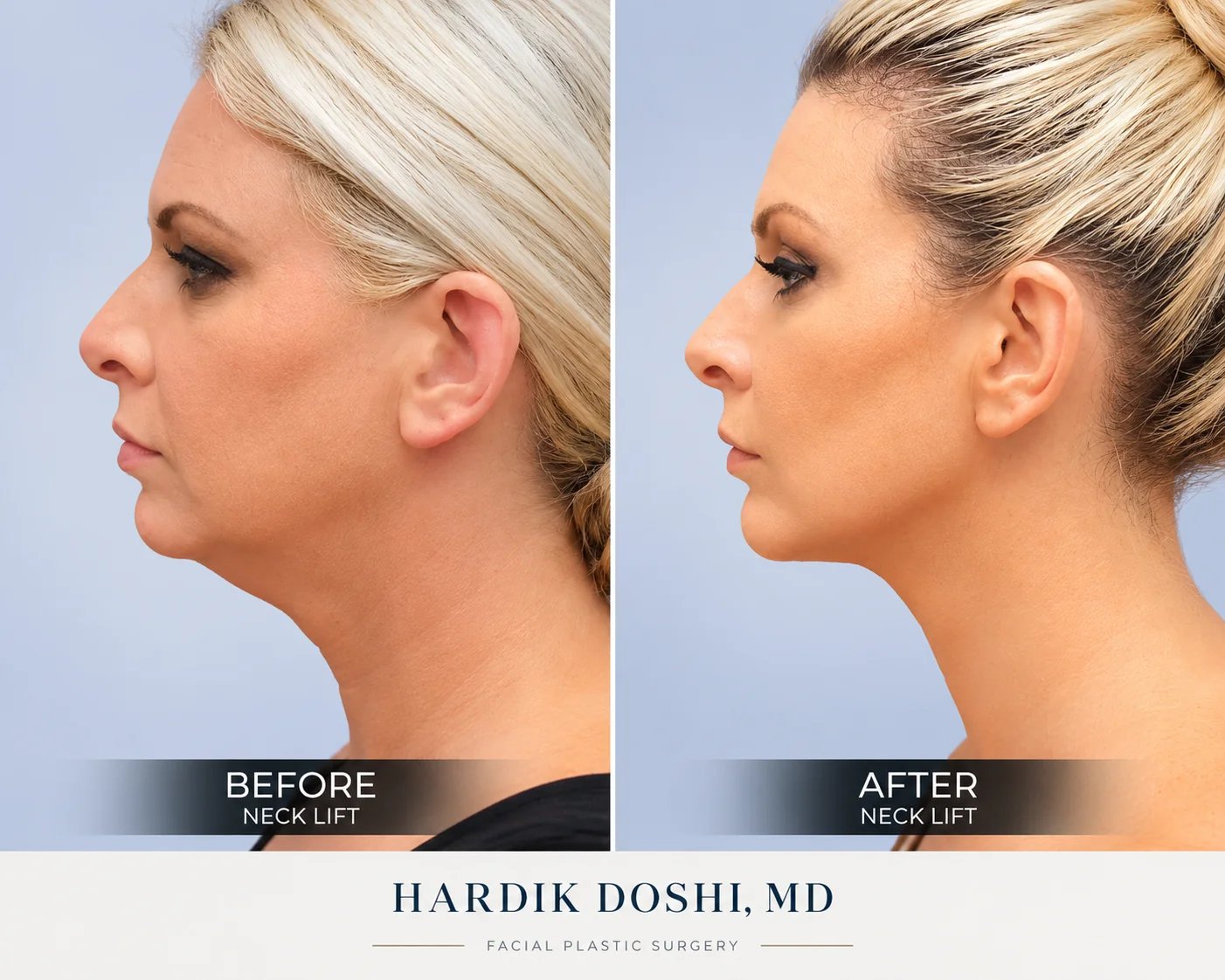
Patients of any age may be appropriate candidates. The procedure is performed in teenagers and young adults when facial growth is complete (typically around eighteen) through patients in their forties, fifties, and beyond. In older patients, chin augmentation is often combined with a neck lift or facelift - restoring lower facial projection alongside the structural correction of neck and facial aging produces a more balanced overall result than neck work alone.
Health considerations are standard for any surgical procedure. Patients should be non-smokers or committed to stopping before surgery, in stable general health, and free of conditions that significantly impair wound healing. Patients with dental issues - particularly those involving the lower front teeth or the gum tissue near the intraoral incision site if that approach is used - are evaluated carefully and may require dental clearance before proceeding.
Patients with unrealistic expectations about the magnitude of change that chin augmentation produces are counseled carefully. The procedure improves proportion. It does not transform the face. Patients who understand and accept this consistently report high satisfaction with their result.
Recovery: What to Expect Week by Week
Chin augmentation recovery is more straightforward than most patients expect and considerably shorter than recovery from rhinoplasty or facelift. The procedure is localized, the tissue disruption is limited to the chin region, and healing occurs efficiently.
In the first twenty-four to forty-eight hours, swelling and tightness in the chin and lower jaw are the primary sensations. The chin appears swollen and larger than the intended result - this is edema, not the implant. A pressure dressing is applied immediately after surgery and worn for the first twenty-four to forty-eight hours. A soft diet begins from the day of surgery: liquids, soft foods, nothing that requires significant chewing or jaw movement in the first week.
By day three to five, swelling is noticeably reducing and the chin area feels less tight. Bruising in the lower jaw and upper neck may be present but is typically modest compared to rhinoplasty or facelift bruising. Most patients feel well enough to move around comfortably at home from day three.
At ten to fourteen days, the majority of visible swelling has resolved and patients are socially presentable. The chin shows its early result - improved projection, better lower facial proportion. The soft diet restriction is typically relaxed by week two, with a gradual return to normal foods over the following days.
Final results are visible at six to eight weeks, when residual swelling has fully resolved and the soft tissue has settled around the implant. The chin feels firm in the first several weeks as the tissue integrates with the implant surface and then gradually becomes indistinguishable from the surrounding anatomy.
Risks and What Patients Should Understand
Chin augmentation is among the less risky facial plastic surgery procedures, but it carries a defined set of considerations that patients should understand before proceeding.
Implant displacement - where the implant shifts from its intended position - is the most common concern. Placement technique and pocket creation directly influence the risk. Implants placed in a well-formed, appropriately sized pocket with correct tissue coverage are significantly less likely to displace than those placed in poorly formed pockets. Most cases of minor implant asymmetry are not detectable in the final healed result. Significant displacement requiring repositioning is uncommon in experienced surgical hands.
Temporary numbness of the lower lip and chin skin is common after chin augmentation and results from the mental nerve, which passes near the chin, being stretched or compressed during pocket creation. In the vast majority of cases, this resolves over six to twelve weeks. Permanent numbness is uncommon.
Infection risk is present with any implant procedure. The risk is reduced by sterile surgical technique, perioperative antibiotics, and careful post-operative wound care. For the intraoral approach, strict oral hygiene is required to minimize bacterial contamination of the incision site.
Patients who are dissatisfied with the result - either because the implant is too large, too small, or not the right shape - can have the implant exchanged or removed. Reversibility is one of the practical advantages of a solid silicone implant over bone grafting approaches.