
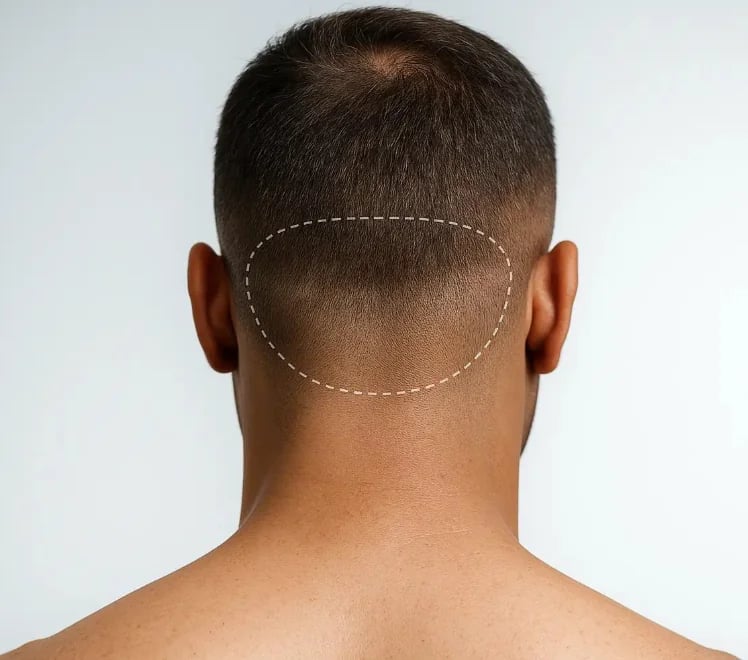
Nearly everything written about follicular unit extraction focuses on the transplanted area, how quickly new hair grows in, how dense the final result looks, and how natural it appears compared to the patient's original hairline. What gets far less attention, despite mattering enormously to anyone considering a second or third procedure down the line, is what actually happens to the donor site itself over the years following extraction, not just the standard six-to-twelve-month recovery window most content addresses, but the five, ten, and even twenty-year picture.
The One-Year Marker: Where Most Content Actually Ends
By one year following FUE, the donor area has typically completed its visible healing, with individual extraction sites no longer detectable to casual inspection even at relatively short hair lengths, assuming appropriately spaced, well-executed extraction technique. This is the point where most patient satisfaction surveys and marketing content effectively stop tracking the donor site, treating this one-year mark as the end of the relevant story, when in reality it's simply the end of the most actively visible healing phase, not the end of what actually matters about donor site health over time.
The Five-Year Marker: What Genuinely Stable Donor Density Looks Like
By five years, a well-managed donor area, meaning one where extraction was performed with appropriately conservative density and spacing rather than aggressively maximizing graft count from a single session, generally shows genuinely stable, healthy density with no significant additional visible thinning beyond what would be expected from ordinary aging in that same region. This is worth stating directly and specifically: the donor area itself, in patients whose extraction was performed conservatively, doesn't typically continue thinning progressively after the initial healing period concludes, since the follicles remaining in that region were never actually removed, only the specific follicles selected for transplantation were extracted, leaving the surrounding density intact.
Patients whose original extraction was more aggressive, harvesting a higher percentage of the donor area's total follicle count in pursuit of maximum graft yield for their initial session, may show more visible thinning at this five-year mark, not because additional hair loss has occurred, but because the donor area's baseline density was already reduced by the original extraction itself, becoming more apparent as hair styling or lighting conditions change over the intervening years.
The Ten-Year Marker: Where Age-Related Change and Extraction History Start to Overlap
This is genuinely the most complex marker to interpret accurately, since by ten years following an original FUE procedure, patients are also experiencing whatever natural, age-related changes their own hair would have undergone entirely independent of any prior extraction. Separating what reflects the original extraction's long-term effect from what reflects ordinary aging in that same scalp region requires careful, individualized assessment rather than a general rule applicable to every patient equally, similar to how our approach to preservation deep plane facelift planning distinguishes genuine structural change from ordinary aging elsewhere on the face.
For patients whose donor hair characteristics were genuinely resistant to the miniaturization process responsible for pattern baldness, the specific genetic trait that makes donor-area hair suitable for transplantation in the first place, this resistance generally continues holding at the ten-year mark as it did at five years, meaning the donor area itself remains relatively stable even as the patient's overall pattern of hair loss elsewhere on the scalp, if genetically predisposed to continue, may have progressed further during this same window.

The Fifteen-to-Twenty-Year Marker: What a Second Procedure Actually Encounters
For patients who pursue a second FUE procedure many years after their first, understanding what the donor area actually looks like at this extended timeframe matters directly to surgical planning. A well-managed original extraction generally leaves adequate remaining donor density to support a meaningful second procedure, assuming the surgeon planning that second session has an accurate picture of exactly how much was extracted originally and how much remains, information best confirmed through direct examination rather than assumed based on how much time has simply passed since the first procedure.
This is precisely why the budget-allocation approach to graft planning, treating total donor supply as a finite resource to be allocated deliberately across present and likely future need rather than maximized in a single session, matters so directly to this extended timeline. A patient whose first procedure was planned with this longer horizon in mind generally arrives at the fifteen-to-twenty-year mark with meaningfully more remaining donor resource than a patient whose first procedure extracted as much as technically possible without this same forward planning.
Why Extraction Pattern, Not Just Total Count, Determines This Long-Term Picture
It's worth being specific about a technical detail that matters enormously to this entire multi-decade picture: how extraction sites are spaced across the donor area affects long-term donor health independent of the total number of grafts removed. Evenly, conservatively spaced extraction, even when it adds up to a substantial total graft count across multiple sessions over the years, generally preserves a more natural, evenly distributed remaining density than concentrated extraction in a smaller area, even if that concentrated approach removes a similar total number of grafts. This is genuinely a surgical planning decision made at the time of extraction, not something a patient can meaningfully influence after the fact, which is exactly why the specific technique and planning philosophy of the surgeon performing your original procedure matters so directly to how your own donor area looks and functions decades later.
What Genuinely Concerning Donor Site Changes Actually Look Like
Given the generally stable picture described throughout the markers above, it's worth being specific about what would actually represent a concerning departure from this expected pattern, since most donor site change patients notice over the years reflects the normal, expected picture rather than anything requiring evaluation. Localized areas of scarring becoming more visible or raised over time, rather than the typically flat, well-healed appearance expected from properly executed FUE extraction, patchy, uneven thinning specifically concentrated in the donor area rather than reflecting broader, symmetric aging patterns, or any new tenderness or irritation in the donor region years after the original procedure, are all reasonable reasons to seek direct evaluation rather than assuming they represent normal long-term variation.
What a Long-Term Donor Site Evaluation Actually Involves
For patients specifically curious about their own donor area's long-term status, whether considering a second procedure or simply wanting a clearer picture of their own scalp health, a thorough evaluation includes direct visual and tactile examination of the donor region, assessment of remaining density compared to what would be expected given the original procedure's extraction pattern, and an honest conversation about how much donor resource genuinely remains available for any future procedure under consideration.
Dr. Doshi's approach to FUE planning specifically incorporates this multi-decade perspective from the outset of a patient's very first procedure, treating donor site preservation as a genuine long-term priority rather than a secondary consideration behind maximizing the first session's immediate visible result. This means conversations about total available donor supply, realistic extraction spacing, and how a given session's plan affects donor health at the five, ten, and twenty-year marks discussed throughout this piece are built into initial consultations, not introduced only once a patient returns years later wondering what remains available to them.
For patients specifically planning around this kind of extended timeline, our hair transplant planning process incorporates donor site preservation from the very first consultation. Patients whose hair loss history includes chemotherapy or another non-genetic cause, discussed in more detail in our related content on restoring hair after cancer treatment, face a somewhat different donor site consideration worth discussing directly given the different underlying cause involved.
Those earlier in their own planning process, still weighing how many sessions and how much total extraction makes sense for their specific goals, may also find it useful to review our broader hair restoration overview before their first consultation.
The donor area you have five, ten, and twenty years from now is largely determined by decisions made during your very first procedure, which is exactly why that first conversation matters as much as it does.