The position of the brow has a disproportionate effect on how the upper face reads. A well-positioned brow frames the eye and projects an expression of alertness and energy. A brow that has descended even a few millimeters creates an entirely different impression - one of fatigue, heaviness, or age - regardless of what the eyes themselves look like. Patients frequently describe feeling that they look tired even when they are not, or that their expression appears harder or more serious than they actually feel.
Brow lift surgery is the procedure designed to address this. Dr. Hardik Doshi is a double board-certified facial plastic surgeon with practices in Long Beach, Huntington, and Manhattan who performs brow lift surgery for patients on Long Island and the greater New York area. What follows is a comprehensive explanation of what the procedure involves, which patients benefit from it, how the different techniques compare, and what recovery and results look like.
What Happens to the Brow With Age
The brow occupies a position that is subject to two competing forces: the muscles that pull it upward and the muscles that pull it downward. In youth, this balance is well-maintained and the brow sits at or slightly above the orbital rim, with a gentle arch that is ideally positioned to frame the eye. Over time, several changes shift this balance unfavorably.
The skin of the forehead loses elasticity and begins to descend. The subcutaneous fat that supported the brow from beneath diminishes. The muscles responsible for elevating the brow weaken relative to the depressor muscles, which remain robust and continue pulling the brow downward. The combined effect is a brow that sits progressively lower, creating a smaller-looking upper eyelid space and a heavier, more hooded appearance along the lateral brow tail.
The descent is not uniform. The lateral portion of the brow, the outer tail that arches above the eye, typically descends first and most significantly. This creates the classic appearance of a heavy lateral brow hood that obscures the outer third of the upper eyelid. The medial brow, closer to the nose, often holds its position longer but can descend in some patients as well, creating a flatter or more horizontal brow shape.
Forehead lines develop simultaneously as the frontalis muscle, the primary brow elevator, works harder to compensate for the descending brow. Patients who are chronically raising their brows to keep them out of their visual field develop horizontal lines across the forehead as a consequence of this overactivity. Glabellar lines, the vertical lines between the brows, result from the action of the corrugator and procerus muscles.
A brow lift addresses the underlying structural cause of these changes rather than treating the skin surface alone.
Who Is a Good Candidate for Brow Lift Surgery
The ideal candidate for a brow lift is a patient whose brow has descended below an aesthetically and functionally appropriate position and whose concerns are not adequately addressed by non-surgical options. Several specific presentations make brow lift surgery the right choice.
Patients with visible lateral brow hooding are among the most straightforward candidates. When the outer brow has descended to the point where it creates a heavy fold over the lateral upper eyelid, non-surgical treatments cannot reposition the tissue effectively. The fold is structural, not just a skin problem, and surgical elevation of the brow is the appropriate solution.
Patients with deep forehead lines that have not responded adequately to neuromodulator treatments may benefit from a brow lift that reduces the tension driving those lines. If the frontalis muscle is working constantly to elevate a heavy brow, the lines it creates are resistant to Botox because the muscle cannot be fully relaxed without the brow dropping further. Elevating the brow surgically reduces the demand on the frontalis and allows neuromodulators to be more effective as a maintenance treatment afterward.
Patients with a heavy or flat brow shape that communicates unintended emotional states are also candidates. The expression the face projects at rest is determined in large part by the brow. A brow that sits too low can make a patient look angry, tired, or sad in ways that do not reflect their actual state. Surgical repositioning corrects the structural basis of this impression.
Health-related candidacy criteria are similar to those for other facial procedures. Patients should be non-smokers, in stable general health, and free of conditions that significantly impair wound healing. A thorough medical history review is part of every consultation.
Non-Surgical Brow Lifting: What Works and What Does Not
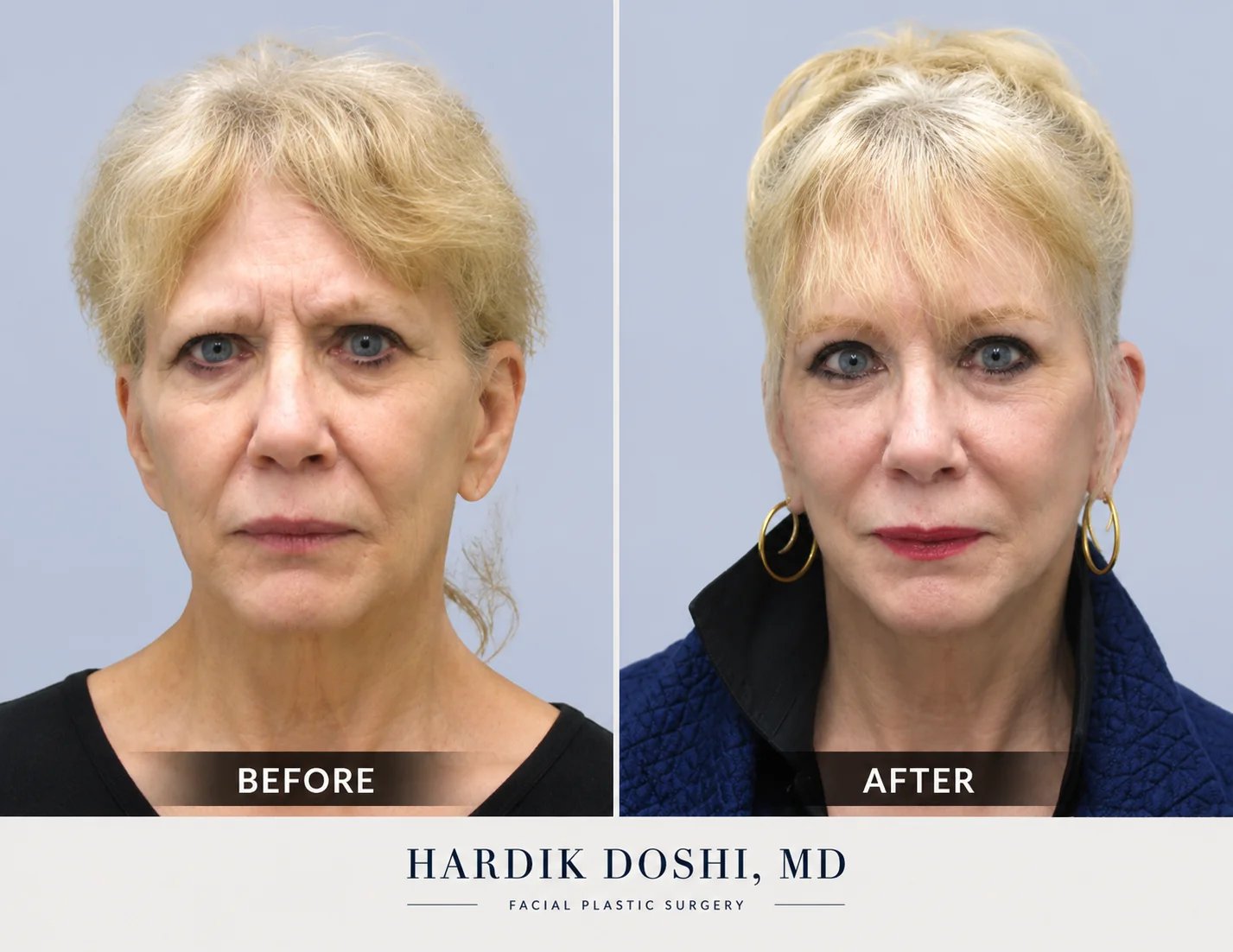
Patients frequently ask whether Botox or other non-surgical treatments can accomplish what a brow lift achieves surgically. This is a reasonable question and deserves a direct, honest answer.
Botox can produce a modest brow elevation in patients with early or mild descent. By relaxing the depressor muscles, particularly the orbicularis oculi laterally, the frontalis is left with less opposition and the brow rises slightly. The improvement is real but limited, typically in the range of two to three millimeters of lateral brow elevation, and it lasts as long as the Botox effect, approximately three to four months. For patients at the early stages of brow descent who want to test the aesthetic direction or bridge time between more significant changes, this is a reasonable approach.
Threads and energy-based devices such as ultrasound or radio frequency offer more lift than Botox but still fall short of surgical results in patients with meaningful descent. These treatments can tighten the overlying skin and produce modest repositioning, but they cannot replicate the structural repositioning achieved by an endoscopic or open brow lift. They are best viewed as maintenance tools or as options for patients who are not yet appropriate surgical candidates.
When brow descent is clinically significant and the patient's goals require durable, meaningful improvement, surgery is the appropriate answer. Understanding where a patient falls on this spectrum is part of what Dr. Doshi assesses during the consultation.
Brow Lift Techniques: Endoscopic Versus Open
Brow lift surgery is not a single standardized operation. There are several techniques, each with specific advantages and limitations. The choice of technique depends on the degree of brow descent, the hairline position, the patient's anatomy, and the specific concerns being addressed.
The endoscopic brow lift is the most commonly performed technique for patients with mild to moderate brow descent and a favorable hairline position. It uses three to five small incisions placed within the hairline, through which a small camera and specialized instruments are inserted. The forehead tissue is elevated and the brow is repositioned and secured in its new position using fixation devices anchored to the skull. The incisions are small enough to heal with minimal visible scarring, and the recovery is generally shorter than with open approaches. The endoscopic approach is technically demanding and requires specific training and equipment, but it offers excellent results with less tissue disruption when performed by an experienced surgeon.
The open or coronal brow lift uses a longer incision placed across the top of the scalp, typically within or just behind the hairline. This provides wider exposure of the forehead and allows greater adjustment of the soft tissue, making it appropriate for patients with more significant brow descent or forehead skin redundancy. The tradeoff is a longer scar and the potential for a slight posterior shift of the hairline. For patients with a low hairline who have significant descent, this tradeoff is often acceptable. A pretrichial variation of the open approach places the incision just at the hairline border, allowing brow elevation without raising the hairline, which is particularly relevant for patients with already high hairlines.
Dr. Hardik Doshi selects the technique after a thorough assessment of the brow position, hairline, forehead length, and degree of laxity. The goal in every case is to achieve a natural-looking result that neither overcorrects to an arched or surprised appearance nor undercorrects to the point that the benefit is not meaningful.
The Consultation for Brow Lift at Doshi Plastic Surgery
The brow lift consultation at Doshi Plastic Surgery begins with a detailed evaluation of the upper face as a whole. Dr. Doshi assesses the current position of both the medial and lateral brow, the degree of lateral hooding, the forehead length, the hairline position, and the condition of the skin overlying the forehead and upper eyelid area.
This evaluation is important because the brow and upper eyelid are anatomically adjacent and their contributions to the aging upper face must be distinguished. Skin redundancy in the upper eyelid can result from descent of the brow as well as from excess upper eyelid skin directly. Treating only the upper eyelid when the brow has descended produces an incomplete result. Treating only the brow when true upper eyelid excess is also present similarly underserves the patient.
Dr. Doshi maps these contributions clearly and recommends the approach that addresses the actual anatomical basis of the concern. Patients who come in thinking they need an upper eyelid lift sometimes need a brow lift instead, and vice versa. In some cases, both are appropriate. The consultation is the mechanism for making this determination accurately.
Patients are also given realistic information about what the procedure can and cannot achieve. A brow lift can restore a youthful brow position and reduce forehead lines. It cannot change the underlying skin quality, correct concerns in other facial regions, or stop the aging process. Patients who understand this clearly are consistently more satisfied with their results than those who arrive with broader expectations.
What Brow Lift Surgery Involves: A Step-by-Step Overview
Brow lift surgery at Doshi Plastic Surgery is performed as an outpatient procedure in an accredited surgical facility. General anesthesia or IV sedation is used depending on the extent of the procedure and the patient's medical history.
For an endoscopic brow lift, the procedure begins with small incisions placed within the hairline. A camera is introduced to allow the surgeon to visualize the tissue planes beneath the forehead skin. The periosteum, the fibrous layer overlying the bone, is released to allow the forehead tissue to be elevated freely. Muscle tissue responsible for forehead lines and brow depression is addressed at this stage. The brow is then repositioned to the target height and secured using small absorbable or permanent fixation devices anchored to the bone. Incisions are closed and covered.
For an open approach, the incision across the scalp allows direct visualization and access to the entire forehead. Excess tissue is removed, the brow is elevated and secured, and the scalp is closed in layers.
Total operative time for a standalone brow lift typically ranges from one to two hours. When combined with other procedures such as upper blepharoplasty, the total time increases accordingly. Patients are discharged the same day and cared for by their designated support person during the initial recovery period.
Brow Lift Recovery: A Timeline
The recovery from brow lift surgery follows a predictable arc. Understanding what each phase looks like allows patients to plan appropriately and reduces unnecessary concern during the healing process.
In the first forty-eight to seventy-two hours, the most prominent sensations are tightness and pressure in the forehead and scalp. Swelling develops around the brow and upper eyelids and is often most pronounced on the second day. Bruising appears around the eyes in many patients. Pain is generally mild to moderate and is managed with oral medications. Head elevation during sleep and rest reduces swelling more quickly.
During the first week, swelling and bruising begin to fade progressively. Most patients feel well enough to move around at home by day three or four, though they are advised to rest and limit activity. Temporary sensory changes in the forehead and scalp, including numbness or tingling, are normal at this stage and resolve as the nerves recover over weeks to months.
By the end of the second week, bruising is typically resolved or nearly resolved in most patients. Swelling is significantly reduced, and the forehead feels less tight. Patients with desk-based work can generally return at this point. Incision sites are healing and beginning to mature.
At three to four weeks, most normal activities can resume, including moderate exercise. The results are increasingly visible as residual swelling continues to improve. Final results are apparent at six to eight weeks for most patients, with subtle improvements continuing for several months as the scalp and forehead tissues fully settle.
Results: What Brow Lift Surgery Achieves and How Long It Lasts
A well-performed brow lift produces a forehead and brow that appear rested, open, and appropriately youthful without an operated or surprised look. The goal is a natural position that suits the patient's facial proportions rather than an exaggerated arch that reads as surgical.
Specific improvements include elevation of the brow to a position that opens the upper eyelid space and eliminates lateral hooding, reduction of forehead lines as the tension driving them decreases, and a more refreshed overall upper facial appearance. In many patients, the eyes look larger and more alert simply because the brow is no longer bearing down on the upper eyelid space.
The durability of brow lift results depends on the technique used, the patient's genetics, and how the aging process continues in the years after surgery. Endoscopic brow lift results typically last five to eight years in most patients. Open approaches may last somewhat longer in patients with significant initial descent. In all cases, the natural aging process continues after surgery, and the brow will gradually descend again over time.
Patients can extend the durability of their results by using neuromodulators as maintenance after surgery to manage the depressor muscles, protecting the skin from UV exposure, and maintaining a stable weight. Dr. Doshi discusses a long-term plan with each patient that incorporates these considerations.
Risks and Complications Patients Should Know
Brow lift surgery carries a defined set of risks that are discussed with every patient before proceeding. A transparent account of these risks is part of what it means to be an informed patient.
Temporary numbness or altered sensation in the forehead and scalp is among the most common post-operative experiences. This results from the nerves being stretched or disturbed during the elevation process. In most cases, normal sensation returns over weeks to months. Persistent numbness beyond one year is uncommon.
Asymmetry in brow position can occur, though most cases of minor asymmetry resolve as swelling dissipates and the tissues settle. Significant asymmetry requiring revision is uncommon with experienced surgeons.
Hairline changes are a consideration with certain techniques. The coronal approach raises the hairline by the amount of scalp removed. For patients who are concerned about hairline position, the pretrichial incision or endoscopic approach is discussed as an alternative.
Scarring at the incision sites is present in all patients but is placed within or behind the hairline in most approaches and becomes minimally visible as healing progresses. Scar management with silicone and sun protection is discussed as part of the post-operative care plan.
More serious complications, including infection, prolonged swelling, or damage to the facial nerve, are rare with proper surgical technique and patient selection. Dr. Doshi reviews the complete risk profile during the consultation so that every patient proceeds with a full understanding of what the procedure involves.