
Male pattern hair loss follows one of the most predictable, well studied patterns in all of dermatology, and yet most men who search for a hair transplant arrive with a surprising amount of confusion about what the procedure actually involves, how their specific pattern of loss affects the plan, and what a realistic result looks like. This guide walks through men's hair transplantation on Long Island in detail, covering the biology of male pattern loss, how the classic Norwood pattern shapes surgical planning, technique selection, recovery, and what to expect at each stage of regrowth. Dr. Hardik Doshi evaluates each of these factors individually for male patients rather than applying a single generic template to every case.
Understanding Male Pattern Hair Loss
Androgenetic alopecia, commonly known as male pattern baldness, affects a majority of men to some degree over their lifetime, and it follows a genetically driven, hormone sensitive process. Hair follicles that are sensitive to dihydrotestosterone, a byproduct of testosterone, gradually shrink over successive growth cycles, producing shorter, finer hairs until the follicle eventually stops producing visible hair at all. This is fundamentally different from hair loss caused by stress, illness, or hormonal shifts, which is typically temporary and diffuse rather than following a defined pattern.
Male pattern loss almost always follows one of several recognizable patterns, most commonly described using the Norwood scale, a classification system that runs from an early, barely noticeable recession at the temples through advanced, near complete loss across the top of the scalp with only a horseshoe shaped band of permanent hair remaining at the back and sides. Understanding where a given patient falls on this scale, and more importantly, how far the pattern is likely to progress in the years ahead, is the single most important factor Dr. Doshi weighs when planning a successful hair transplant.
Why the Norwood Pattern Matters for Surgical Planning
The permanent hair at the back and sides of the scalp, known as the donor area, is genetically resistant to the hormonal process that drives pattern loss, which is exactly why hair transplanted from this area continues to grow normally once relocated to a thinning zone. This genetic resistance is the entire foundation of hair transplant surgery, but it also means the donor area itself is a finite, non renewable resource. A man with early Norwood stage loss has a very different long term planning conversation than a man who has already progressed to an advanced stage, since the earlier patient's hair loss is likely to continue progressing for years or decades, while the donor supply available to address that future loss remains fixed.
This is why a thoughtful surgical plan for a younger man with early pattern loss often looks deliberately different from a plan for an older man whose pattern has been stable for years. Dr. Doshi frequently recommends a more conservative approach to hairline placement and density for younger patients, preserving donor hair for likely future need, while older patients whose pattern has fully stabilized can often be planned more definitively during a consultation at Doshi Plastic Surgery, since the risk of significant additional loss surrounding a newly created hairline is much lower.
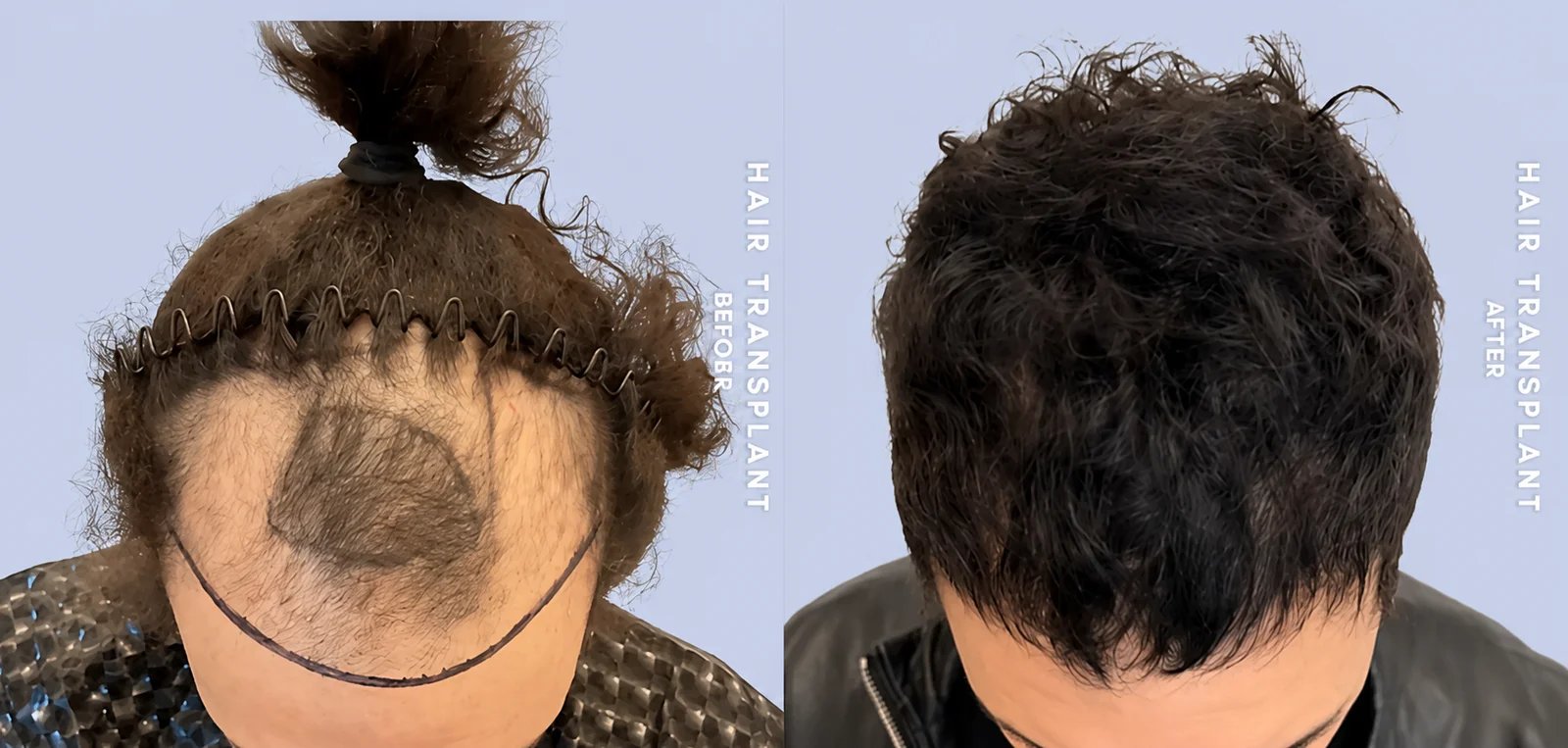
The Consultation: What Actually Gets Assessed
A hair transplant consultation with Dr. Doshi for male pattern loss involves a close examination of several specific factors, each of which shapes the surgical plan in a different way. Learn more about what to expect as a FUE hair transplant surgeon on Long Island.
Donor density and scalp laxity are assessed by examining the back and sides of the scalp closely, checking how many healthy follicular units are present per square centimeter and how easily the skin moves, since looser scalp skin allows for more efficient strip harvesting if that technique is selected. Hair caliber, meaning the actual thickness of individual hair shafts, is also assessed, since thicker hair provides more visual coverage per graft than fine hair, which affects how many grafts are needed to achieve a given density.
The pattern and stage of loss, using the Norwood scale as a reference framework, is evaluated alongside family history, since a father's or grandfather's pattern and rate of progression is one of the strongest predictors available for how a given patient's own hair loss is likely to progress. Scalp laxity, skin quality, and the presence of any scarring from prior procedures elsewhere are also assessed, since these all affect technique selection and expected results.
Finally, the conversation covers goals directly. Some men are focused primarily on restoring a receded hairline, others are more concerned with thinning at the crown, and many are dealing with both simultaneously. These are genuinely different surgical targets, and the graft allocation plan looks different depending on which area is prioritized.
FUE vs. FUT for Male Pattern Restoration
Two primary harvesting techniques are available for hair transplantation, and the right choice depends on a combination of hair length preference, scalp characteristics, and the number of grafts required.
Follicular Unit Extraction, or FUE, removes individual hair follicles directly from the donor area using a small punch tool, leaving tiny, dot like scars that are generally not visible even with very short haircuts. This makes FUE a strong option for men who prefer to keep their hair closely cropped or shaved, since there is no linear scar to conceal.
Follicular Unit Transplantation, or FUT, sometimes called strip harvesting, removes a thin strip of scalp from the donor area, which is then dissected into individual grafts under magnification before the donor site is closed as a single fine line. This line is well concealed under hair of moderate to longer length, making FUT a reasonable option for men who do not wear their hair extremely short and who may benefit from the technique's ability to harvest a large number of grafts efficiently in a single session.
Neither technique is universally superior. The decision comes down to individual hair length preference, the total number of grafts needed, scalp laxity, and how a patient wants to balance a single, larger session against potentially staged sessions over time. Dr. Doshi walks through both options directly during consultation rather than defaulting to a single preferred technique for every patient, and our FUE hair transplant guide covers the technique in additional detail.
How Graft Counts Are Determined for Male Patients
Graft count planning is one of the more individualized parts of the entire process, since it depends on the specific area being restored, the density being targeted, and the patient's own hair characteristics. A hairline restoration alone might require several hundred grafts, while a more extensive restoration addressing both the hairline and crown can require considerably more, sometimes performed across more than one session to manage donor supply responsibly and allow the surgeon to assess how the first session settles before committing further grafts.
Coarse or curly hair provides more visual density per graft than fine, straight hair, which is one of the reasons two men with the same graft count can end up with visibly different final density. Dr. Doshi discusses this directly during consultation so expectations are set around your own hair characteristics rather than a generic average.
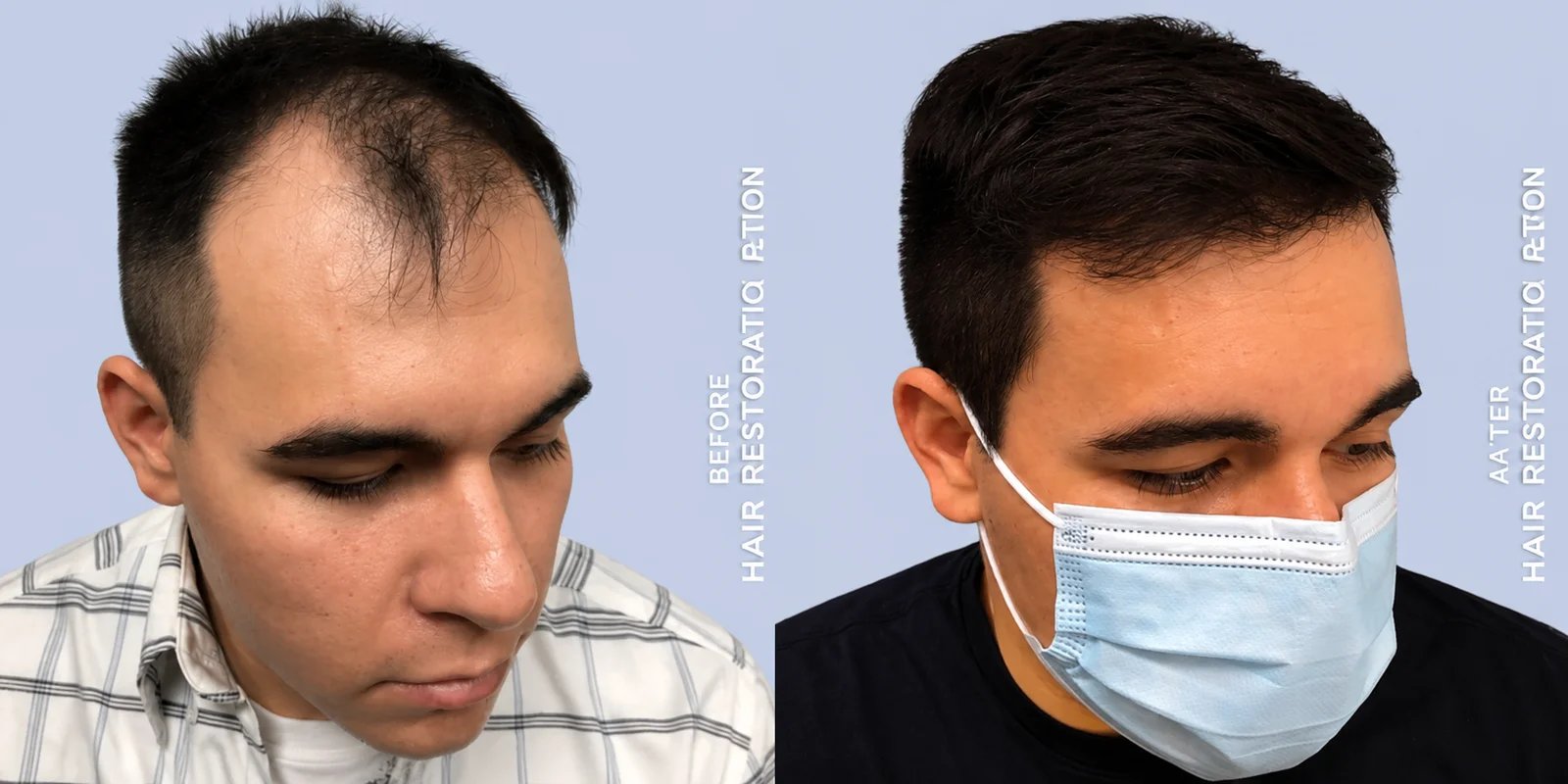
Designing a Natural, Age-Appropriate Hairline for Men
One of the more common concerns male patients raise, often without saying it directly, is the fear of ending up with a hairline that looks obviously artificial, either too straight, too low, or too dense compared with the surrounding native hair. A natural male hairline is not a straight line at all. It has soft, subtle irregularity along its edge, individual finer hairs placed at the very front border, and a gradual increase in density moving backward that mimics how hair actually grows in a man who has never experienced any loss.
Hairline height and shape are also planned with age and future loss in mind. A hairline set too low or too dense on a younger man can end up looking disconnected years later if the surrounding native hair continues to recede naturally while the transplanted hairline itself stays fixed in place, since transplanted hair does not carry the same genetic sensitivity to hormonal hair loss that the surrounding, untreated native hair does. Dr. Doshi plans conservatively for younger patients, and more definitively for older patients whose pattern has already stabilized, which is central to a result that continues to look appropriate as a man continues to age. Our permanent hair transplant guide covers this long term planning approach in more depth.
What Actually Happens on Procedure Day
Hair transplantation with Dr. Doshi is performed under local anesthesia, and most male pattern procedures take between four and eight hours depending on the number of grafts and the technique selected. Patients remain awake and comfortable throughout the procedure, often watching a movie or listening to music during the harvesting and placement process. Most men return home the same day.
The procedure itself involves two distinct phases. First, grafts are harvested from the donor area, either through individual extraction with FUE or through strip removal with FUT. Second, tiny recipient sites are created in the thinning areas, and the harvested grafts are placed individually, one at a time, with careful attention to the natural angle and direction each hair would grow if it had never been transplanted, since matching this natural angle is one of the most important technical factors in how convincingly the result blends with surrounding hair.
Recovery Week by Week
Recovery from a male hair transplant follows a fairly predictable timeline, though individual healing varies somewhat.
In the first one to three days, mild scalp tightness and swelling are common, and this swelling can temporarily migrate down toward the forehead and even around the eyes in some patients before resolving within several days.
Between days four and ten, small scabs form around each individual transplanted graft and gradually flake off on their own. It is common, and completely normal, for the transplanted hairs themselves to shed during this window, a process sometimes called shock loss. This does not mean the transplant failed. The follicle remains alive beneath the skin even as the visible hair sheds temporarily, and new growth begins later once the follicle resets its natural growth cycle.
From roughly week three through week twelve, the scalp enters what is often described as a dormant period, where very little visible change occurs even though the transplanted follicles are resetting internally in preparation for new growth. This stretch is often the hardest part of the entire process psychologically, precisely because so little seems to be happening despite the procedure having gone well.
Between months three and six, new hair growth becomes visible, typically fine and somewhat sparse at first. Between months six and twelve, that hair continues to thicken and fill in, with most men seeing sixty to eighty percent of their eventual result by around month nine. Final density and thickness are generally reached between month twelve and eighteen.
Combining a Hair Transplant with Medical Therapy
For many male patients, particularly those whose pattern loss is still actively progressing in areas that were not part of the transplant plan, combining surgical restoration with ongoing medical management makes sense. A hair transplant restores hair in the specific area it addresses, but it does not change the underlying genetic and hormonal process still affecting the native, untransplanted hair elsewhere on the scalp. Dr. Doshi discusses appropriate medical therapy, including PRP therapy, alongside your transplant plan to help protect the investment in your surgical result by slowing further loss in the surrounding native hair.
Common Concerns Male Patients Raise During Consultation
A few concerns come up often enough in male consultations that they deserve direct attention.
Many men ask whether the transplant will be noticeable to others. When planned with attention to natural hairline design, appropriate density gradients, and correct hair angle, a well executed transplant is designed to be indistinguishable from a man's natural growth pattern, not an obviously artificial addition.
Many men also ask about activity restrictions, particularly around exercise and sports, since an active lifestyle is often part of daily routine. Strenuous exercise is generally restricted for one to two weeks following the procedure, since elevated blood pressure and heavy sweating can affect the healing grafts during this early window, after which normal activity typically resumes without restriction.
Sun exposure on the healing scalp is another common question, particularly for men who spend time outdoors. Direct sun exposure is generally minimized for several weeks after the procedure, with a hat recommended once the surgeon confirms it is safe to wear one without disturbing the healing grafts.
Is a Hair Transplant Right for Every Pattern of Male Hair Loss?
Not every man with thinning hair is an ideal transplant candidate, and Dr. Doshi will say so directly during an honest consultation when that is the case. Men with a donor area that is already significantly thinned, whether from advanced pattern loss or from prior procedures elsewhere, may not have sufficient donor supply to achieve the density they are hoping for. Men whose loss has not yet stabilized, meaning further significant loss is likely in the near future, may benefit from a period of medical management first, or from a more conservative initial surgical plan that leaves room for a later session once the pattern becomes more predictable.
Common Misconceptions Male Patients Have About Hair Transplants
A few misunderstandings come up often enough in male consultations that they deserve direct attention.
One common misconception is that a hair transplant stops hair loss everywhere on the scalp, not just in the treated area. It does not. A transplant relocates permanent, hormone resistant follicles into thinning zones, but it does nothing to change the biology of the native hair that remains in areas outside the treatment. This is exactly why many men benefit from pairing surgery with appropriate medical management, particularly if their pattern of loss is still actively progressing in areas the transplant did not address.
Another common misconception is that a higher graft count automatically produces a better result. In reality, graft placement, density distribution across the treated area, and the natural angle at which each hair is placed matter just as much as the raw number of grafts, sometimes more. A carefully planned session using a moderate graft count can look considerably more natural than a larger session where placement and hairline design were rushed or poorly executed.
A third misconception is that results appear quickly. As the recovery timeline makes clear, meaningful visible growth does not begin until around month three or four, and the full result takes closer to a year to fully mature. Men who expect a dramatic, immediate transformation are often the ones who struggle most with the quiet, uneventful middle months of recovery, simply because they were not told in advance to expect that stretch.
Finally, some men assume that any hair transplant clinic, regardless of who is performing the actual harvesting and placement, will produce comparable results. This is not accurate. Hair transplantation is a surgical procedure that depends heavily on individual technique, particularly around graft handling, angle matching, and hairline design. A significant difference in outcome can exist between an experienced, hands on surgeon and a high volume clinic where much of the actual procedure is delegated to less experienced technicians.
Choosing the Right Surgeon for Male Pattern Restoration
Because so much of a hair transplant's final result depends on surgical judgment rather than the technology used, choosing the right surgeon matters more for this procedure than for almost any other cosmetic surgery decision. Our broader guide on men's facial plastic surgery on Long Island covers similar vetting considerations across other male focused procedures.
A surgeon's direct, hands on involvement in your specific procedure is worth clarifying upfront, since some high volume clinics rely heavily on technicians for the actual graft placement, with the surgeon playing a more limited supervisory role. Understanding exactly who will be performing which part of your procedure before you commit is a reasonable and important question to ask during consultation.
Reviewing before and after photos of male patients specifically in Dr. Doshi's men's hair transplant gallery, ideally with a hair type and starting pattern similar to your own, gives a more accurate sense of what is achievable for your particular situation than reviewing a general portfolio that may lean heavily on the most dramatic or favorable cases available.
Asking directly about the surgeon's approach to hairline design for male patients, including how they think about long term aging and future hair loss when planning where to place a new hairline, is also worth doing, since this single planning decision has more long term impact on how natural a result looks over the following decades than almost any other factor in the entire procedure.
Find Out What Your Own Pattern of Loss Actually Requires
Every man's pattern of hair loss, donor supply, and hair characteristics are different, which is why a personalized, in person assessment with Dr. Doshi is the only reliable way to determine the right surgical plan. Patients who have had prior hair transplant procedures elsewhere can review hair transplant scar revision, and patients weighing the cost of surgery can learn about financing options.