
When patients visit Doshi Plastic Surgery for a facelift consultation, Dr. Hardik Doshi often spends more time examining the neck than the face. The neck, in his view, is not a secondary concern or an afterthought to be addressed once the face is done. It is frequently the primary driver of visible aging and, in many cases, the reason a patient looks older than they feel. The disconnect between how someone experiences themselves and how they appear to others is almost always rooted in the lower third of the face and the neck.
Despite this, neck lift surgery remains one of the least understood procedures in facial plastic surgery. Patients arrive having researched facelifts extensively and having barely considered the neck at all. Or they arrive convinced they need liposuction when the actual problem is muscle laxity. Or they arrive having already had a procedure elsewhere that addressed only one part of a multi-component anatomy and produced a result that looks operated on rather than restored.
Dr. Doshi, double board-certified by the American Board of Facial Plastic and Reconstructive Surgery (ABFPRS) and the American Board of Otolaryngology (ABOto), treats the neck as an integrated anatomical system. What follows is an honest account of what neck lift surgery actually involves, how Dr. Doshi approaches patient selection, what the procedure can and cannot realistically accomplish, and why most patients who would benefit from it tend to wait far longer than they should.
The Anatomy of Neck Aging: Why the Neck Gets Old Faster Than the Face
The neck ages through four distinct but interrelated mechanisms, and understanding the difference between them is essential to understanding why a single procedure does not solve all neck problems for all patients.
The first mechanism is skin laxity. The skin of the neck is thinner than facial skin and has fewer sebaceous glands, which means it loses elasticity earlier and more dramatically. Sun exposure, weight fluctuations, and the natural decline of collagen and elastin production all accelerate this process. When skin laxity is the dominant issue, the neck develops a creped, loosened texture and a soft, undefined jawline.
The second mechanism is submental fat accumulation. Beneath the chin and in the submental triangle sits a compartment of fat that is partly genetic in distribution and partly responsive to overall body weight. In some patients, this fat accumulates regardless of their general fitness level. It creates what is commonly called a double chin or a heavy neck, and it is the one component that can in certain cases be addressed with liposuction alone, provided the skin has sufficient elasticity to redrape once the volume is removed.
The third mechanism is platysmal banding. The platysma is a broad, flat muscle that spans the neck from the chest upward to the lower face. With age, the central edges of the platysma separate and become visible as vertical bands running from the chin down toward the chest. These bands are among the most visible signs of neck aging and are frequently the reason a patient looks noticeably older. No amount of liposuction or skin removal addresses platysmal banding because the problem is muscular, not cutaneous.
The fourth mechanism involves the deeper structures: the digastric muscles and the submandibular glands. In some patients, the digastric muscles, which run from the chin to the hyoid bone, hypertrophy or become prominent with age. The submandibular glands, which sit just beneath the lower jaw, can descend and become visible as fullness along the lower border of the mandible. Both of these issues can contribute to a heavy, poorly defined neck contour even in patients who are not overweight and who do not have significant platysmal banding.
Most patients who arrive for a neck consultation have a combination of two or more of these issues. The diagnostic conversation that Dr. Doshi has with each patient is therefore not simply about deciding whether to do surgery; it is about identifying precisely which anatomical components are contributing to the appearance and designing an approach that addresses each of them specifically.
The Procedural Options: Liposuction, Platysmaplasty, and the Full Neck Lift
Not every neck problem requires the same surgery, and one of the most important things a surgeon can do in a consultation is help a patient understand why a simpler or more limited approach may not deliver the result they are looking for.
Submental liposuction is appropriate for a narrow subset of patients: those who are younger, typically in their thirties or forties, whose primary issue is isolated submental fat, and whose skin has sufficient residual elasticity to contract and redrape after the fat is removed. When this procedure is chosen for the right patient, the result can be dramatic. When it is chosen for a patient who also has skin laxity or platysmal banding, the result often reveals those problems more clearly than before by removing the volume that was softening them.
Platysmaplasty refers specifically to repair of the platysma muscle. During this procedure, the central edges of the platysma are brought together and sutured, eliminating the visible banding and restoring a smoother, more continuous muscular hammock beneath the chin. Platysmaplasty is performed through a small incision beneath the chin and can in some cases be combined with submental liposuction without the need for incisions around the ear. This combination, sometimes called a mini neck lift or anterior neck lift, is a genuinely useful procedure for the right candidate, but its limitations must be understood clearly: it does not address lateral neck skin laxity, it does not redrape the skin over the lower jaw, and it will not produce the same degree of improvement as a full neck lift for patients with moderate to significant skin excess.
A full neck lift combines submental work, including fat management and platysmaplasty, with incisions that extend behind the ear and into the hairline. These posterior incisions allow the surgeon to lift and redrape the skin of the lateral neck, address laxity along the lower jaw and jawline, and produce a result that is comprehensive rather than partial. For most patients who are dealing with the visible signs of neck aging in their fifties, sixties, and beyond, a full neck lift is the procedure that delivers the outcome they are describing when they say they want to look like themselves again.
The decision between these approaches is not about cost or convenience. It is about matching the anatomical problem to the procedure that actually addresses it. Dr. Doshi will not perform a lesser procedure on a patient who needs a more comprehensive one simply because it is easier to agree to. The goal is a result that holds up over time and looks natural, not a result that produces initial satisfaction followed by disappointment when the limitations of an underpowered approach become visible within two years.
The Neck Lift and the Facelift: When They Should Be Done Together
One of the most common questions in a neck lift consultation is whether the procedure should be combined with a facelift. The honest answer is that for the majority of patients who are candidates for a full neck lift, combining it with a facelift produces a more harmonious and longer-lasting result than either procedure does alone.
The reason is anatomical continuity. The face and neck do not age in isolation. The jowls descend as the same ligaments and soft tissue structures that support the midface lose their integrity. The platysma, which Dr. Doshi addresses during neck lift surgery, is the same muscle that connects to the SMAS layer of the face. Addressing only the neck while leaving the jowls and midface untreated can produce a result that looks incongruous: a tightened, youthful-looking neck beneath a face that still shows significant descent.
Conversely, performing a facelift without addressing the neck in a patient who has significant platysmal banding or submental fullness can produce an equally mismatched result. This is why Dr. Doshi's approach to any consultation involving lower face and neck aging begins with a holistic assessment rather than a menu of isolated procedures.
There are patients for whom an isolated neck lift makes sense. Younger patients, typically in their forties or early fifties, who have begun to develop submental fullness and early platysmal banding but whose midface and cheeks remain largely youthful may benefit more from addressing the neck selectively than from a full combined procedure. Dr. Doshi makes this recommendation based on what he actually sees during examination, not on a general bias toward doing more surgery or less surgery.
For patients who have already had a facelift and are experiencing recurrence in the neck specifically, an isolated revision neck lift may be appropriate. These cases require a careful assessment of what was done in the original surgery, where the incisions were placed, and what tissue planes were addressed, so that the revision can be planned in a way that does not compromise the prior result.
How Neck Aging Differs in Men and What That Means for Surgery
Male and female neck anatomy differ in ways that matter surgically. Male skin is thicker and more sebaceous, which means it ages somewhat differently and has different tensile properties during and after surgery. Male platysmal muscles tend to be more robust, which can make platysmaplasty both more important and more technically demanding. Male patients also have beard-bearing skin that extends toward and behind the ear, which places specific constraints on where incisions can be made without displacing hair-bearing skin into areas where it should not be.
Men also tend to present later than women. The cultural conversation around facial aging and surgical intervention has historically been more active among women, and many male patients arrive at a consultation only after the changes in their neck have become significant enough to affect how they perceive themselves in professional contexts or in photographs. By this point, the anatomical changes are often more advanced than they would be if the patient had sought evaluation earlier.
Dr. Doshi treats a meaningful proportion of male patients at Doshi Plastic Surgery and approaches their consultations with an understanding that the priorities are somewhat different. Male patients typically want a result that is not detectable as a surgical result. They want to look better and more energetic, not to look like they have had surgery. This requires conservative tissue repositioning, careful attention to where incisions are hidden within the hairline and the natural ear contours, and an honest conversation about what is achievable versus what would require a degree of tightening that would look unnatural.
The GLP-1 and Weight Loss Patient: A Growing Category of Neck Lift Candidates
The widespread adoption of GLP-1 receptor agonists such as semaglutide has created a new and growing category of facial plastic surgery patient. These patients have often achieved substantial weight loss over a relatively short period of time. The metabolic benefits of this weight loss are significant. The cosmetic consequences in the face and neck can be profound and, for many patients, unexpected.
Rapid or significant weight loss depletes facial and submental fat volume, which can leave the skin of the neck without the internal structure it previously had. The result is skin laxity that is often disproportionate to the patient's age. Patients in their forties who have lost thirty, forty, or fifty pounds may present with a degree of neck skin laxity more typically associated with patients in their sixties. The underlying platysma may be relatively intact, but without the fat volume to support the skin from within, the tissue has nowhere to go.
Dr. Doshi sees a significant number of GLP-1 patients at both his Long Island and Manhattan offices. His advice for these patients is consistent: stabilize weight before proceeding with surgery. A neck lift performed while weight loss is still ongoing risks being undermined by continued changes in tissue volume. Once weight has been stable for several months, a comprehensive evaluation can determine what combination of procedures will produce the most durable and proportionate result.
For GLP-1 patients, the neck lift consultation also frequently involves a discussion of facial fat grafting or filler to restore volume that has been lost in the midface and around the jawline. These patients often need a combined approach that addresses both the excess skin of the neck and the volume deficit of the face, because treating one without the other can produce a result that looks incomplete.
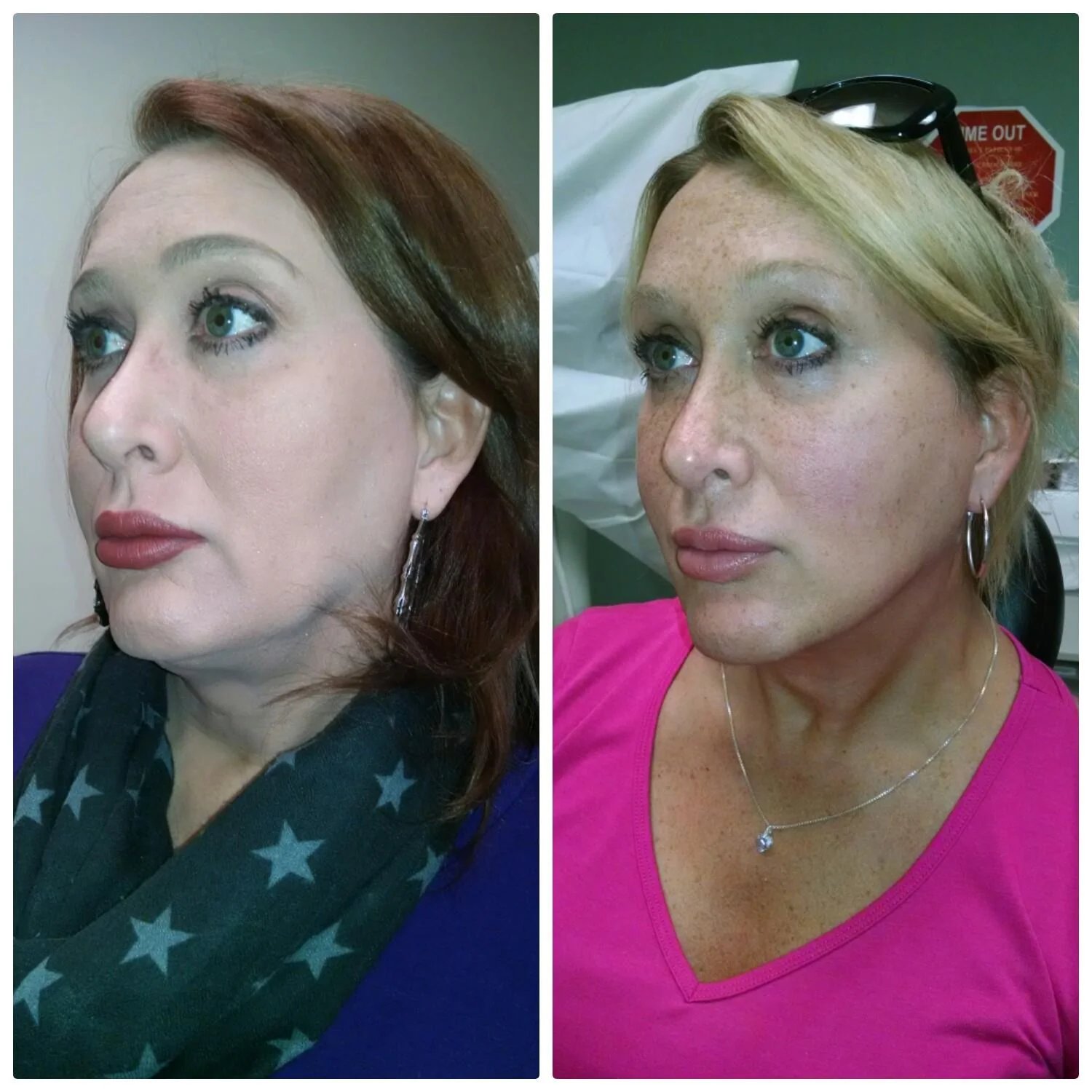
What the Surgery Actually Involves: A Patient-Level Account
A neck lift at Doshi Plastic Surgery is performed under general anesthesia or deep IV sedation, depending on the scope of the procedure and the patient's preferences and medical profile. The surgery takes approximately two to three hours for an isolated neck lift and longer when combined with a facelift.
The submental incision, made beneath the chin in a natural crease, is the access point for direct fat management and platysmaplasty. Through this incision, Dr. Doshi directly visualizes and removes or contours the submental fat, reapproximates the medial edges of the platysma, and in some cases addresses the digastric muscles or submandibular glands if they are contributing to the contour problem. This direct visualization is important: it allows for precise tissue management rather than the indirect approach of external-only treatments, which cannot reach or address the deeper anatomical issues.
When a full neck lift is being performed, incisions extend from the submental area around the earlobe and into the posterior hairline behind the ear. These incisions are placed carefully within natural contours so that once healed, they are not visible. The skin of the lateral neck is elevated, any residual laxity in the deeper tissues is addressed, and the skin is redraped under appropriate tension before being sutured closed. The goal of this redrapement is to restore the natural angle between the jaw and the neck, which in a youthful face is clean and defined and which in the aging face becomes obscured.
Dr. Doshi is personally involved in every aspect of his patients' surgical care. He does not perform part of a procedure and leave the remainder to a resident or assistant. This level of direct involvement is a meaningful differentiator in an environment where high surgical volume practices often delegate portions of procedures to less experienced team members.
Recovery: What Long Island and Manhattan Patients Should Realistically Expect
Recovery from a neck lift is manageable but requires genuine planning and a realistic understanding of the timeline. The first three to five days involve the most acute discomfort: swelling, tightness along the neck and jaw, and some bruising that is typically more visible in the neck than in the face. Most patients describe the sensation during this period as pressure rather than sharp pain, and it is well controlled with the medications provided.
A compression garment is worn for the first one to two weeks to support the healing tissues, reduce swelling, and encourage the skin to adhere to the underlying contours as they consolidate. Patients are instructed to sleep with their head slightly elevated during this period to reduce fluid accumulation.
By the end of the first week, most patients feel comfortable moving around the house and are presentable enough for low-key social interaction if they choose, though most prefer to remain at home. By weeks two to three, the majority of visible bruising has resolved and swelling has reduced substantially. Most patients return to desk-based work within ten to fourteen days. Physical activity, including exercise, is typically cleared at four to six weeks.
Final results take time to emerge. Swelling continues to resolve over months, not weeks. The skin of the neck continues to consolidate and adhere to the underlying contours for six to twelve months after surgery. Patients who evaluate their result at one month are seeing an early and still incomplete version of what the final outcome will be. Dr. Doshi emphasizes this timeline with all his patients, both to set appropriate expectations and to prevent the anxiety that can arise when early-stage results are compared to the before-and-after photographs of other patients at the six-month or one-year mark.
Adjuvant protocols, including hyperbaric oxygen therapy and red light therapy, are available at Doshi Plastic Surgery and are discussed with patients who may benefit from them as tools to support healing and reduce the visible duration of the recovery period.
‘
Why Most Patients Wait Too Long and What That Costs Them
There is a pattern that Dr. Doshi sees repeatedly in consultations. A patient comes in for a neck lift and mentions, almost in passing, that they have been thinking about it for eight or ten years. They say they were waiting until the right time, or until the changes were significant enough to justify surgery, or until they retired, or until their children were grown. And by the time they arrive, the anatomical changes that have accumulated during those years of waiting have made the procedure they now need more extensive than it would have been had they come in earlier.
Facial plastic surgery is not a procedure that becomes easier or simpler as patients age. Skin loses elasticity progressively. Tissues that have descended further require more mobilization to reposition. The combination of skin laxity, muscle separation, and fat changes that accumulates over a decade of waiting creates a more complex anatomical environment than would have existed if the same patient had presented ten years earlier.
The concept of prejuvenation, which Dr. Doshi discusses in other contexts on this site, applies directly to the neck. A patient in their late forties or early fifties who has early platysmal banding and mild submental fullness is a candidate for a relatively limited intervention that, performed at the right moment, can produce a result that looks natural and requires minimal recovery. The same patient at fifty-eight or sixty, having waited through the window where a simpler procedure would have sufficed, may now require a full neck lift with platysmaplasty and skin excision to achieve a comparable outcome.
Dr. Doshi does not advocate for surgery for its own sake or attempt to push patients toward procedures they do not need. But he does tell patients honestly when he thinks waiting will make the eventual procedure more complicated, more expensive, and require a longer recovery. The goal of that conversation is not to create urgency but to give patients the information they need to make a decision that is right for them.
Who Is and Is Not a Candidate: Honest Patient Selection at Doshi Plastic Surgery
A neck lift consultation at Doshi Plastic Surgery is not a sales process. It is a diagnostic process. Dr. Doshi evaluates each patient's specific anatomy, medical history, skin quality, and expectations before making any surgical recommendation. There are patients who present for a neck lift and leave with a recommendation for a more conservative approach, either because surgery is premature or because a non-surgical option will address their primary concern adequately. There are also patients who present for what they believe is a minor procedure and learn that the result they are describing would require a more comprehensive surgical plan.
Good candidates for neck lift surgery are in generally good health, are non-smokers or have committed to cessation well before and after surgery, have realistic expectations about what the procedure will achieve, and have anatomical findings that surgery can meaningfully address. Patients who are significantly overweight may be advised to stabilize their weight before proceeding. Patients with certain medical conditions that affect healing or increase surgical risk may not be appropriate candidates at all.
Patients with previous neck surgery present a separate set of considerations. Scar tissue from a prior procedure changes the tissue planes that Dr. Doshi must navigate during revision surgery. Prior platysmaplasty can limit how the muscle can be re-addressed. Prior liposuction can affect skin adherence and make assessment of residual fat distribution more complex. None of these factors automatically disqualify a patient from revision surgery, but they must be understood and accounted for in the surgical plan.
The $99 consultation at Doshi Plastic Surgery exists specifically to lower the barrier to this diagnostic conversation. The consultation is a genuine clinical evaluation, not a conversion opportunity. Patients who are not ready for surgery, not appropriate candidates, or who would be better served by a non-surgical approach are told so clearly.
About Dr. Hardik Doshi
Dr. Hardik Doshi is a double board-certified facial plastic surgeon serving patients from Long Beach, Huntington, and Manhattan. He is certified by the American Board of Facial Plastic and Reconstructive Surgery (ABFPRS) and the American Board of Otolaryngology (ABOto), and trained at institutions including Sloan Kettering, Cornell, and the Children's Hospital of New York before completing a dedicated facial plastic surgery fellowship. Dr. Doshi is one of approximately 50 surgeons nationally who performs the preservation deep plane facelift, and brings the same anatomical precision and commitment to natural results to every neck lift procedure he performs. Doshi Plastic Surgery offers consultations at offices in Long Beach (100 West Park Avenue, Suite 310), Huntington (33 Walt Whitman Road, Suite 232), and Manhattan (215 East 72nd Street). To schedule a consultation, call (516) 667-1320.