Three weeks after surgery, a patient looks in the mirror under bathroom lighting, tilts their head, and notices it: one side of the tip looks slightly higher than the other, or the bridge seems to lean a hair to the left. The panic that follows is almost universal, and almost always unnecessary. Nasal asymmetry in the early and even middle stages of rhinoplasty healing is one of the most common sources of patient anxiety, and one of the least reliable indicators of the eventual result.
Swelling Does Not Resolve Evenly, and That's the Whole Story
The nose is not a single uniform structure. It is skin, cartilage, bone, and soft tissue layered together, and each of these tissue types swells and drains at a different rate. More importantly, swelling itself is rarely symmetric, even in a technically excellent surgery. One nostril may drain lymphatic fluid slightly faster than the other simply due to individual anatomy, prior sinus history, or which side a patient tends to sleep on during recovery. This alone can produce a visible, if temporary, asymmetry that has nothing to do with how the underlying cartilage framework was actually set during surgery.
Bruising follows the same uneven pattern. It is common, almost expected, for bruising to be noticeably worse on one side than the other in the first two weeks, which can make the entire nose look tilted or lopsided even when the structural work underneath is centered and symmetric. Patients comparing themselves in a mirror during this window are, in a real sense, evaluating swelling and bruising patterns rather than the actual surgical result.
The Splint Comes Off, But the Swelling Doesn't
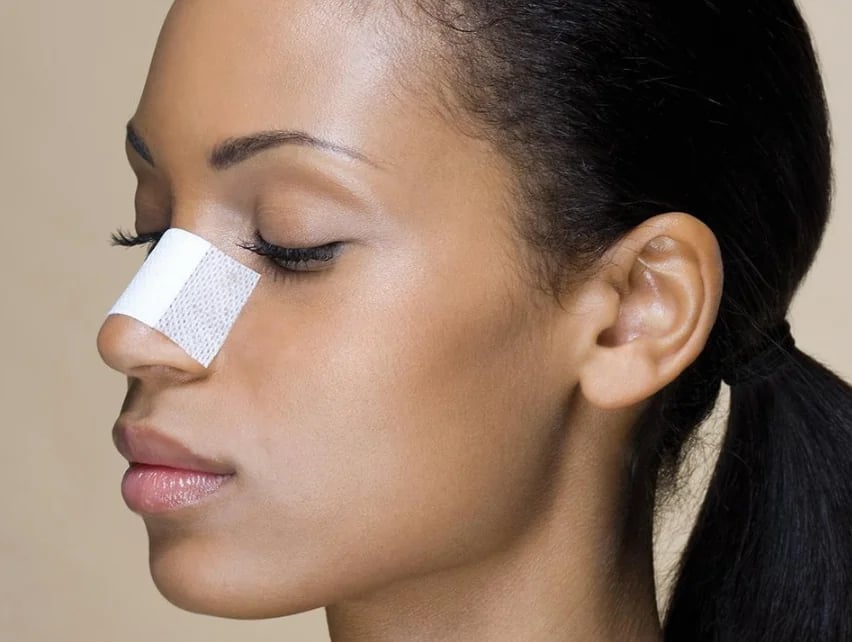
One of the more disorienting moments in rhinoplasty recovery is splint removal, typically around day six or seven. Patients often expect to see something close to the final shape at this point, since the hard external support is gone. In reality, splint removal reveals a nose that is still substantially swollen, and this swelling is almost never distributed with perfect symmetry. The tip in particular tends to remain swollen and slightly firm to the touch for months, and any pre-existing asymmetry in the underlying bone or cartilage, even asymmetry a patient had before surgery and simply never noticed, becomes more visible once the immediate post-splint swelling starts to change shape.
Internal Structural Healing Takes Its Own Path
Beneath the visible swelling, the cartilage framework, especially if it was reshaped, grafted, or repositioned during surgery, is going through its own healing process. Sutures holding cartilage in a new position gradually dissolve or get incorporated into scar tissue over weeks to months. During this window, it is common for one side to feel firmer than the other, or for the tip to seem to shift subtly in appearance from one week to the next, simply because the internal scaffolding is still settling into its final position. This is a normal part of how cartilage grafts and reshaped structures integrate, not a sign of surgical failure.
When Slight Asymmetry Is Actually Permanent, and Why That's Still Normal
It is worth saying plainly: almost no nose, before or after surgery, is perfectly symmetric. Facial symmetry in general is more of an aesthetic ideal than a biological reality, and a small degree of asymmetry, invisible at conversational distance and only noticeable under close self-inspection with harsh lighting, is present in the vast majority of good rhinoplasty results and, frankly, in the vast majority of noses that have never been operated on at all. The goal of rhinoplasty is a balanced, harmonious nose, not mathematical perfection, and surgeons are working with living tissue that has its own healing variability, not a 3D-printed material that behaves identically on both sides.
The Timeline for Distinguishing Swelling From Structure
Weeks one to three. Almost all visible asymmetry during this period is swelling and bruising related. This is the least reliable window for judging final symmetry, even though it is when patients are most likely to be anxiously checking.
Months one to three. Gross swelling has resolved, but the tip and areas of grafting or significant reshaping remain swollen enough to still mask fine detail. Some patients notice what looks like new or shifting asymmetry during this window as different areas of swelling resolve at different rates, revealing structure that was previously hidden evenly beneath uniform puffiness.
Months four to nine. This is generally when a clearer picture starts to emerge, particularly in the mid-nose and bridge. The tip, especially in patients with thicker skin, is often still the last area to fully reveal its final shape.
Month twelve and beyond. For most patients, this represents the point of full, or nearly full, structural settling. Any asymmetry visible at this stage, if it is bothersome, is the point at which a genuine conversation about whether it reflects normal residual variation versus something worth revising becomes appropriate.
What Tends to Cause Genuine, Non-Swelling Asymmetry
While most early asymmetry is swelling, a smaller subset of cases involves something more structural. This can include a graft that has shifted position during healing, asymmetric scar tissue formation, particularly common in revision cases or patients prone to thicker scarring, or an underlying facial skeletal asymmetry that was present before surgery and becomes more visually apparent once the nose itself is refined and smaller, drawing more visual attention to pre-existing facial asymmetry that used to be less noticeable. This last category is worth understanding: a larger, less refined nose can sometimes visually mask underlying facial asymmetry simply by drawing more attention to itself, and a well-executed rhinoplasty can inadvertently reveal asymmetry that was always there in the jaw, cheekbones, or eyes.
What to Do If You're Worried
The most useful step during the early months is simply documenting with consistent, well-lit photographs from the same angles every few weeks, rather than relying on daily mirror checks under variable lighting and inconsistent head positioning, both of which can make completely normal, static healing look like it is changing dramatically day to day. Bringing these photos to scheduled follow-up appointments gives the surgical team an objective way to track whether an area of concern is genuinely evolving or whether it has looked essentially the same for the past six weeks and simply feels more noticeable due to anxiety.
When It's Reasonable to Raise the Question of Revision
Because the nose continues settling for a full year or longer, most surgeons are hesitant to consider any form of revision before the twelve month mark, and often prefer to wait longer, particularly in revision cases or those involving significant grafting. Bringing up a specific, persistent asymmetry at a routine follow-up is always reasonable and does not commit anyone to any further procedure. It simply keeps the surgical team informed and gives them the opportunity to reassure, monitor, or, if genuinely warranted after adequate healing time, discuss options.

What to Expect With Dr. Doshi During Rhinoplasty Recovery
Dr. Doshi's approach to rhinoplasty recovery emphasizes patience and careful follow-up, particularly because the appearance of the nose can continue changing significantly as swelling resolves and the underlying structures heal. During follow-up appointments, he can assess whether an apparent asymmetry is consistent with the normal healing process or whether there is a structural issue that warrants closer monitoring. This is particularly important for patients who become concerned about changes in the tip, bridge, or breathing during the months following surgery, when the nose is still settling.
Patients should also understand that rhinoplasty is not judged by a single early post-operative photograph. Dr. Doshi's evaluation considers the progression of healing over time, the patient's preoperative anatomy, the surgical changes that were made, and the patient's functional and aesthetic goals. Maintaining regular follow-up and communicating concerns as they arise gives the surgical team the opportunity to track healing appropriately and provide reassurance or further evaluation when necessary.