
The under-eye area is one of the first places facial aging becomes visible, and it is also one of the areas patients most often try to fix with the wrong tool first. Dermal filler under the eyes has become extremely popular over the past several years because it is fast, non-surgical, and requires no downtime. For a specific subset of patients, it also produces disappointing or even worse-looking results than the hollowing or puffiness it was meant to correct. Understanding why filler works beautifully for some under-eye concerns and actively backfires for others is the difference between a patient who looks refreshed and a patient who looks like they have permanent under-eye bags that were previously temporary.
Dr. Hardik Doshi, a double board-certified facial plastic surgeon practicing on Long Island and in Manhattan, sees both sides of this problem regularly: patients who never needed surgery and were talked into it, and patients who spent years and thousands of dollars on filler trying to fix a structural problem that only surgery can actually correct. This guide walks through how to tell which category a patient falls into.

What's Actually Happening Under the Eyes as We Age
To understand why filler helps some people and hurts others, it helps to understand the actual anatomy of under-eye aging. The lower eyelid area ages through a combination of factors that often occur together but are mechanically distinct problems.
Volume loss in the cheek and upper cheek area causes the border between the lower eyelid and cheek to become more visible, creating a hollow, sunken appearance often called a tear trough deformity. This is a loss of support, not an excess of anything.
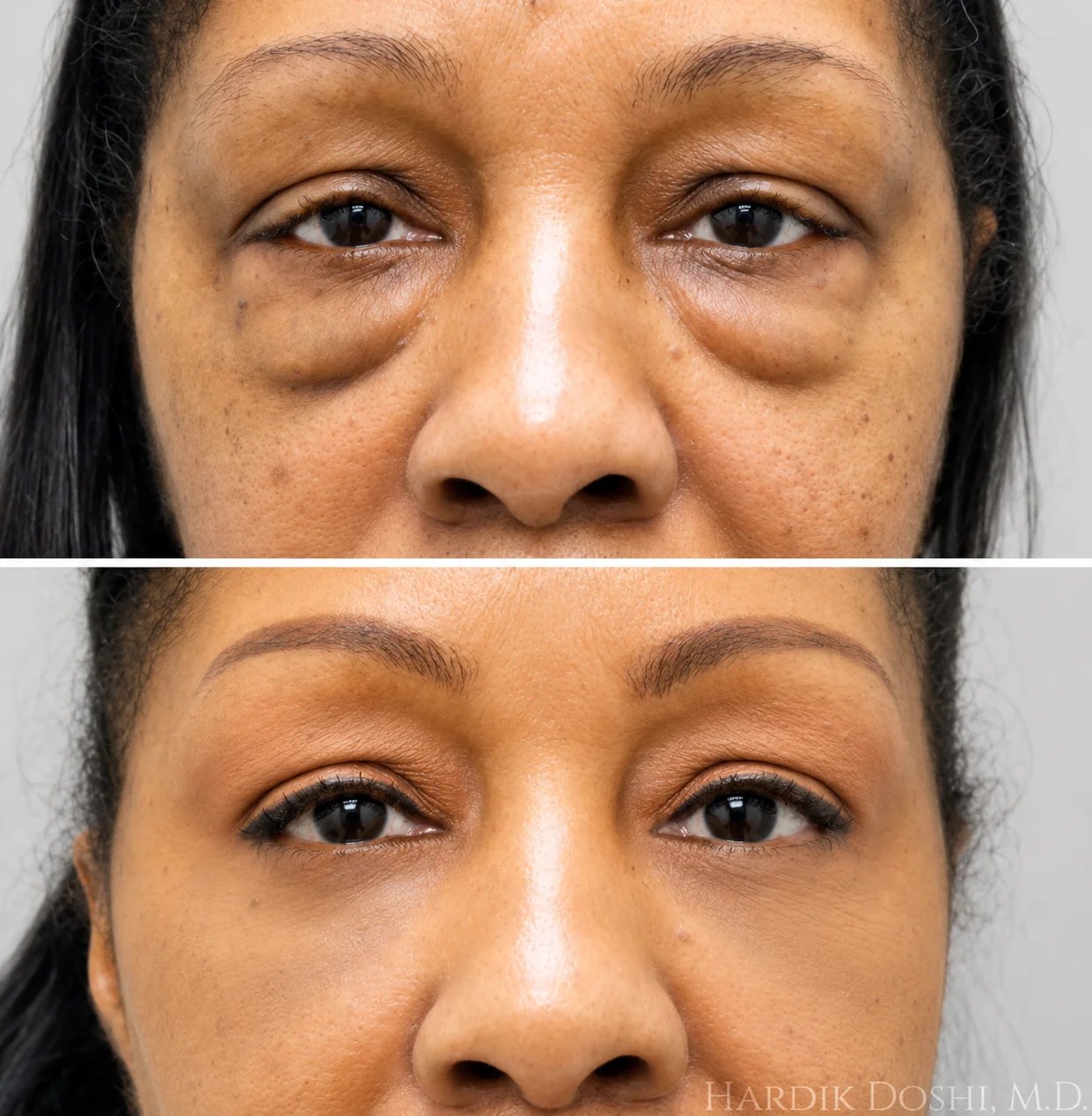
Fat pad herniation is the opposite problem. The fat pads that normally cushion the eye from behind can bulge forward as the thin membrane holding them in place weakens with age, creating visible puffiness or "bags" under the eyes. This is an excess of tissue in the wrong position, not a deficiency.
Skin laxity and pigment changes contribute a third layer, where the skin itself thins, loses elasticity, and can develop discoloration that makes shadows and hollows appear darker than the underlying structural issue alone would explain.
Most patients have some combination of all three, but usually one factor dominates, and that dominant factor determines whether filler or surgery is the right tool.
Why Filler Works Well for Some Patients
Under-eye filler is genuinely an excellent solution when volume loss and hollowing are the primary problem. Injecting filler into the tear trough area or upper cheek restores the support that has been lost, smooths the transition between the lower eyelid and cheek, and can produce a dramatic, natural-looking improvement in fifteen minutes with no downtime. For patients in their thirties and early forties whose main concern is hollowing rather than puffiness, filler is often genuinely the right first step, and surgery would be overkill.
Why Filler Fails, or Actively Worsens Things, for Other Patients
The problem arises when a patient's primary issue is fat pad herniation rather than volume loss, meaning there is already too much tissue bulging forward rather than too little support underneath. Adding filler on top of an existing fat pad bulge does not correct the bulge. It adds volume on top of volume that was already excessive, which can make the puffiness look more pronounced, not less.
There is a well-documented phenomenon in aesthetic medicine sometimes called "filler fatigue" or malar edema, where repeated filler injections in the under-eye area over months or years can cause the treated area to look chronically puffy and swollen, sometimes taking on a bluish or grayish discoloration under the skin due to the Tyndall effect, where filler placed too superficially scatters light differently than surrounding tissue. Patients in this situation often describe feeling like their eyes look worse the more filler they get, which leads some to seek even more filler to correct the problem the filler itself is causing. This is one of the more frustrating cycles Dr. Doshi sees in consultation, and it is entirely avoidable with an accurate diagnosis at the outset.
How to Tell Which Problem You Actually Have
A simple way to think about it: press gently on the skin just under your lower lash line while looking in a mirror in good lighting. If you see a distinct bulge or bag that doesn't flatten, and a hollow or groove just below it before the cheek begins, you likely have both fat herniation and volume loss, which usually means surgery is needed to address the fat pads, sometimes combined with fat repositioning or filler to address the hollow beneath them. If instead you see mostly a smooth transition with a shadow or hollow and no significant bulge, filler alone may be all that's needed.
This self-assessment is a starting point, not a diagnosis. The accurate way to determine which category a patient falls into is an in-person evaluation, since lighting, skin tone, and the exact anatomy of fat pad position can be difficult to assess accurately in a mirror or photograph.
What Lower Blepharoplasty Actually Does That Filler Cannot
Lower blepharoplasty is a surgical procedure that directly addresses the herniated fat pads causing under-eye bags, either by removing excess fat, repositioning it to fill in the hollow beneath the bulge, or both, depending on the specific anatomy involved. This is a fundamentally different mechanism than filler. Filler adds volume from the outside. Lower blepharoplasty corrects the position and amount of tissue that is already there.
Dr. Doshi's approach to lower blepharoplasty typically favors fat repositioning over simple fat removal whenever a patient has both bulging and hollowing, since repositioning the existing fat to fill the hollow beneath it, rather than discarding it and adding filler separately, tends to produce a more integrated, natural-looking result that ages more gracefully than fat removal alone. This approach treats the eye as connected to the surrounding structure of the face rather than an isolated problem, consistent with his broader philosophy that the eye is never just the eye when it comes to facial aging.
Recovery and Timeline Differences
Filler has essentially no recovery. A patient can return to normal activity immediately, with results visible right away and lasting between six months and one year depending on the specific filler used and individual metabolism.
Lower blepharoplasty involves a real surgical recovery, typically with visible bruising and swelling for one to two weeks, and full settling of final results over one to three months. The tradeoff for this longer recovery is a result that, unlike filler, does not need to be repeated every six to twelve months. A well-performed lower blepharoplasty addressing genuine fat pad excess produces a durable correction, since the fat that was causing the bulge has been removed or repositioned rather than temporarily masked.
Combining the Two Approaches
For many patients, the most effective long-term plan isn't strictly filler or strictly surgery, it's surgery to correct the structural problem followed by conservative filler years later if age-related volume loss develops further. Dr. Doshi generally recommends addressing fat pad herniation surgically first if it's present, rather than layering filler on top of it, and reserving filler for patients whose primary issue is genuine volume deficiency without a structural bulge to correct.
Patients who are further along and want to understand what the actual recovery process looks like day by day can review the practice's blepharoplasty recovery guide, which breaks down the healing timeline week by week. Patients evaluating the surgery in the context of their overall face, rather than the eyes in isolation, may also find it useful to review complete guide to blepharoplasty, which explains how Dr. Doshi evaluates eyelid surgery as part of overall facial balance rather than a standalone fix. For patients specifically comparing upper and lower eyelid concerns, eyelid surgery overview page covers how upper and lower procedures differ and which one actually applies to a given concern.
What Happens During a Consultation
A consultation for under-eye concerns with Dr. Doshi starts with a careful examination to determine which of the three underlying factors, volume loss, fat herniation, or skin laxity, is driving the visible concern, since the right treatment plan depends entirely on getting this diagnosis right. This typically involves examining the area under different lighting conditions, sometimes with the patient looking down or smiling to see how the tissue moves, and asking about the timeline of when the concern developed and whether it has changed with previous filler treatments.
Patients who have already had filler and are unhappy with progressively puffier or discolored results are a group Dr. Doshi sees regularly, and the conversation in that scenario typically starts with determining whether the existing filler needs to be dissolved before any further treatment, surgical or otherwise, can be accurately planned.
Common Myths About Under-Eye Treatment
Myth: If filler didn't work the first time, more filler will eventually fix it. This is one of the most common patterns Dr. Doshi sees in consultation, and it almost always makes the underlying problem worse rather than better when the actual issue is fat pad herniation rather than volume deficiency. Adding volume to an area that already has excess tissue pushing forward does not create the missing support a hollow area needs. It simply adds more bulk in a location that is already struggling to look smooth. Patients caught in this cycle often need the previous filler dissolved before any accurate new plan, surgical or otherwise, can be made.
Myth: Under-eye surgery always leaves visible scars. Lower blepharoplasty is frequently performed through an incision placed inside the lower eyelid, called a transconjunctival approach, which leaves no visible external scar at all. This approach is generally well suited to patients whose primary concern is fat herniation without significant excess skin. Patients who also have meaningful skin laxity may need an external incision placed just below the lash line, which heals to be virtually invisible in most cases.
Myth: Younger patients don't need to worry about this distinction. Fat pad herniation is not exclusively an older-patient problem. Some patients develop visible under-eye bags in their twenties or early thirties due to genetics and inherited anatomy rather than aging specifically. These patients are sometimes told they are "too young" for surgery and should just use filler or skincare, when in fact a structural problem present from a young age generally will not resolve with either approach.
Myth: Dark circles are always a sign you need more sleep. While fatigue and sleep quality do affect the appearance of the under-eye area, particularly through fluid retention and skin tone changes, structural dark circles caused by thin skin overlying visible blood vessels, or shadowing cast by a hollow beneath a fat pad bulge, will not meaningfully improve with more sleep alone. Distinguishing between a fatigue-related dark circle and a structural one is part of an accurate evaluation, since the two require entirely different treatment approaches.
The Role of Skin Quality in Treatment Planning
Skin quality is a factor that deserves more attention than it often receives in under-eye treatment planning, because it interacts with both filler and surgical outcomes in ways that are easy to overlook. Thin, crepey under-eye skin, common in patients with a history of significant sun exposure, smoking, or simply thinner skin as a matter of individual genetics, behaves differently than thicker, more resilient skin when either filler or surgery is performed.
In patients with thin skin, filler is more likely to become visible through the skin surface, contributing to the bluish Tyndall effect discussed earlier, and surgical incisions and swelling may take somewhat longer to settle into a smooth final appearance. This does not mean thin-skinned patients are poor candidates for either treatment, but it does mean the specific technique, filler type, and surgical approach chosen should account for skin quality specifically, rather than applying a generic protocol regardless of individual skin characteristics.
Patients with more significant skin laxity in addition to fat herniation may also benefit from adjunctive treatments such as laser resurfacing or radiofrequency skin tightening performed either at the time of surgery or as a staged treatment afterward, since surgery alone addresses the fat compartment and general position of tissue but does not fully reverse skin quality changes that developed from sun damage or years of gradual collagen loss.
Combining Under-Eye Correction With Other Facial Procedures
The under-eye area rarely exists in complete isolation from the rest of the midface, and for many patients, the most effective long-term plan addresses the eyes alongside adjacent structures rather than treating the lower eyelid as a standalone concern. Patients with both under-eye hollowing and early cheek volume loss, for example, may benefit from combining lower blepharoplasty with fat transfer or filler placed in the upper cheek, since restoring cheek volume can reduce the visual severity of the tear trough hollow independent of any correction performed directly at the eyelid.
Similarly, patients further along in the aging process who have both under-eye concerns and broader midface descent may find that a facelift or midface lift, rather than eyelid surgery in isolation, produces a more complete and proportionate improvement, since repositioning the cheek can indirectly improve the appearance of the lower eyelid transition without requiring as extensive a direct intervention at the eyelid itself. Dr. Doshi's evaluation process for under-eye concerns typically includes an assessment of the broader midface for this reason, consistent with his general philosophy that no single feature ages or should be treated in complete isolation from the structures surrounding it.

What Recovery Actually Feels Like Day by Day
Patients considering lower blepharoplasty often want a more granular sense of what the healing process actually feels like beyond the general one-to-two-week estimate. In the first two to three days, swelling and bruising are typically most pronounced, and many patients describe a sensation of tightness around the eyes rather than significant pain. Cold compresses during this window are commonly recommended to help manage swelling.
By days four through seven, bruising generally begins to visibly fade, often shifting from a darker purple to a yellow-green tone as it resolves, and swelling continues to decrease steadily. Many patients feel comfortable returning to work or social activities with the help of sunglasses or light concealer somewhere in this window, though this varies considerably based on individual healing and the extent of the procedure performed.
By the second week, most visible bruising has resolved and swelling has decreased substantially, though some patients notice mild residual puffiness, particularly in the morning, that continues to improve gradually over the following several weeks. Final results, meaning the fully settled appearance once all residual swelling has resolved, are generally best evaluated around the two to three month mark.
Understanding the Cost Difference and What Drives Long-Term Value
Cost is a legitimate factor patients weigh when deciding between ongoing filler treatments and a one-time surgical correction, and the comparison is more nuanced than simply looking at the price of a single session versus a single surgery. Under-eye filler typically needs to be repeated every six to twelve months to maintain results, and each session carries its own cost, meaning the cumulative expense over several years of repeat filler treatment can, for many patients, approach or exceed the cost of a single surgical procedure that does not need to be repeated on the same schedule.
This calculation shifts further when a patient has already experienced the filler fatigue or Tyndall effect discussed earlier, since correcting those issues, whether through dissolving existing filler or through a more complex surgical repair that also has to work around previously placed material, generally costs more than either an accurate initial filler treatment or an accurate initial surgical evaluation would have. Getting an accurate diagnosis at the outset, before choosing a treatment path, is one of the more effective ways to avoid unnecessary cumulative cost regardless of which treatment ultimately proves to be the right fit.
What to Look for When Choosing a Provider for Under-Eye Treatment
Whether a patient is pursuing filler or surgery, the qualifications and specific experience of the provider matter considerably in this particular area of the face, arguably more than in many other cosmetic treatment areas, because the under-eye region has particularly thin skin, close proximity to the eye itself, and a narrow margin between an excellent result and a visible complication like the Tyndall effect or an overfilled, puffy appearance.
For filler treatment specifically, patients should confirm that the provider has specific experience injecting the tear trough and under-eye area, since this is widely regarded as one of the more technically demanding areas for filler injection due to the thin skin and delicate surrounding anatomy, distinct from injecting fuller-skinned areas like the cheeks or lips. Providers who inject a high volume of under-eye filler regularly are generally better positioned to recognize early signs of an approach that isn't working for a specific patient's anatomy, rather than continuing to add filler through multiple sessions when a different approach may be more appropriate.
For surgical evaluation, board certification specifically in facial plastic and reconstructive surgery, rather than general plastic surgery certification alone, reflects specialized training concentrated specifically on the face and its unique anatomical considerations, including the delicate relationship between the eyelid, orbital fat, and surrounding facial structures. Patients should feel comfortable asking a prospective surgeon how many lower blepharoplasty procedures they have performed, whether they typically favor fat repositioning or fat removal and why, and to see specific before-and-after examples of patients with a similar starting anatomy to their own.
A Note on Non-Surgical Alternatives Beyond Filler
Filler is not the only non-surgical option available for patients whose under-eye concerns are primarily related to skin quality rather than structural fat herniation. Radiofrequency skin tightening and certain laser resurfacing treatments can improve skin texture, mild laxity, and some degree of fine lines in the under-eye area without adding any volume at all, which can be a more appropriate choice for patients whose primary complaint is crepey or textured skin rather than hollowing or bulging.
These treatments generally cannot address either significant volume loss or fat pad herniation on their own, but they can serve as a useful complement to either filler or surgery, addressing the skin quality component of under-eye aging that neither volume replacement nor fat repositioning fully resolves by itself. Patients with combined concerns, meaning some degree of skin laxity alongside either hollowing or bulging, often benefit most from a combination approach that addresses each contributing factor with the specific tool best suited to it, rather than expecting a single treatment to resolve every component of under-eye aging simultaneously.
The Role of Ethnicity and Individual Anatomy in Treatment Planning
Under-eye anatomy varies considerably across ethnic backgrounds, and an accurate treatment plan should account for these differences rather than applying a single standard approach to every patient. Patients with naturally deeper-set eyes or more prominent fat pads as a matter of typical ethnic anatomy may have a different baseline appearance that should not automatically be treated as a correctable problem, while patients whose family history includes early fat pad herniation regardless of overall facial aging may benefit from an evaluation earlier than general age-based guidelines would suggest. Dr. Doshi's approach generally treats each patient's baseline anatomy as the starting reference point for what a natural, improved result should look like for that individual, rather than measuring every patient against a single generic ideal.