
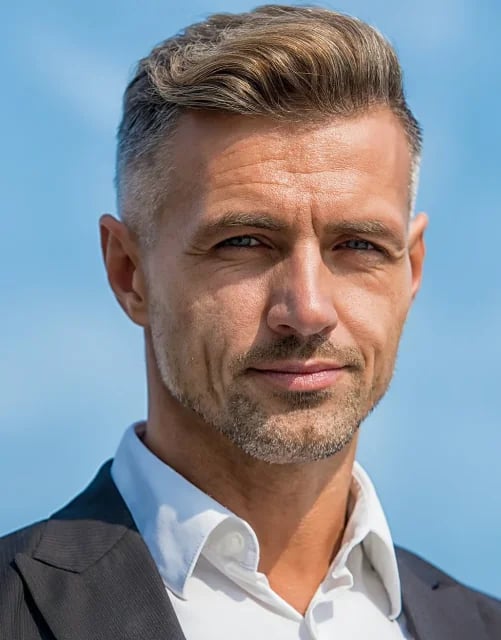
A beard transplant on Long Island is usually not about vanity in the way people assume. Most of the men who ask me about it have tried for years to grow a full beard and keep running into the same problem: the chin and mustache come in, but the cheeks stay patchy, the connection between the mustache and goatee never closes, or an old scar leaves a bare line through an otherwise thick beard. Shaving everything off becomes the default, not because they prefer it, but because the patches are more noticeable than a clean face.
Facial hair restoration uses the same core technique as a scalp transplant. Individual follicles are harvested from the back of the scalp with follicular unit extraction (FUE) and placed one at a time into the beard area. The details, however, are very different. Beard hairs grow at extremely flat angles, almost always as single hairs, and in directions that change every few centimeters across the face. Getting those details right is the difference between a beard that looks grown and one that looks planted.
Who Is a Candidate for a Beard Transplant on Long Island?
The best candidates have a clear, specific pattern of missing or thin facial hair and healthy donor hair on the back of the scalp. The common patterns I evaluate are:
Patchy cheeks
This is the most frequent request. Many men grow dense hair along the jawline and chin, but the upper cheeks are sparse, or there are islands of bare skin between areas of growth. Grafts can raise the cheek line, fill the islands, and soften the transition so the beard does not end abruptly.
A thin or broken mustache
Some men have a mustache that is wispy, does not reach the corners of the mouth, or has a gap in the center under the nose. Mustache hair has a very particular direction (downward and outward from the midline), so this area demands careful placement.
Goatee and connection gaps
A common frustration is a mustache and chin beard that never connect at the sides of the mouth. A modest number of grafts placed in that connection zone can make the whole lower face read as a complete beard.
Scars in the beard area
Scars from injury, acne, prior surgery, or a cleft lip repair often leave a hairless line or patch. Hair can be transplanted into mature scar tissue, although scar tissue has a less predictable blood supply, so growth may be somewhat lower and a second session is sometimes planned from the start. This is the facial version of what patients search for as a scar hair transplant on Long Island, and it is one of the most satisfying uses of the procedure. When the scar itself is wide, raised, or distorted, it may make sense to address it first with surgical scar revision and then transplant into the improved scar once it has matured.
Transgender men
Some transgender men find that facial hair remains sparse even after a period on testosterone. For patients who want it, a beard or mustache transplant can be part of a broader plan for a masculine facial appearance. In general, it is reasonable to allow testosterone time to produce whatever facial hair it will (often a year or more) before deciding on grafts, so that surgery fills the gaps that remain rather than areas that would have filled in on their own. As with every patient, the plan is built around the result the person wants.
Who should wait or reconsider
A beard transplant is usually not the right first step for younger men whose facial hair is still developing (facial hair commonly continues to fill in through the mid twenties), for men whose scalp donor hair is already thin or reserved for future scalp work, or for anyone with patchy loss caused by an active condition such as alopecia areata. Patchy loss that appears suddenly, in round smooth patches, needs a medical evaluation rather than surgery, because grafts placed into an active autoimmune process may not survive.
Candidacy Self-Check
Before a consultation, it helps to answer these questions honestly. They are the same things I look at in the exam room.
- I am in my mid twenties or older, and my facial hair pattern has not changed much in the last two years.
- My thin areas have been stable, not appearing suddenly in smooth round patches.
- I have tried letting my beard grow for at least 6 to 8 weeks to see its full pattern.
- The back of my scalp has dense, healthy hair.
- I am not planning a large scalp transplant soon, or I am willing to discuss how to divide my donor supply.
- My existing beard hair color and thickness are reasonably close to my scalp hair.
- I can avoid shaving the treated area for about 10 days and accept a period of shedding before new growth.
- I understand final results take about a year and that some areas may benefit from a second session.
- I do not smoke, or I am willing to stop around the procedure to support graft healing.
If you checked most of these boxes, you are likely a reasonable candidate to evaluate in person. If several are unchecked, that does not rule you out, but it means the consultation should focus on timing and expectations before scheduling anything.
The Donor Area: Why Beard Grafts Come From the Back of the Scalp
Beard hair and scalp hair are not identical. Beard hair is typically coarser, curlier, and grows in single hairs. Scalp hair grows in follicular units of one to four hairs and is usually finer. The back and sides of the scalp are still the preferred donor area for facial hair for two reasons. First, this zone is generally resistant to the hormone-driven thinning that causes male pattern baldness, so the follicles tend to keep growing for life. Second, it offers a large, accessible supply that can be harvested with FUE without a linear scar.
To match the beard, I generally select single-hair grafts, or divide multi-hair units into single hairs, and favor hairs with a coarser caliber. Hairs from the lower back of the scalp and the area just above the neckline often match facial hair best. Over time, transplanted scalp hair on the face tends to look and behave more like beard hair, especially once it is groomed and trimmed with the rest of the beard, although it keeps its scalp-like growth rate and texture to some degree.
Some surgeons also harvest from under the chin or from body hair. These are secondary options with more variable growth and are not standard for most patients. Because a beard transplant uses the same harvest method as a scalp procedure, the principles described in our overview of FUE hair transplant technique apply directly to beard work: small circular extractions, spread evenly so the donor area does not look thinned.
Graft Angle and Density Design: The Part That Makes or Breaks a Beard
If there is one thing to understand about facial hair transplants, it is this: the face is less forgiving than the scalp. On the scalp, surrounding hair partially hides small imperfections. On the cheek, every hair is visible, especially when the beard is kept short.
Why facial hair grafts must sit at very acute angles
Natural beard hair exits the skin at a very flat angle, often lying almost parallel to the skin surface. On the cheeks it usually points downward and slightly backward. Along the jawline it often sweeps downward and toward the neck. In the mustache it angles downward and outward from the center. Under the lower lip and on the chin the direction can swirl.
If grafts are placed too upright, the hairs stand out from the face like bristles, catch light differently, and grow in a direction that makes grooming difficult. To avoid this, the recipient sites are made with very fine instruments at sharply acute angles, and each site follows the direction of the native hairs around it.
Why single-hair units matter
Natural beards are made almost entirely of single hairs. Placing two or three hair units on the face can create a pluggy or clustered look, especially along the upper cheek line and in the mustache. For that reason, beard work relies on single-hair grafts in nearly all visible areas. In denser zones, such as the lower jaw or chin where the native beard is thick, some surgeons will occasionally use two-hair units placed deeper in the pattern, but the borders and the mustache are typically single hairs only.
Density design and the cheek line
Density is not uniform across a natural beard. The jawline and chin are usually densest. The upper cheek thins gradually toward the cheekbone. A good design copies that gradient, with the highest density where the beard is naturally thickest and a soft, irregular border along the upper cheek. A perfectly straight, dense cheek line looks artificial even when it is filled with real hair.
During planning I mark the proposed borders with the patient looking in a mirror, because where a man likes his cheek line is personal. Some prefer a lower, cleaner line. Others want a higher, fuller beard. It is far easier to lower a cheek line later with shaving or laser than to remove transplanted hair, so a conservative upper border is usually the smarter starting point.
How Many Grafts Do Common Areas Need?
Every face is different, and the numbers below are general estimates only. They are not quotes, and your plan depends on how much native hair you already have, the size of the gap, the density you want, and your donor supply. Treat them as a way to understand scale, not as a promise.
| Area | General estimate (grafts) | Notes |
|---|---|---|
| Mustache (filling gaps or thickening) | About 250 to 600 | Depends on width and whether the center is bare |
| Goatee or chin beard | About 400 to 900 | Includes the connection to the mustache |
| Sideburns (each side) | About 100 to 300 | Often combined with cheek work |
| Cheek patches (both sides) | About 300 to 1,000 | Wide range, depends on how many islands need filling |
| Full beard from very sparse baseline | About 1,500 to 3,000 or more | Sometimes staged over two sessions |
| Scar in the beard | About 50 to 400 | Scar tissue may need a second pass |
Smaller, targeted cases are common. A man who only needs his mustache and goatee to connect may need a few hundred grafts, while a man with very little native beard is planning a much larger procedure. The actual count is decided at your consultation after examining both the face and the donor area.
The Procedure Day
A beard or mustache transplant is an outpatient procedure. Patients are typically awake, with the donor and recipient areas numbed with local anesthesia, and some practices offer oral medication to help with relaxation. The general sequence is:
- Design. The borders, density zones, and hair direction are marked on the face.
- Donor preparation. The donor area on the back of the scalp is trimmed short so follicles can be extracted.
- Harvest. Follicles are removed one at a time with FUE, then sorted and trimmed under magnification, with single-hair grafts selected for the face.
- Recipient sites. Tiny sites are created in the beard area at the correct angle and direction.
- Placement. Each graft is placed into its site by hand.
Depending on graft count, the procedure can take from a few hours for a small mustache or scar case to most of a day for a full beard. You go home the same day. If you are also comparing practices for scalp work, the evaluation steps are similar to those in our guide to a men's hair transplant on Long Island, since many patients consider both at some point.
Recovery and When You Can Shave
The first week
Small crusts form around each graft on the face for the first several days. The cheeks and lips may be mildly swollen and pink. Most men describe the face as tender rather than painful, and the donor area feels like a mild sunburn. You will be asked to keep the grafts dry or rinse them gently as directed, sleep with your head elevated, and avoid touching or rubbing the treated area.
Crusts typically fall away within about 7 to 10 days. Many men return to desk work within a few days, though some prefer to wait until the crusts are gone because the treated area is visible. Strenuous exercise, heavy sweating, saunas, and swimming are usually limited for about the first week or two. Detailed aftercare should follow the practice's own post-operative instructions for hair transplant patients, which cover washing, sleeping position, and activity in more detail.
When you can shave or trim
This is one of the most common questions. In general:
- Trimming with scissors or clippers (no blade on the skin): often allowed around 10 to 14 days, once the crusts have cleared and the grafts are anchored.
- Shaving with a razor over the treated area: usually allowed after about 2 to 3 weeks, once the skin has fully settled.
- Native beard outside the treated zone: can often be trimmed sooner, as long as the grafted areas are not touched.
Your surgeon may adjust these times. Once the transplanted hairs are established, they can be shaved, trimmed, styled, and groomed exactly like the rest of your beard.
Possible side effects
Expected effects include redness, swelling, crusting, small bumps, and temporary numbness in the donor or recipient areas. Less common issues include ingrown hairs or small cysts where grafts are growing in, infection, and visible changes in the donor area if it is over-harvested. The most important long-term risk is aesthetic: hair placed at the wrong angle or density, or a cheek line set too high. That is why design and conservative planning matter more than raw graft numbers.
Timeline: Shedding, Regrowth, and Final Results
The beard transplant timeline surprises many patients because the hairs fall out before they come back. Understanding this up front prevents a lot of worry.
| Time after surgery | What is typically happening |
|---|---|
| Days 1 to 7 | Small crusts around each graft, mild swelling and redness, donor area tender |
| Days 7 to 14 | Crusts fall off, short hair shafts visible, trimming often allowed toward the end |
| Weeks 2 to 6 | Most transplanted hairs shed (shock loss), the area may look like it did before surgery |
| Weeks 6 to 12 | Resting phase, follicles alive beneath the skin, little visible change |
| Months 3 to 4 | New hairs begin to emerge, often fine at first |
| Months 5 to 8 | Hairs thicken and lengthen, the beard starts to look fuller |
| Months 9 to 12 | Most patients see close to the final result in density and texture |
| After 12 months | Assessment for any touch-up session if desired |
Shedding and shock loss
Between roughly two and six weeks, most transplanted hairs shed. This is normal. The hair shaft falls out, but the follicle remains in the skin and enters a resting phase. Some native hairs near the grafts may also shed temporarily, which is called shock loss. These usually grow back over the following months.
New growth and final results
New growth from the transplanted follicles typically starts around three to four months. Early hairs can be fine, uneven, or slightly kinked. Over the next several months they thicken. Most men see the majority of their result by nine to twelve months, and the beard continues to mature a bit beyond that. This growth pattern is consistent with how transplanted hair behaves on the scalp, which the main hair transplant page describes in more detail.
Minoxidil, Beard Growth Products, and Surgery
Before surgery, many men try minoxidil, beard oils, derma rollers, or supplements. It is worth being clear about what each can and cannot do.
Topical minoxidil
Minoxidil is approved for scalp hair loss, and using it on the face is off-label. Some men do notice thicker vellus hairs or new terminal hairs on the cheeks after several months of consistent use. The limitations are real: results vary widely, it must be applied once or twice daily for months, the skin can become irritated, and if gains depend on ongoing use, some may fade after stopping. It can also be absorbed through facial skin, so it should be discussed with a physician rather than started casually.
Beard oils, balms, and supplements
Oils and balms condition the hair and skin and can make an existing beard look healthier and better groomed. They do not create follicles where none exist. Biotin and similar supplements help only when there is a true deficiency, which is uncommon.
Microneedling and PRP
Microneedling and platelet-rich plasma are sometimes discussed for facial hair, but the evidence for beard growth specifically is limited compared with the evidence for scalp thinning. Some practices use PRP for hair restoration on the scalp and, in selected cases, as a supporting treatment around a transplant. It is reasonable to ask whether it makes sense for your situation, but it should not be thought of as a replacement for grafts in an area with no follicles.
When surgery makes more sense
| Situation | More likely to help |
|---|---|
| Fine, light hairs present but not thick | Trial of medical therapy may be worth discussing first |
| Bare islands with no hair at all | Transplant, since products cannot create follicles |
| Scar running through the beard | Transplant, sometimes after scar treatment |
| Gap between mustache and goatee that never fills | Transplant |
| Wants a permanent result without daily products | Transplant |
Many men try medical therapy first and choose surgery for the areas that still do not respond. That is a sensible order.
How a Beard Transplant Relates to Scalp Hair Transplants
The most important long-term planning question is donor supply. Your scalp donor area is a finite resource. Every follicle used for your beard is one that cannot be used later for your hairline or crown.
For a man with a stable scalp and a full head of hair, this may not matter much. For a man in his late twenties or thirties who is already noticing a receding hairline or thinning crown, it matters a great deal. Male pattern hair loss is progressive for many men, and the scalp may eventually need far more grafts than the beard. A good plan accounts for both.
In consultation I look at the current state of the hairline and crown, family history, the density and size of the donor zone, and what the patient may want in ten or twenty years. In some cases a moderate beard transplant is easy to justify. In others, it makes sense to do a smaller, targeted beard procedure, address the scalp first, or combine both in a staged plan.
This is also one reason that searching for the best hair transplant on Long Island should go beyond before-and-after photos. Ask any surgeon how they manage donor supply across procedures, how they choose single-hair grafts for the face, and how they set the cheek line. Patients often find it useful to read through a prepared list of hair transplant consultation questions before their visit so they can compare answers.
Choosing a Surgeon for a Facial Hair Transplant on Long Island
Facial hair restoration sits at the intersection of hair transplant technique and facial aesthetics. The beard frames the jawline, chin, and mouth, and where it starts and stops changes how the whole lower face reads. That is why it helps to work with a surgeon who thinks about facial proportions, not only graft counts.
Things worth asking any practice include:
- How many hairs per graft do you use on the cheeks and mustache?
- How do you decide the height and shape of the cheek line?
- How do you protect my donor area for possible future scalp work?
- Who creates the recipient sites, and who places the grafts?
- What does growth look like in scar tissue, and do you plan for a second pass?
- What happens if I am not satisfied with the density at one year?
For patients across Nassau and Suffolk, and those coming from New York City, the practical advantage of a local surgeon is follow-up. The first year after a beard transplant involves several check-ins, and being close to the office makes it easier to evaluate growth, address ingrown hairs early, and plan any touch-up. Careful extraction and graft handling are the foundation of every facial hair case, because each follicle has to survive the trip from scalp to cheek.
Many men who come in about a beard are also thinking about other changes to the lower face, such as the jawline or chin. A beard can soften or strengthen the appearance of the jaw, and it is reasonable to consider the overall picture. The practice's procedures for men cover the range of options, though a beard transplant is often best planned and judged on its own first.
As a double board-certified facial plastic surgeon, Dr. Hardik Doshi approaches facial hair restoration as a facial procedure that happens to use hair grafts. The consultation starts with how you wear your beard now and how you would like to wear it, then moves to a close look at the native hair direction on your cheeks, mustache, and chin, the quality of your donor area, and the state of your scalp so that your donor supply is used wisely.
From there, the plan is built around natural angles, single-hair grafts in visible areas, a density gradient that matches a real beard, and a conservative cheek line that you can always adjust later. You will leave with a realistic graft range, an honest view of whether medical therapy is worth trying first, and a clear timeline for shedding, regrowth, and final results.