
Rhinoplasty is often discussed as if it were a single, uniform procedure with a universal definition of success. It isn't. The goals that guide a rhinoplasty for a male patient and the goals that guide one for a female patient are frequently different, sometimes subtly and sometimes quite significantly, and a surgeon who does not account for that distinction risks giving a male patient a result that looks feminized, or a female patient a result that looks heavier and more masculine than she intended.
Dr. Hardik Doshi, a double board-certified facial plastic surgeon with practices on Long Island and in Manhattan, performs rhinoplasty using a preservation-based approach, meaning he removes only what is functionally or aesthetically necessary rather than defaulting to an aggressive reshaping of the nose. This guide focuses specifically on what tends to differ for male rhinoplasty patients, why those differences matter, and what a male patient considering the procedure should actually expect.
The Nose Exists to Function First
Before getting into how male and female goals diverge, it's worth grounding the conversation in something Dr. Doshi emphasizes with every rhinoplasty patient regardless of gender: the nose has a job to do before it has a look to maintain. He describes his priorities in order. First, breathing. Second, smell. Third, aesthetics. Every rhinoplasty he performs is evaluated against all three, because a nose that looks perfect but does not function well has not actually solved the patient's problem, and a nose that functions perfectly but doesn't reflect what the patient wanted to see in the mirror hasn't either.
This matters specifically for male patients because men are, on average, somewhat more likely to present with a functional airway concern layered on top of an aesthetic one, whether from a prior injury, a deviated septum, or structural narrowing that becomes more apparent once a dorsal hump or other aesthetic feature is addressed. A rhinoplasty that only chases appearance and ignores the internal airway can leave a male patient with a nose that looks the way he wanted, but breathes worse than before surgery. Dr. Doshi's preservation philosophy treats these as inseparable, not sequential, concerns.
Where Male and Female Rhinoplasty Goals Actually Diverge
Dorsal Profile
One of the most consistent differences in male versus female rhinoplasty goals involves the dorsum, the bridge of the nose. Female rhinoplasty patients frequently want a subtle concavity or a smooth, slightly scooped profile, sometimes referred to informally as a ski-slope or supratip break, which reads as delicate on the face. Male patients, by contrast, more often want to maintain or only slightly soften a straighter, stronger dorsal line. Over-reducing the male dorsum is one of the more common ways a male rhinoplasty ends up looking feminized, even when the surgeon technically executed a clean, well-healed result. A straight or gently reduced bridge, rather than a scooped one, tends to preserve a masculine profile.
Nasal Tip Rotation and Projection
Tip rotation, meaning how upturned the tip of the nose is, is another area where goals commonly diverge. Female rhinoplasty patients more often request some degree of tip rotation for a refined, slightly upturned appearance. For male patients, excessive tip rotation is one of the fastest ways to soften a nose beyond what the patient actually wanted. Male rhinoplasty tends to prioritize a straighter, more neutral tip position with less rotation, keeping the tip in proportion with a stronger dorsal line rather than lifting it.
Overall Nasal Size and Width
There is also a difference in how surgeons think about overall proportion. A male nose in proportion with a male face is generally larger and can carry more width and length than would look proportionate on a smaller female face. A common technical mistake in male rhinoplasty is over-narrowing the nose to match aesthetic proportions more typically associated with female rhinoplasty, which can leave a male patient's nose looking disproportionately small or delicate relative to the rest of his facial structure, particularly a stronger jawline or brow.
Nasolabial Angle
The nasolabial angle, which is the angle formed between the upper lip and the base of the nose, tends to be planned differently as well. A slightly more acute, closed angle generally reads as more masculine, while women's rhinoplasty goals more often involve a slightly more open angle. This is a subtle measurement, but it has a real visual effect on how the nose relates to the rest of the lower face.
Why These Distinctions Are Easy to Get Wrong
Part of what makes male rhinoplasty a genuinely distinct conversation, rather than simply "the same surgery on a different face," is that many of the aesthetic reference points patients bring into a consultation, whether photos, filters, or general cultural ideals of an "ideal nose," skew toward features that read as more traditionally feminine: a scooped bridge, an upturned tip, a narrow, refined profile. Dr. Doshi is candid that when patients bring in reference photos, his job is to use them as a conversation starter about aesthetic preference, not a literal blueprint, because that photo represents someone else's face and someone else's proportions, not the patient's own. For a male patient, following an aesthetic reference built around a female ideal, even unintentionally, is one of the more common ways a rhinoplasty ends up looking inconsistent with the rest of a masculine facial structure.
This is also why revision rhinoplasty rates tend to be meaningfully higher among male patients who received a rhinoplasty designed around generic aesthetic goals rather than goals calibrated to a masculine profile specifically. Dr. Doshi has noted that in his own revision practice, a recurring theme among unhappy patients, regardless of gender, is a surgeon not fully listening to or accounting for what the specific patient's face and goals actually called for. A nose can be technically well-executed and still be the wrong nose for the face it's on.
Ethnicity and Male Rhinoplasty
Ethnic background adds another layer to this conversation, particularly for male patients who want to preserve certain family or cultural features rather than eliminate them. Dr. Doshi has described patients who specifically ask him to keep a slight dorsal bump because it reflects their ethnic background and family resemblance, rather than removing it entirely to conform to a generic aesthetic standard. For male patients especially, where a straighter or more prominent dorsal profile is often already the aesthetic goal, preserving ethnically distinct nasal characteristics and achieving a masculine, balanced result frequently align rather than conflict. This is a meaningfully different conversation than a rhinoplasty built around erasing every distinguishing feature of a patient's nose.
Recovery Considerations for Male Rhinoplasty Patients
The core recovery process for male and female rhinoplasty patients is largely similar, but a few practical factors come up more often in conversations with male patients specifically.
Return to physical activity. Male patients are statistically more likely to ask about returning to contact sports, weightlifting, or activities with a higher risk of accidental impact to the nose. Dr. Doshi generally advises against any activity with meaningful collision risk for a period of weeks after surgery, since the nasal bones are still healing and stabilizing during that window, and any impact during early healing can shift results or cause additional injury.
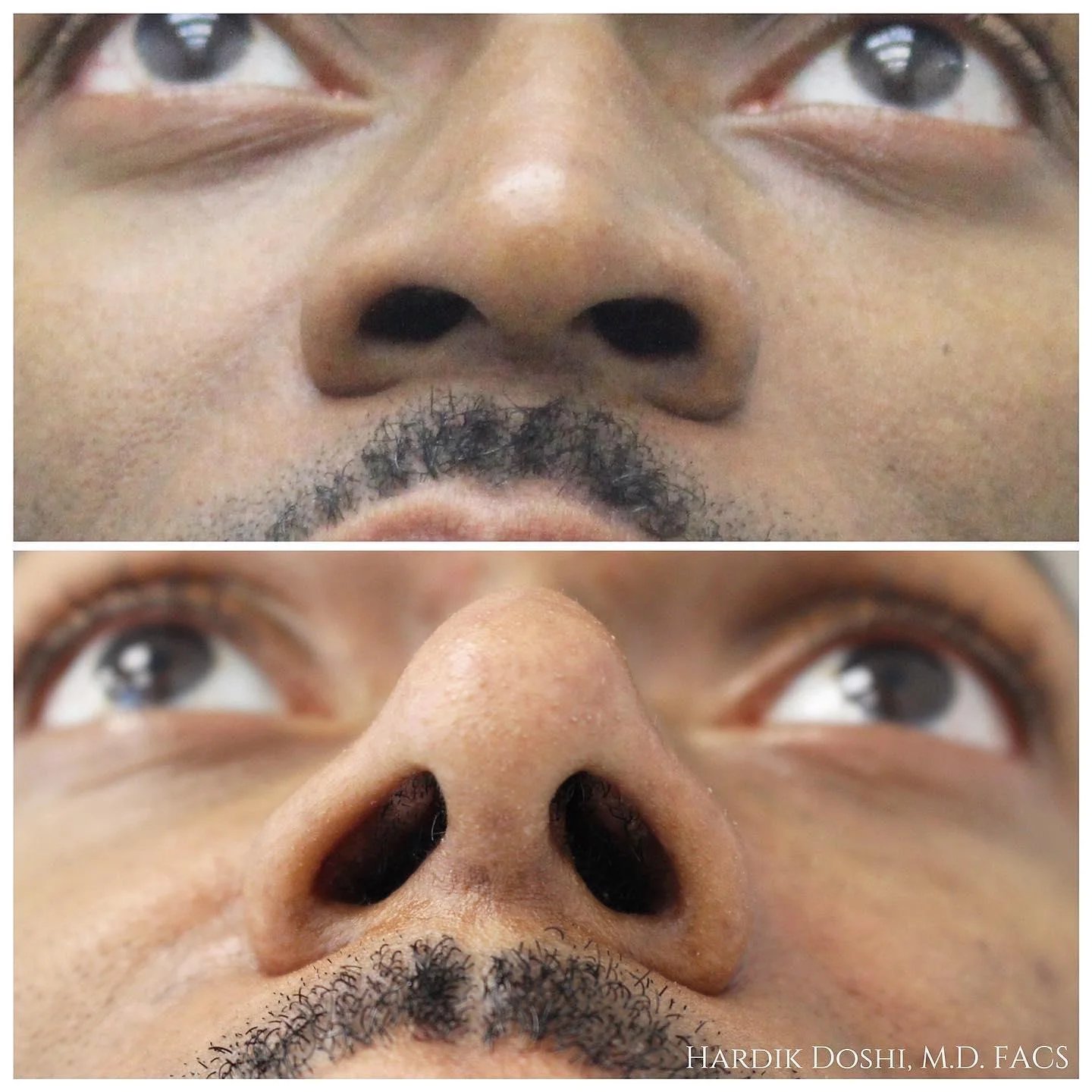
Facial hair and healing. Beards and mustaches can make it slightly harder to visually track swelling and bruising in the lower half of the face during recovery, which is a minor but real consideration Dr. Doshi discusses with bearded patients ahead of surgery.
Technique reduces swelling regardless of gender. Dr. Doshi's preservation rhinoplasty approach incorporates piezoelectric instrumentation, an ultrasonic tool that reshapes bone without the traditional fracturing techniques older rhinoplasty methods relied on. This meaningfully reduces bruising and swelling for all patients, which is particularly relevant for male patients who may be more likely to want to return to work or public-facing activity sooner and are often less inclined toward makeup or concealer to manage visible bruising during the healing window.
Common Myths About Male Rhinoplasty
Myth: A "natural" male nose result means barely changing anything. Natural does not mean minimal. It means a result that looks consistent with the rest of a patient's facial structure, ethnicity, and proportions, rather than looking generically reshaped. A natural male rhinoplasty result can still involve meaningful correction of a dorsal hump, a deviated tip, or a functional airway problem. The goal is coherence with the rest of the face, not the smallest possible change.
Myth: Rhinoplasty results look the same regardless of which surgeon performs the surgery. Rhinoplasty is widely considered one of the most technically demanding and aesthetically nuanced procedures in facial plastic surgery, precisely because the margin between a masculine, balanced result and an overly narrowed or feminized one can come down to a few millimeters of tip rotation or dorsal height. Surgeon experience and specific familiarity with male aesthetic goals matter considerably here.
Myth: If I don't like my results, any revision surgeon can just fix it. Revision rhinoplasty is generally more difficult than a primary procedure, not less. Scar tissue changes how the nose heals and responds to further surgery, and correcting an over-narrowed or over-feminized male rhinoplasty often has less tissue and structural support available to work with than the original surgery did. This is part of why getting the aesthetic goals right the first time matters more in rhinoplasty than in almost any other facial procedure.
Myth: Male rhinoplasty patients don't care as much about subtle aesthetic outcomes. This has not been Dr. Doshi's experience in practice. Male patients are frequently just as detail-oriented about outcome, sometimes more reluctant to bring in reference photos or verbalize specific aesthetic goals during a first conversation, which makes it more important, not less, for a surgeon to ask direct questions about dorsal profile, tip position, and overall proportion rather than assuming male patients want the least amount of change possible.

Combining Rhinoplasty With Other Facial Procedures
Because the nose is a central feature that anchors overall facial balance, some male rhinoplasty patients are also evaluating chin projection, jawline definition, or brow position at the same time. A nose that is disproportionately large or small relative to a weak chin, for example, can sometimes be addressed more effectively by combining rhinoplasty with chin augmentation rather than through nasal surgery alone, since balancing overall facial proportion can reduce how much correction the nose itself actually needs.
Patients evaluating a combined approach to facial balance may find it useful to review the practice's chin augmentation content alongside their rhinoplasty research, along with chin augmentation recovery expectations if a combined procedure is under consideration. This kind of proportional thinking, treating the nose as one feature within a broader facial framework rather than an isolated structure, is consistent with Dr. Doshi's overall philosophy that a good result highlights the natural attributes of an individual face rather than chasing one feature in isolation.
What to Ask a Surgeon Before Choosing a Rhinoplasty Approach
Because male and female rhinoplasty goals diverge in specific, technical ways, it is reasonable for a male patient to ask a prospective surgeon directly how that surgeon typically approaches dorsal height, tip rotation, and overall proportion differently for male versus female patients. A surgeon who has a clear, specific answer, rather than a generic description of rhinoplasty technique that doesn't distinguish between the two, is more likely to have genuinely considered this distinction as part of routine practice rather than treating every rhinoplasty consultation identically.
It is also worth asking what percentage of a surgeon's rhinoplasty practice is revision work, since a higher revision caseload often indicates a surgeon who takes on complex corrective cases, which can be a meaningful credential, but it is worth understanding in context. Dr. Doshi notes that revision surgery makes up roughly thirty percent of his rhinoplasty practice, and that he is selective about which revision cases he accepts, generally taking on cases where he believes he can meaningfully improve the outcome rather than accepting every referral that comes his way.
Candidacy for Male Rhinoplasty
Age is a real factor in male rhinoplasty candidacy in a way that deserves direct discussion. Dr. Doshi is firm that he does not perform purely cosmetic rhinoplasty on patients whose facial structure, including the nose, is still developing, generally recommending patients wait until at least age eighteen for elective aesthetic surgery, even when a patient is confident about what they want sooner. The exception is genuine functional or structural need, such as correcting a birth-related deformity, a cleft-related nasal issue, or trauma, where earlier intervention may be appropriate regardless of age.
Beyond the age threshold, good candidates for male rhinoplasty generally share a few characteristics: realistic expectations grounded in their own facial anatomy rather than a reference photo of someone else's face, a clear sense of whether their primary concern is functional, aesthetic, or both, and overall health sufficient to tolerate anesthesia and a normal healing process. Patients with unrealistic expectations, such as wanting to match an exact reference photo regardless of their own bone structure, are a group Dr. Doshi is candid about turning away, since promising an outcome that anatomy can't actually deliver sets a patient up for disappointment rather than genuine satisfaction with their result.
Patients considering revision surgery after a previous rhinoplasty deserve a specific note here. Revision candidacy depends heavily on how much structural support and cartilage remain available to work with after the original surgery, and on how much scar tissue has developed. Not every revision case is a good fit for every surgeon, which is part of why Dr. Doshi is selective about which revision referrals he accepts, generally taking cases where he believes a meaningfully better outcome is achievable rather than every case that comes through the door.
What a Consultation Actually Covers
A male rhinoplasty consultation with Dr. Doshi starts with the same functional assessment every rhinoplasty patient receives, evaluating the internal airway, septum, and breathing function alongside the external aesthetic goals. From there, the conversation shifts specifically to what a masculine result should look like for that individual's face: bone structure, brow prominence, jawline strength, and how those existing features should inform dorsal height, tip position, and overall nasal proportion.
Patients considering revision surgery after a prior rhinoplasty that left them with a nose that reads as too narrow, too feminine, or otherwise inconsistent with the rest of their facial structure can review the practice's revision rhinoplasty page for more detail on what correcting a previous surgery involves. Patients specifically interested in preserving ethnic characteristics as part of a masculine result may find the practice's ethnic rhinoplasty page useful as background. And for anyone deciding between a surgical approach and a non-surgical option, the non-surgical rhinoplasty page outlines what filler-based correction can and cannot achieve, which is generally far more limited for structural male rhinoplasty goals than it can be for smaller, more contained aesthetic adjustments.
Patients further along in the process who want a sense of what healing actually looks like week by week should review rhinoplasty recovery on Long Island and the practice's dedicated breakdown of the rhinoplasty swelling timeline, both of which apply regardless of gender but are especially relevant for patients planning their return to work or physical activity around the procedure.