
The first thing most women notice is not a bald spot. It is a part line that used to be a thin seam and is now a visible channel of scalp. Or a ponytail that takes an extra twist of the elastic. Or a photograph under overhead light in which the crown reads lighter than it did two years ago, while the hairline sits exactly where it always sat.
That last detail causes the most confusion, and it is why so much of what a woman reads about hair loss feels like it was written for somebody else. It was. Almost all hair restoration information, from the staging scales to the galleries to the candidacy rules of thumb, was built around male pattern loss. In men the front recedes, the temples retreat, the crown opens, and the hair at the back and sides is genetically protected from the process. That protected band is the bank the surgeon withdraws from.
Female pattern hair loss usually does not behave that way. It is typically diffuse: density drops across the mid scalp and crown at once, the part widens from the front backward, and the frontal hairline frequently stays intact. That single structural difference changes how the condition is diagnosed, how donor supply is planned, who is a surgical candidate, and what a realistic result looks like at twelve months. It also explains a sentence many women have heard from somebody in a white coat: women are not good candidates for hair transplants.
That sentence is not entirely wrong. It is far too broad to be useful, and it is applied to many women for whom it does not hold.
Dr. Hardik Doshi is a double board certified facial plastic surgeon practicing on Long Island and serving patients throughout the New York metro area. Female hair loss sits at the intersection of aesthetics and medicine more squarely than almost any other procedure in a facial plastic surgery practice, and getting it right starts with a diagnosis, not a graft count.
Why the male template fails
The male model assumes loss is regional, that the donor area is stable, and that the goal is to rebuild a hairline. In classic female pattern loss all three can be false at once. Loss is global. The donor area may be thinning along with everything else, because the same process is acting on it. And the hairline may need nothing while the area behind it needs everything.
Apply a male plan to that picture and you get a poor outcome delivered with technical competence: grafts that survive and grow, and a patient who is no happier, because density was moved from one thinning zone into another. That is the real clinical reason behind the blanket refusals, and it is a legitimate one. The error is treating it as a rule about women rather than a rule about a pattern many, but not all, women have.
Reading the Pattern: A Widening Part Is Not a Receding Hairline
The Ludwig scale versus the Norwood scale
The Norwood scale stages male pattern loss: a receding frontal hairline, deepening temporal recession, and a crown that thins and eventually connects with the front. It is a map of retreat.
The Ludwig scale measures something else entirely. Its stages describe progressive widening of the central part with preservation of the frontal hairline. Stage one is mild thinning along the part, visible mostly under bright light. Stage two is pronounced widening with clearly reduced volume through the mid scalp. Stage three is diffuse thinning across the top with scalp visible throughout, and in almost all of it the front hairline is still standing.
Using the wrong scale produces the wrong plan. A woman staged on the Norwood scale looks like an early or atypical case, which pushes toward a frontal hairline procedure she does not need. Staged correctly on the Ludwig scale, she is understood as having a density problem across a wide area, which is different surgical arithmetic and often a different first line of treatment. A less common Christmas tree pattern flares wider toward the front of the part, and a minority of women do lose frontally in a more male distribution.
The part width self check
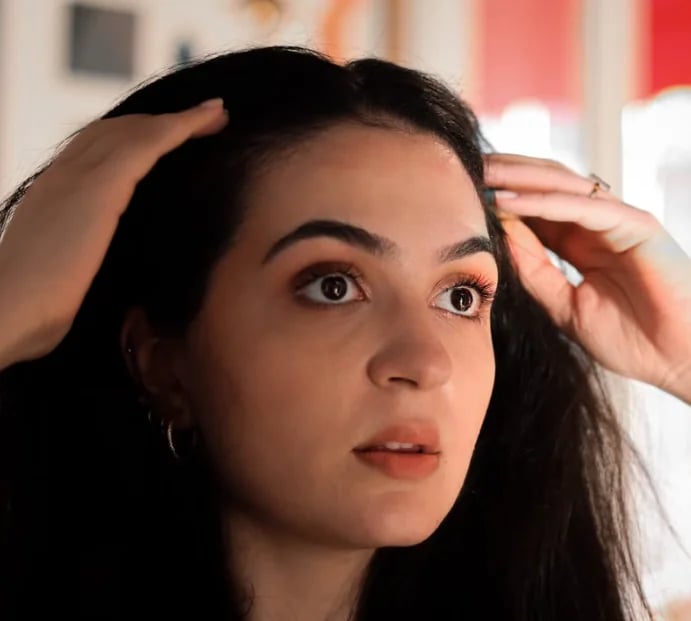
The most useful monitoring tool for a widening part costs nothing. Part the hair in exactly the same place, in the same lighting, dry and unstyled, and take a straight overhead photograph on a phone. Repeat every three months in the same conditions. The comparison is far more reliable than the daily mirror, which adapts to gradual change so smoothly that women routinely underestimate how long a process has been running.
What you are looking for is not hair on the pillow or in the drain. Shedding volume is a poor signal: it fluctuates with season, stress and styling, and shedding and thinning are not the same phenomenon. What matters is whether the channel of visible scalp along the part is widening, and whether it is widening evenly front to back.
The ponytail check
A second measure is circumference. Gather the hair into a ponytail as usual and note how many wraps the elastic takes and how thick the bundle feels at the base. Tracked over a year, it is a reasonable proxy for total density across the whole head rather than at one location, and total density is precisely what a diffuse process affects. A widening part with an unchanged ponytail suggests a localized process. A steadily thinner ponytail suggests a global one, which is the finding that changes donor planning.
Both are screening tools, not diagnoses. What they do is establish a trajectory, which is worth more than any single snapshot. A hair restoration consultation that begins with twelve months of standardized photographs is a substantively different conversation from one that begins with a description.
Why Diffuse Loss Complicates Transplant Candidacy
A hair transplant does not create hair. It relocates it. Follicles are harvested from a donor region and redistributed to a recipient region, and the total number of hairs on the head is unchanged. The entire value of the operation rests on one biological fact: donor hair carries its own genetic programming with it and keeps behaving like donor hair after it is moved. That property, called donor dominance, is why transplanted hair in a properly selected patient grows in its new location for decades. The guide to hair transplant permanence covers what does and does not last.
Donor dominance is the assumption that diffuse female loss can quietly break. If the process affecting the crown is also affecting the occipital scalp, the hair harvested from the back is not protected. It is transplanted while it still looks healthy, grows for a period, then miniaturizes on schedule along with everything else, because it was always going to. The result is permanent donor site changes and no lasting gain in the recipient area. That is the outcome the blanket refusal is trying to prevent, and preventing it is correct.
How donor stability is actually assessed
The assessment is a measurement, not a glance, and it is the single most important part of a female hair restoration evaluation.
Under magnification, using a handheld dermatoscope or video scope, the surgeon examines defined areas of the occipital and parietal scalp for several things at once. Follicular unit density, meaning how many grouped units sit in a given area. Hairs per unit, because a healthy unit commonly carries two or three hairs and a stressed one increasingly carries one. Shaft caliber, because miniaturization thins the individual hair long before the hair disappears. And caliber variability, the most telling of all: a stable donor zone shows hairs of relatively uniform thickness, while an unstable one shows thick terminal hairs and thin miniaturized ones side by side.
That variability measure is the crux. A donor area with a high proportion of miniaturized hairs is not a safe zone, whatever it looks like under a good blow dry. A donor area with uniform caliber and good hairs per unit is a safe zone, even in a woman whose crown is visibly thin. The two findings are independent, which is exactly why so many blanket refusals are wrong.
When the donor area is stable enough
Several presentations routinely produce a stable donor zone in women. Loss that is genuinely patterned rather than diffuse, meaning frontal and mid scalp involvement with a measurably spared occipital region. Loss that is mechanical rather than hormonal, traction alopecia being the clearest example. Loss that is post surgical or post traumatic, including scars along a previous facelift incision, scars from injury, and previous hair transplant scar revision needs. A naturally high hairline that was never a loss at all. And stable, non progressive thinning documented as unchanged over several years.
In each of these the donor bank is intact and the withdrawal is real. The question at consultation is never whether women can have hair transplants. It is whether this woman's donor area is stable, and the only way to answer it is to look.
What Has to Be Ruled Out Before Anyone Talks About Grafts
Female hair loss has a longer differential diagnosis than male hair loss, and much of it is reversible without any procedure. Working through that list is a medical obligation, not a delay tactic and not a sales step. Skipping it is how grafts get placed into scalps that were going to recover on their own, and into scalps that were going to destroy them.
Thyroid function
Both underactive and overactive thyroid states affect the hair cycle and can produce diffuse thinning that mimics pattern loss. Thyroid disease is common in women, often subclinical when hair changes appear, and detectable on straightforward blood work. Correcting it can resolve the hair problem, and no surgical planning substitutes for that.
Iron and ferritin
Serum iron alone is not sufficient. Ferritin, which reflects stored iron, is the value that matters for hair, and it can sit at the low end of a reference range while still being too low to support a normal growth cycle. Heavy menstrual bleeding, restrictive eating, plant based diets without deliberate iron planning, and pregnancy all deplete stores. Repletion is slow, which is a reason to start it early rather than after a procedure.
Postpartum and other telogen effluvium
Pregnancy holds an unusually large proportion of hair in its growth phase. After delivery that cohort shifts into the resting phase together and sheds together, typically two to four months later, and it can be dramatic. Telogen effluvium is a shedding event, not a pattern loss, and its defining feature is that it recovers, usually over six to twelve months. The same mechanism follows major surgery, significant illness, rapid weight loss and severe stress. Transplanting during an active effluvium is a mistake, because the baseline is not real.
Medication effects
Several drug categories can drive hair shedding, including some hormonal contraceptives and hormone therapies, some blood pressure and cardiac medications, anticoagulants, certain psychiatric medications and retinoid derivatives. This belongs in a conversation with the prescribing physician rather than a list on a website, because switching a medication has its own consequences and no aesthetic goal outweighs them. What the evaluation contributes is timeline correlation: if shedding began within months of a new prescription, that relationship deserves examining.
Traction and tension history
Easy to miss, because patients rarely volunteer it. Styling history has to be asked about directly, and it is covered in full below.
Scarring alopecias
This is the highest stakes category. Frontal fibrosing alopecia, lichen planopilaris, central centrifugal cicatricial alopecia and related conditions destroy the follicle and replace it with fibrous tissue. Nothing regrows there, and the process is often ongoing. Clues include a hairline that has moved back in a band with loss of the fine vellus hairs in front of it, loss of eyebrow hair, scalp that feels smooth and shiny rather than textured, and itching, burning or tenderness that pattern loss does not usually produce.
Transplanting into an active scarring alopecia wastes grafts. The same inflammatory process that destroyed the original follicles attacks the transplanted ones, and they are lost. The disease has to be identified, treated and shown to be quiescent before any surgical planning is appropriate, and in some cases surgery stays off the table permanently. A scalp biopsy is the definitive test, and recommending one is a sign the evaluation is being done properly.
Traction Alopecia: The Most Transplantable Female Hair Loss
Traction alopecia deserves its own discussion: common, frequently undiagnosed, mechanical rather than hormonal, and genuinely correctable with surgery once the cause is removed.
The mechanism is sustained tension on the follicle. Tight ponytails and buns worn daily for years, braids and cornrows placed under tension, weaves and extensions secured to native hair, and locs heavy enough to pull at their attachment points all produce the same result. Tension over long periods first inflames the follicle, then damages it, then scars it.
Distribution is the diagnostic giveaway. Traction loss appears where the pull is greatest, usually the temporal hairline in front of and above the ears, along the frontal margin, and around the nape. It does not respect the Ludwig pattern, and the mid scalp and crown are typically untouched. That is why it is such a favorable surgical scenario: the donor area in pure traction alopecia is entirely normal, because nothing has been pulling on it.
Timing has one hard rule: the tension has to stop first, and stay stopped. Early traction loss, before scarring sets in, can recover on its own once the mechanical cause is removed, and that recovery deserves six to twelve months before anything is grafted. Late traction loss, where follicles have been replaced by scar, will not recover, and that is where transplantation does excellent work. Grafting into a scalp still being pulled on is grafting into an active injury.
Where PRP Genuinely Helps, and Where It Is Oversold
Platelet rich plasma is the most common non surgical offering in hair restoration and the most commonly misrepresented. The honest version is narrower than the marketing version, and more useful.
PRP is prepared by drawing the patient's blood, spinning it to concentrate the platelet fraction, and injecting that concentrate into the scalp. Platelets carry growth factors, and the working theory is that delivering them around the follicle improves the local environment, prolongs the growth phase and reverses some degree of miniaturization.
What it does
PRP therapy acts on follicles that still exist. Where a follicle has miniaturized, producing a shorter, finer, lighter shaft, PRP can thicken that shaft and lengthen the growth cycle. Across a whole scalp that means better coverage, because coverage is a function of shaft caliber as much as follicle count. It also has a role in stabilizing progressive loss and as an adjunct around a surgical plan.
For women with early to moderate diffuse thinning and a widening part it is frequently the highest value intervention available, precisely because the problem is miniaturization across a broad area rather than an empty zone, and it is often the right first step while medical causes are being worked up.
What it does not do
PRP does not regrow hair from a follicle that is gone. Where the follicular unit has been replaced by fibrous tissue, through a scarring alopecia, long standing traction or end stage pattern loss, there is no structure left to stimulate. No injectable creates a new follicle, and any presentation implying otherwise is selling something.
Schedule and plateau
A typical protocol runs an initial series of sessions spaced roughly a month apart, followed by maintenance at longer intervals. Nothing visible happens for the first several weeks, because the effect operates on a hair cycle and hair cycles are slow. Meaningful assessment starts at three to four months and the clearest read comes around six.
Plateau is the part rarely discussed honestly. Response improves through the initial series, reaches a level, then holds there with maintenance rather than continuing to climb. Maintenance is genuinely maintenance: stop, and the gains recede over the following year or so, because the underlying process was never cured. A patient who understands that at the outset makes a rational decision about an ongoing commitment. A patient expecting a steady annual climb concludes the treatment failed. Scalp protocols are sometimes combined with other office based treatments, and any combination should be justified on evidence rather than assembled for volume.
Hairline Lowering and Temple Points: A Different Category Entirely
A high hairline is frequently congenital. A forehead tall in proportion to the middle and lower thirds of the face is an inherited feature, present since adolescence, stable for decades, and not a disease. The complaint is real and the effect on facial proportion is real, but the treatment is entirely different from density restoration. The goal is to move a border, not to fill a field.
There are two surgical routes. Follicular unit grafting builds a new hairline forward of the existing one, which allows the outline to be shaped precisely but carries a density ceiling. Surgical hairline advancement moves the hair bearing scalp forward in one operation, producing immediate change at full native density, but it requires adequate scalp laxity and leaves an incision along the new hairline that must be planned to heal inconspicuously. Which is appropriate depends on the distance needed, scalp mobility, and how the patient weighs one operation against a staged one.
Temple points are the other category. The triangular wedge at each temple frames the upper face and recedes for reasons unrelated to pattern loss: years of tension styling, over plucking, age related regression, and repositioning after a facelift or brow lift. Temple work is technically demanding out of proportion to its size. The hairs grow at an extremely acute angle, nearly flat to the skin, point downward and backward in a specific fan, and are among the finest on the head. A temple rebuilt at the wrong angle or with hairs that are too coarse reads as artificial from across a room even when the density is correct. It is worth seeing hair restoration results before committing to it.
Technique Decisions That Are Specific to Women
FUE versus FUT when the patient will not shave
Follicular unit excision harvests individual units directly through small circular punches, leaving scattered dot scars rather than a line. Follicular unit transplantation removes a strip of donor scalp from which the units are dissected, leaving a single linear scar. Both are legitimate, and the trade offs run differently for women.
Standard follicular unit excision requires the donor area to be shaved for access, which for a woman with long hair is a visible imposition for several months. The strip technique requires no shaving at all, because the donor is taken from beneath existing hair and the linear scar is concealed by hair of any reasonable length. For a woman who wants no visible evidence during recovery, it can genuinely be the less disruptive option, which inverts the usual assumption.
Long hair excision is the third route. The donor area is shaved in narrow horizontal strips beneath a layer of longer hair left in place, which falls over the harvested zones and conceals them. It takes longer and harvests fewer grafts per session, and it allows a woman to leave with her hair looking essentially unchanged. The full comparison of surgical approaches covers the mechanics in more depth, and the practice's FUE work on Long Island sets out what the technique involves day to day.
Shock loss, and why it frightens women more than men
Transplanting into an area that still has hair in it can push some of that hair into its resting phase temporarily. It sheds within the first weeks and returns over the following months. It is common, usually temporary, and far more distressing for women than for men.
The reason is baseline. A man grafted into a bald crown has nothing to lose there. A woman grafted into a thinning but still covered mid scalp does, and for several weeks after surgery she may look worse than she did before it. Anyone who does not explain that clearly beforehand has not prepared the patient. Careful placement between existing follicles reduces it, and thorough post operative care for hair transplant patients matters for the same reason.
The twelve month rule
Transplanted follicles shed their existing shafts within the first several weeks. That is normal and it is not graft loss. The follicle sits dormant, re enters its growth cycle, and new hair emerges around the third to fourth month, fine and light in color at first, building caliber over the following months. Reasonable assessment starts at eight months, the honest result is at twelve, and in some patients the picture keeps improving into a second year.
Nothing useful can be concluded at four months. A woman judging her result then is looking at the middle of a process, and she will conclude it failed. The timeline is not a caveat added to manage expectations, it is the biology of the hair cycle.
Building the Plan
For most women the right plan is a sequence rather than a single procedure: rule out the medical causes and correct anything correctable, document a trajectory with standardized photographs, measure donor stability under magnification, stabilize what is present, and consider surgery where the follicles are genuinely gone and the donor supply genuinely supports the move.
That sequence takes time, which is why the first appointment matters more than any other. Dr. Doshi's credentials in facial plastic surgery and his dual board certification both bear on it: the evaluation is medical before it is aesthetic, and a diffuse pattern with an unexamined donor area is a diagnosis waiting to be made rather than a refusal waiting to be issued. Women in Nassau and Suffolk counties and across New York City can begin with a virtual consultation, and the consultation question and answer guide sets out what to bring and what to ask.
If you have been told you are not a candidate and nobody put a scope on the back of your head, you were not evaluated. You were categorized.